

End-of-Unit Science Newsletter: Sections to Include Every Time
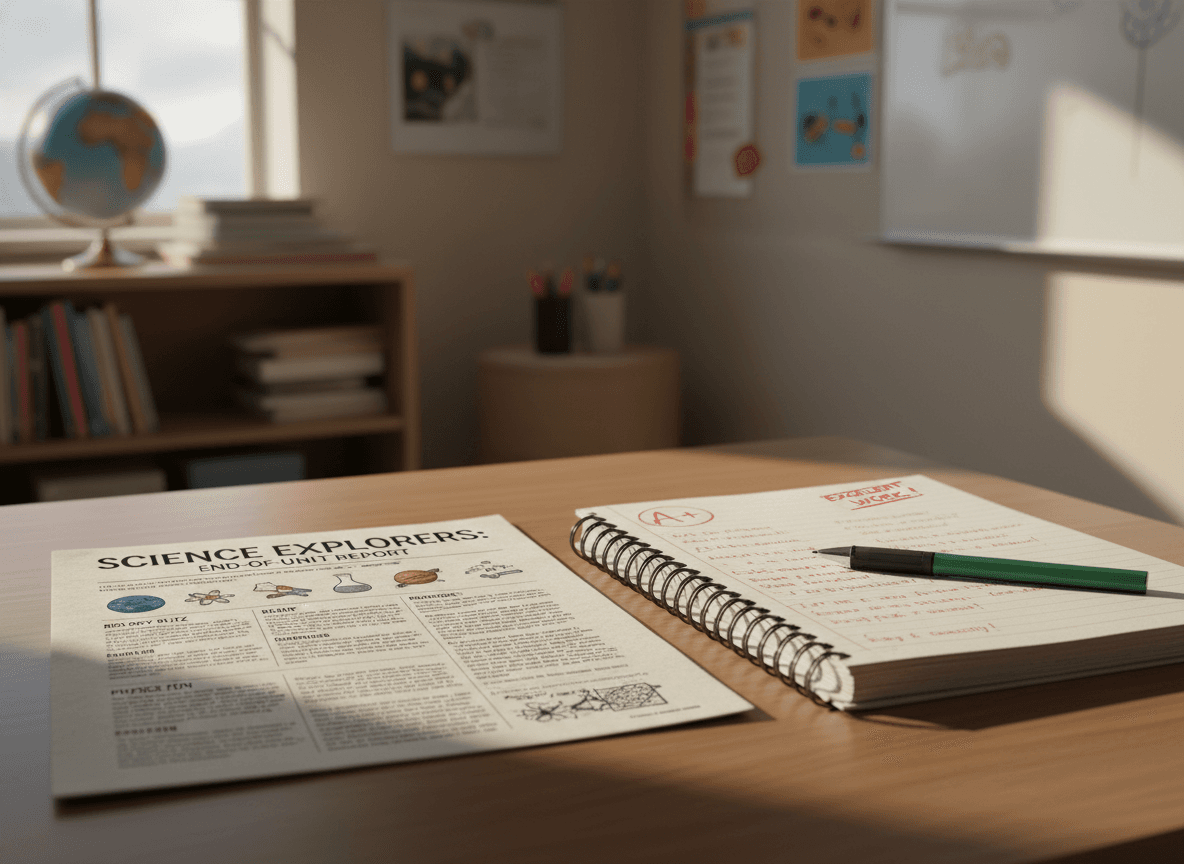
The end-of-unit moment is the best one to write a science newsletter. Students have built knowledge over weeks, the assessment is done or coming up, and parents are about to ask, "how did the test go?". A good end-of-unit newsletter answers that question before they ask it, recaps the unit in plain language, and bridges to what is next. Six sections, every unit, same order. That is the whole template.
Section 1: The big idea of the unit
Two sentences. Name what the unit was really about, not the textbook chapter title. "This unit was about how energy moves from one object to another. Students built circuits, tested heat transfer, and modeled sound as a wave." That tells a parent more than "Chapter 6: Energy" ever will.
Section 2: What students did
Three bullet points. Real activities, not lesson titles. "Tested four materials for conductivity using a battery and a bulb. Built and tuned a string-and-cup phone. Modeled solar panels using foil and a thermometer." Parents see effort and specificity. Students recognize what they did and start talking about it.
Section 3: Assessment recap
Class-level only. What most students nailed, what one skill needs more practice. "Most students could explain conduction and convection with a model. Writing claims using evidence is still developing, and we will keep practicing it in the next unit." No individual grades. No naming students. Parents read the pattern, not a ranking.
Section 4: What surprised your child
This is the section parents actually use. A short prompt: "Ask your child what surprised them in this unit. The 'aha' moments we heard in class included finding out that metal feels cold because it pulls heat from your hand, not because it has cold in it." Now parents have a real question and a real answer to compare it to.
Section 5: Bridge to the next unit
One short paragraph. Name the next unit, the anchoring phenomenon, a date. "Next we move into ecosystems. We start by trying to explain why a pond can support fish in summer but freeze over in winter without killing them all. Unit kickoff is Monday." Parents calendar the start. Students get a teaser.
Section 6: Quick notes
Permission slips, supply needs, picture day, parent-teacher conferences. Keep this section to four lines max. Same spot every time. Parents learn to scan it.
Example: end-of-unit newsletter for a 6th grade energy unit
Big idea: students learned that energy never disappears, it just changes form. Activities: built simple circuits, tested heat transfer through four materials, modeled sound with a string phone. Assessment recap: most students could trace energy through a system. Claims with evidence is still developing. Surprise: many students thought heat and temperature were the same thing. They are not. Next: ecosystems, starting Monday with the frozen pond phenomenon. Notes: field trip permission slip due Friday.
Why this structure works
Parents do not want a unit overview. They want to know how their kid did, what to ask at home, and what is coming. Six sections give them that without filler. The same order every unit means parents stop skimming and start reading, because they know exactly where to look for the answer to their actual question.
How Daystage helps with end-of-unit science newsletters
Daystage has the six-section end-of-unit template ready to duplicate. You can draft the newsletter mid-unit, schedule it for the day of the assessment, and reuse the same structure all year. It sends as a real email to your class list, parents do not need an app, and the formatting stays consistent every issue so families learn where to look.
Get one newsletter idea every week.
Free. For teachers. No spam.
Frequently asked questions
When should the end-of-unit science newsletter go out?
The same day as the unit assessment, or the next morning at the latest. Parents are asking their child how the test went anyway. The newsletter gives them better questions to ask and frames the unit in a way that beats 'how did it go?'.
Should I include grades or scores in the end-of-unit newsletter?
No individual grades. The newsletter goes to all families. Share the class-level pattern instead: what most students mastered, what one or two skills need more practice. Individual scores belong in the grade portal, not a public newsletter.
What is the 'what surprised your child' section for?
It gives parents a real question to ask at the dinner table. 'What surprised you in the rocks unit?' beats 'what did you learn?' every time. Kids will actually answer it, and you get a unit recap that lives outside the classroom.
How do I bridge from one unit to the next inside the newsletter?
One short paragraph. Name the next unit, name the anchoring phenomenon, give one date. 'Next we move into forces and motion. We start by trying to explain why a skateboard slows down on grass. Unit kickoff is Monday.' That is enough.
Can Daystage send the end-of-unit newsletter on a schedule?
Yes. Daystage lets you draft the end-of-unit newsletter while the unit is still running, schedule it to send the day of the assessment, and reuse the same six-section template every unit. The structure stays consistent so parents learn where to look.

Adi Ackerman
Author
Adi Ackerman is a former classroom teacher and curriculum writer with 8 years in K-8 schools. She writes about school communication, parent engagement, and what actually works in real classrooms.
More for Science Newsletter
Ready to send your first newsletter?
3 newsletters free. No credit card. First one ready in under 5 minutes.
Get started free