
Title I School Family Communication in New Jersey
New Jersey is one of the most densely populated and economically unequal states in the country. Camden and Newark sit just miles from some of the wealthiest communities in America, yet they have child poverty rates that rival the poorest cities in the South. The Abbott Districts, a set of historically underfunded urban schools identified through decades of school funding litigation, are the center of New Jersey's Title I landscape.
New Jersey's Title I landscape
Camden, New Jersey, has been cited repeatedly as one of the most impoverished cities in the United States. Its school district has undergone significant restructuring, with the state taking control and then transitioning to a recovery school district model. Newark, the state's largest city, has also been under state oversight and has seen significant charter school growth driven by national reform attention.
Paterson, Trenton, Elizabeth, and the other Abbott Districts have varied demographics and challenges, but all share the core pattern of concentrated poverty with inadequate resources relative to the need. New Jersey's school funding lawsuits have forced more equitable distribution of state aid, but the challenges remain significant.
New Jersey also has suburban Title I schools in communities that have received significant immigrant populations. Towns like Lakewood (large Orthodox Jewish and Hispanic community), Passaic (large Hispanic community), and Perth Amboy (large Hispanic community) have Title I schools that serve dense immigrant populations in communities that are technically suburban but have urban-level poverty concentrations.
ESSA requirements for New Jersey Title I schools
The New Jersey Department of Education administers Title I and monitors compliance. Required activities under ESSA Section 1116:
- Annual meeting for all parents explaining Title I status and parent rights
- Family Engagement Policy developed with parent input, distributed annually
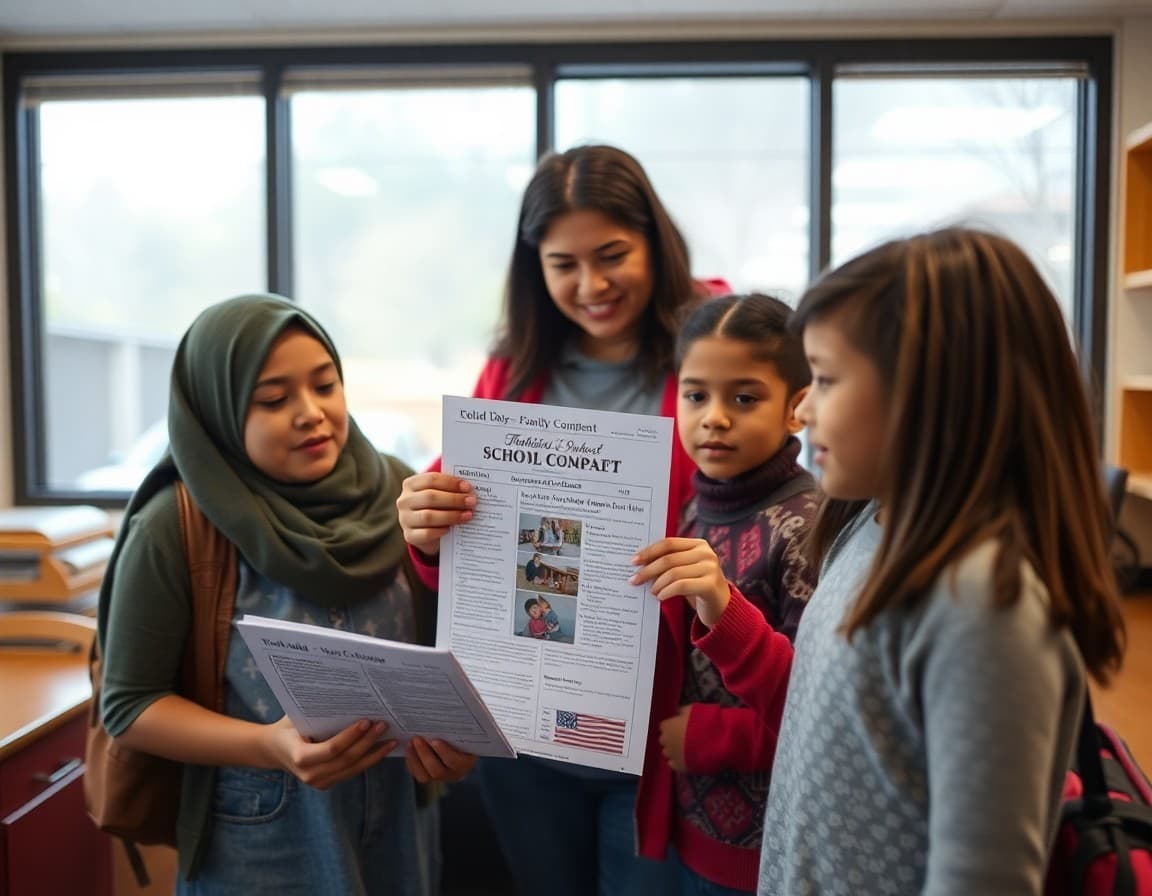
- School-Parent Compact provided to every family, discussed at parent-teacher conferences
- Annual notification of the right to request teacher qualification information
- At least 1% of Title I funds reserved for family engagement activities
Abbott District schools receive additional state oversight and support through NJ DOE's urban education initiatives.
Camden: Puerto Rican and Dominican community communication
Camden's population is predominantly Hispanic (largely Puerto Rican and Dominican) and Black. Spanish is the working language of much of the community, and Puerto Rican cultural ties are strong. Puerto Rican community organizations and churches are established communication channels that schools can partner with.
Camden's school district has restructured significantly, with the state taking control and then creating a "renaissance schools" model that involves charter operators alongside district schools. This fragmentation means families may have children in different types of schools with different communication systems. Clear, consistent communication from each school about its specific Title I programs and rights helps families navigate this complexity.
Newark: West African and Caribbean communities
Newark has seen significant immigration from West Africa (Nigeria, Ghana, and Guinea), Haiti, and various Latin American countries. Its Ironbound neighborhood is one of the most famous Portuguese-speaking communities in the US. Each community has its own communication needs and community institutions.
Haitian Creole materials are needed for Newark schools serving significant Haitian families. Portuguese materials matter in the Ironbound, though many Ironbound residents are Brazilian, not Portuguese, which affects dialect. West African community organizations and churches are important partners for outreach to Nigerian and Ghanaian families.
Paterson: Arabic and Bangla communication
Paterson has a large Arab American community (predominantly Jordanian and Palestinian) alongside a significant Bangla-speaking community from Bangladesh. These communities require Arabic and Bangla translation capacity in addition to Spanish. Paterson's Arab American community is well-established, with community organizations and mosques that serve as communication hubs.
School-Parent Compact writing for New Jersey families
New Jersey's Abbott District families are diverse enough that a one-size-fits-all compact approach does not work. Schools should have the compact in Spanish, and at least a summary in the other primary languages of the school community. Specific school commitments in plain language, including what Title I programs the school specifically provides, make the compact useful for families.
Consistent newsletters across New Jersey's Abbott Districts
A consistent bilingual newsletter is the communication backbone for New Jersey Title I schools. Schools using Daystage send newsletters that arrive inline in email without extra click-throughs, supporting multilingual families across the Abbott Districts. The consistency of weekly communication builds the relationship that makes Title I compliance activities feel like genuine partnership with families.
Get one newsletter idea every week.
Free. For teachers. No spam.
Frequently asked questions
What ESSA requirements apply to New Jersey Title I schools?
New Jersey Title I schools must hold an annual meeting for all parents explaining Title I status and parent rights, develop and distribute a Family Engagement Policy with parent input, provide every family a School-Parent Compact, reserve at least 1% of Title I funds for family engagement, and notify parents of their right to request teacher qualifications. The New Jersey Department of Education monitors Title I compliance through its Division of Education Standards and Programs.
Where are Title I schools concentrated in New Jersey?
New Jersey's Title I schools are concentrated in its Abbott Districts, a group of historically underfunded urban districts identified through decades of school funding litigation. The Abbott Districts include Camden, Newark, Trenton, Paterson, Elizabeth, and about 30 other cities. Camden has among the highest concentrations of poverty in any US city. New Jersey also has Title I schools in suburban communities with lower-income immigrant populations.
What is the Abbott District background and how does it affect Title I?
New Jersey's Abbott Districts are designated under the Abbott v. Burke school funding litigation, which began in the 1970s and resulted in decades of court orders requiring the state to provide supplemental funding to underfunded urban districts. Abbott and Title I funding overlap significantly. These districts have received substantial state and federal investment, but the challenges of concentrated poverty remain significant.
What languages do New Jersey Title I schools need to support?
New Jersey's Abbott Districts have extraordinary linguistic diversity. Paterson has large communities speaking Spanish, Arabic, and Bangla (Bengali). Newark serves Spanish, Portuguese, Haitian Creole, and West African language speakers. Camden's population is predominantly Hispanic (primarily Puerto Rican and Dominican) and Black. Elizabeth has very large Hispanic and immigrant communities. Federal language access law requires materials in the primary non-English language of a sufficient share of families.
What newsletter tool works for New Jersey Title I schools?
Daystage is used by New Jersey schools, including some Abbott District schools, to send multilingual newsletters to families. For Camden's Spanish-dominant community and Newark's diverse population, Daystage supports bilingual content in a single email. Inline delivery without extra click-throughs works well across New Jersey's range of family situations.

Adi Ackerman
Author
Adi Ackerman is a former classroom teacher and curriculum writer with 8 years in K-8 schools. She writes about school communication, parent engagement, and what actually works in real classrooms.
More for Rural & Title I
Ready to send your first newsletter?
3 newsletters free. No credit card. First one ready in under 5 minutes.
Get started free