
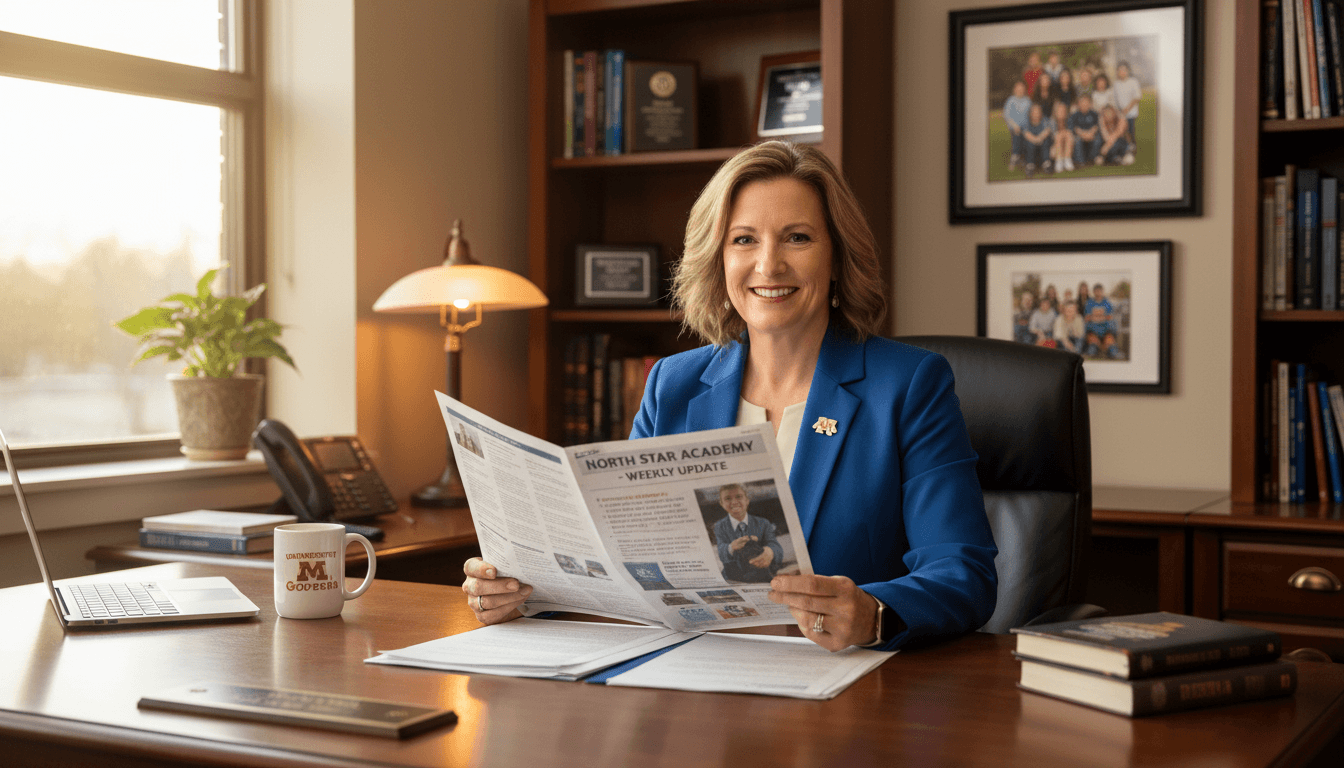
The Minnesota Principal Newsletter Guide

Minnesota principals work in a state with high academic expectations, one of the most significant racial achievement gaps in the country, and a multilingual school population that reflects decades of refugee resettlement. Minneapolis and Saint Paul have become home to the largest Somali diaspora and one of the largest Hmong communities in the United States. Effective principal communication in Minnesota means reaching all of those families, not just the ones most comfortable with English-language institutional communication.
What Minnesota parents expect from school communication
Minnesota parents in suburban districts like Wayzata, Minnetonka, and Edina bring high expectations to school communication. Those communities rank among the top academic performers in the state, and parents there will check the Minnesota Report Card, review MCA data, and ask informed questions about curriculum and instructional approaches. Newsletters that present data honestly and in context are more credible than those that lead only with good news.
In Minneapolis Public Schools and Saint Paul Public Schools, the communication picture is more complex. Both districts serve majority students of color and have significant populations of English learners. Minneapolis and Saint Paul principals who send newsletters only in English are effectively communicating with a subset of their school community. Even partial translation of key sections, or a bilingual subject line, meaningfully expands the reach of your communication.
In Greater Minnesota, which covers everything from Rochester and Duluth to the small agricultural communities of the Red River Valley and the Iron Range, school communication has a different character. Those communities have deep ties to their local schools. A principal who communicates consistently and authentically is a trusted civic figure, not just an administrator.
MDE requirements and Minnesota notification obligations
Minnesota Statutes Chapter 120A and MDE requirements establish several annual communication obligations for school principals:
- Annual parent notification: Families must receive information on student rights, the discipline code, and school safety plans at the start of each year.
- English Learner notifications: Minnesota requires schools to notify families within 30 days of enrollment if their child is an English learner and to explain available language services. Annual notification of EL program placement and progress is also required.
- World's Best Workforce reporting: Minnesota law requires districts to communicate annual goals for student achievement and progress toward closing the achievement gap to the community. The newsletter is a natural vehicle for the building-level version of this communication.
- Title I parent engagement policy: Eligible schools must distribute the policy annually and document receipt.
Communicating the MCAs to Minnesota families
The Minnesota Comprehensive Assessments cover reading and mathematics for grades 3 through 8 and grade 10, science for grades 5, 8, and high school, and writing for grades 5 and 8. Results are reported in four levels: Does Not Meet Standards, Partially Meets Standards, Meets Standards, and Exceeds Standards.
Before the spring testing window, typically in April and May, send a newsletter explaining which grades are tested, what subjects are assessed, and how families can support their students. When results arrive in late summer, send a dedicated newsletter with your school's data. Include year-over-year comparisons, performance by subject, and a clear account of what instructional changes the school is making in response to the data.
Minnesota has a well-documented and persistent racial achievement gap. Minneapolis and Saint Paul principals who address this directly in their newsletters, acknowledging the gap that exists at their school and explaining specific strategies to close it, communicate more honestly and build more trust than those who present aggregate results without context. Families who are on the losing side of an achievement gap know it. They deserve a principal who names it.
Minnesota's multilingual community and newsletter accessibility
The Twin Cities metro area is home to the largest Somali diaspora community in the United States, concentrated in south Minneapolis and the Cedar-Riverside neighborhood, with significant populations in Brooklyn Center, Brooklyn Park, and Saint Paul. It is also home to one of the largest Hmong communities outside of Southeast Asia, centered in Saint Paul's east side and Frogtown neighborhood.
Minneapolis and Saint Paul school principals who serve these communities should consider the language accessibility of their newsletters as a practical matter, not just a compliance question. A family that cannot read the newsletter will not attend the parent conference, will not know about the tutoring program, and will not understand the MCA testing schedule. Language barriers in school communication compound over time into disengagement.
At minimum, subject lines in Somali and Hmong for newsletters containing urgent information will meaningfully improve open rates. For schools with high EL enrollment, a brief summary of key newsletter content in the family's primary language is worth the translation cost. Many Minnesota districts have community liaisons who can support this.
Minnesota's open enrollment law and what it means for principals
Minnesota passed the first open enrollment law in the country in 1988. Families can apply to any public school district in the state during the open enrollment window, which typically opens in January. Charter school enrollment is also widely available in the Twin Cities metro area.
Minnesota principals who communicate consistently throughout the year, sharing academic results honestly, explaining what makes their school worth choosing, and building relationships with families, are far better positioned to retain students during open enrollment season than those who ramp up communication only when enrollment is at risk. The newsletter is a year-round retention tool.
Greater Minnesota districts and communication differences
Rochester Public Schools is the largest outstate district in Minnesota and serves a community shaped by the Mayo Clinic, with many families employed in medicine and research. Rochester principals often serve highly educated parent populations with specific expectations around data quality and communication precision.
Iron Range districts, including Hibbing and Virginia, serve communities that have experienced significant economic transition as the mining industry has changed. Those communities have strong identities and deep ties to their schools. Principals there who communicate with respect for community history and pride build stronger relationships than those who apply urban district communication templates without adaptation.
Using Daystage for Minnesota principal newsletters
Daystage delivers school newsletters inline in Gmail and Outlook, which means Minnesota parents see the full content as soon as they open the email. No PDF, no link, no external app. Principals in Minneapolis, Saint Paul, Rochester, and Greater Minnesota districts use Daystage to manage weekly communication without hours of formatting work. The free plan requires no credit card and works for most Minnesota schools from day one.
Get one newsletter idea every week.
Free. For teachers. No spam.
Frequently asked questions
How often should a Minnesota principal send a school newsletter?
Weekly or bi-weekly is the standard for Minnesota schools with strong parent engagement. Monthly newsletters miss too many important windows, including MCA testing communication, the Minnesota Report Card release, and open enrollment season in the spring. Bi-weekly is a realistic starting cadence for most Minnesota principals. Set up a reusable template and most issues take under 30 minutes.
What should a Minnesota principal include in the back-to-school newsletter?
Cover the bell schedule, staff introductions, discipline code, and contact information for teachers and the office. Note the MCA testing window for spring. If your school is in Minneapolis or Saint Paul, address any English Learner supports and language services available for multilingual families. Minnesota's large Hmong and Somali communities are concentrated in the Twin Cities metro area, and principals in those schools should consider whether translated key sections or bilingual subject lines would improve engagement from families whose primary language is not English.
How should Minnesota principals communicate MCA results?
The Minnesota Comprehensive Assessments report results in English language arts, mathematics, and science across grades 3 through 8 and high school. Results are reported in four levels and released in the summer. They feed directly into the Minnesota Report Card and influence state accountability status. Send a dedicated newsletter when results arrive. Explain the performance levels, how your school performed compared to the prior year and state average, and what specific instructional changes the school is making. Minnesota parents, particularly in suburban districts and in high-income areas of Minneapolis, will check the Minnesota Report Card directly, so a proactive newsletter contextualizing the data is always the stronger approach.
What MDE requirements affect Minnesota principal newsletters?
Minnesota Statutes Chapter 120A and MDE requirements obligate schools to notify families of student rights, discipline policies, and school safety plans annually. Title I schools must distribute their parent engagement policy each year. Minnesota's English Learner notification requirements include informing families of their child's EL status and available language services within 30 days of enrollment. Minnesota also has specific requirements under the World's Best Workforce law, which requires districts to communicate student achievement goals and progress to the community annually. The newsletter is the most practical channel for most of these obligations.
What is the best newsletter tool for Minnesota principals?
Daystage is used by principals across Minnesota to send consistent, professional school newsletters. It delivers inline in Gmail and Outlook so parents see the full content as soon as they open the email, without an attachment or link. Principals in Minneapolis, Saint Paul, Rochester, and Greater Minnesota districts use Daystage to manage weekly communication efficiently. The free plan requires no credit card and includes school-specific templates that work on mobile from day one.

Adi Ackerman
Author
Adi Ackerman is a former classroom teacher and curriculum writer with 8 years in K-8 schools. She writes about school communication, parent engagement, and what actually works in real classrooms.
More for Principals
Ready to send your first newsletter?
3 newsletters free. No credit card. First one ready in under 5 minutes.
Get started free