
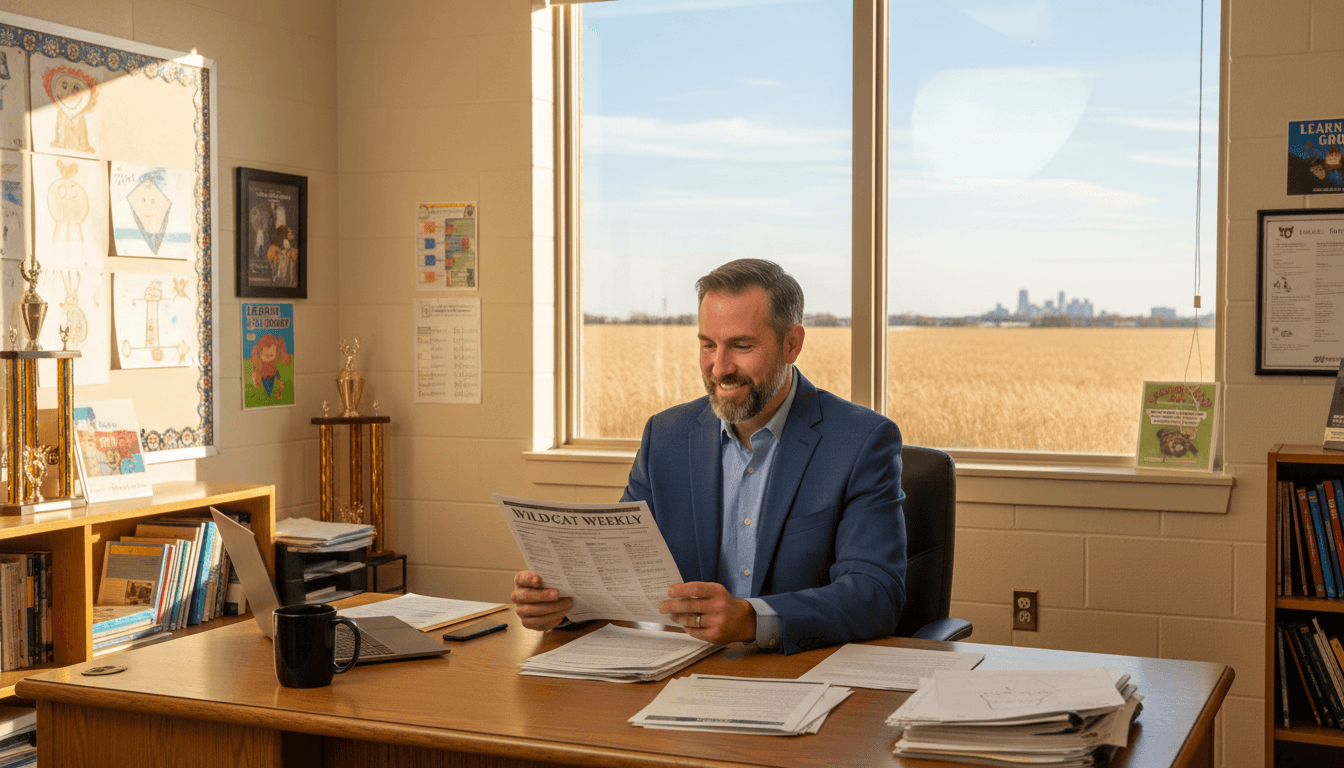
The Kansas Principal Newsletter Guide

Kansas principals work in a state with a clear statewide education vision, a distinctive mix of urban, suburban, and agricultural communities, and a school funding history that has been shaped by landmark court cases. The principal newsletter is how you translate all of that into language families can act on.
What Kansas parents expect from school communication
Kansas parents generally want direct, practical information. In Wichita USD 259, the state's largest district, principals serve a diverse urban population that includes many families who are recent arrivals and may not have prior experience with Kansas schools. In Johnson County suburban districts like Blue Valley USD 229 and Olathe USD 233, the parent population tends to be highly educated and expects data communicated clearly and honestly.
In rural Kansas, where some communities still schedule school calendars around wheat harvest season, the principal's newsletter is often the primary communication channel between the school and the community. Families in those settings pay close attention to what the principal sends. Inconsistent communication in a small rural district creates disproportionate concern.
KSDE requirements and Kansas notification obligations
The Kansas State Department of Education and Kansas statute establish several annual communication obligations for school principals:
- Annual parent notification: Families must receive information about student rights, the discipline code, and safe schools policies at the start of each year.
- Assessment notification: Kansas statute requires schools to notify parents of any assessment their child will participate in, including KAP and any locally-selected assessments.
- Title I parent engagement policy: Eligible schools must distribute the policy annually and maintain documentation.
- Kansans Can postsecondary readiness: KSDE's accountability model ties school performance to indicators including graduation rate, attendance, and postsecondary engagement. Principals should communicate how their school is performing on these indicators and what programs support students toward those goals.
Communicating the Kansas Assessment Program to families
The Kansas Assessment Program (KAP) is the state's summative assessment system, covering English language arts, mathematics, science, and social studies for grades 3 through 8 and high school end-of-course assessments. Results are reported in five performance levels: Level 1 through Level 5, with Level 3 representing the proficiency standard.
Many Kansas parents are not familiar with the specific structure of KAP or how to interpret its performance levels. Before the spring testing window, send a newsletter explaining which grades are tested, what subjects are covered, and what proficiency means in practical terms. When results arrive in late summer, send a dedicated newsletter with your school's data, a comparison to the prior year, and a plain explanation of what the school is doing to support students who are not yet at Level 3.
KAP results feed directly into the Kansas school report card, which is publicly available and searchable. Parents in Johnson County communities often compare school report cards directly. A newsletter that proactively contextualizes your school's performance is a stronger communication strategy than waiting for parents to find the data on their own.
The Kansans Can vision and what it means for your newsletter
KSDE's Kansans Can vision frames education around preparing students to be "civic-minded, financially literate, ready for postsecondary education, and prepared for the world of work." This is not just aspirational language. It is the framework that Kansas accountability metrics are built around.
Principals who communicate their school's work through this lens connect individual programs and decisions to a larger story parents can understand. When you launch a career exploration program or add a financial literacy unit, explaining how that connects to where Kansas education is heading gives families context that increases buy-in and reduces resistance to change.
District differences across Kansas
Wichita USD 259 is the state's largest district and has been navigating significant demographic change. Wichita principals deal with high family mobility, a diverse multilingual population, and a persistent achievement gap that requires honest, ongoing communication to address credibly. Newsletters that acknowledge challenges directly while communicating specific plans build more trust than communications that only highlight positive results.
Kansas City USD 500, located in Wyandotte County, is one of the most economically challenged districts in the state. Many families there have limited digital access, which means considering delivery channels beyond email. Principals in USD 500 may benefit from pairing the newsletter with text message notifications that drive families to the email version.
Rural Kansas districts, particularly in western Kansas counties along the Colorado border, operate with very small enrollment numbers. Some run fewer than 100 students K-12. In those settings, the principal often wears many hats and cannot spend significant time on newsletter production. A streamlined, reusable format that requires minimal editing each issue is the most sustainable approach.
Kansas school calendar and newsletter timing
Kansas school calendar start dates are set locally, and some rural districts in western Kansas still use modified calendars to accommodate harvest season. Most Kansas districts start in late August, but principals should confirm their specific calendar and plan newsletter outlines around the KAP testing window, parent-teacher conference dates, and any school improvement reporting requirements. Build your first three newsletters before school starts. The beginning of the year is both the most important communication window and the most chaotic.
Making Kansas principal newsletters worth reading
Subject lines are where readership is won or lost. "Principal's Newsletter, September" tells parents nothing. "KAP testing starts May 6: what you need to know" gives them a reason to open. Match the subject line to the most important piece of content in each issue.
Keep it scannable. Most Kansas parents are reading on mobile between pickups and work obligations. Short paragraphs, bullet points for dates and action items, and clear section headers make the difference between a newsletter that gets read and one that gets archived unread.
Using Daystage for Kansas principal newsletters
Daystage delivers school newsletters inline in Gmail and Outlook, which means Kansas parents see the full content as soon as they open the email. No PDF, no link to click, no separate app to open. Principals in Wichita, Kansas City, and rural Kansas districts use Daystage to manage weekly communication without spending hours on formatting. The free plan works for most Kansas schools and requires no credit card.
Get one newsletter idea every week.
Free. For teachers. No spam.
Frequently asked questions
How often should a Kansas principal send a school newsletter?
Weekly or bi-weekly is the target for Kansas schools. Monthly newsletters are too infrequent to cover the KAP testing window, parent conference dates, and the events that fill a Kansas school calendar. Bi-weekly is a realistic starting point for most Kansas principals, including those in rural districts where administrative capacity is limited. Build a reusable template and most issues take under 30 minutes to complete.
What should a Kansas principal include in the back-to-school newsletter?
Cover the bell schedule, staff introductions, dress code, and contact information for teachers and the office. Include the KAP testing window for spring. Kansas school calendars vary by district, particularly in rural areas where some districts still observe wheat harvest schedules, so listing all early release days and breaks upfront prevents parent confusion. Wichita USD 259 principals should also address any boundary or school choice updates that affect enrollment.
How should Kansas principals communicate KAP results to families?
The Kansas Assessment Program reports results in English language arts, mathematics, science, and social studies for grades 3 through 8 and high school. Results are reported in five levels. When results arrive in late summer, send a dedicated newsletter explaining what the levels mean, how your school performed compared to the prior year, and what the school is doing for students who are not yet proficient. Kansas parents, including those in agricultural communities, expect honest communication and respond poorly to vague or overly optimistic framing.
What KSDE requirements affect Kansas principal newsletters?
The Kansas State Department of Education requires schools to notify families of student rights, discipline procedures, and safe schools information at the start of each year. Title I schools must distribute their parent and family engagement policy annually. KSDE's Kansans Can vision also ties school accountability to postsecondary success indicators, so principals should communicate how school programs connect to those outcomes. Kansas statute requires parents to be notified of any assessment their child participates in.
What is the best newsletter tool for Kansas principals?
Daystage is used by principals across Kansas to send consistent, professional school newsletters. It delivers inline in Gmail and Outlook so parents see the content the moment they open the email, without a link or attachment. Principals in Wichita, Kansas City, and rural Kansas districts use Daystage to manage weekly communication without spending hours on layout. The free plan requires no credit card and works for most Kansas schools from day one.

Adi Ackerman
Author
Adi Ackerman is a former classroom teacher and curriculum writer with 8 years in K-8 schools. She writes about school communication, parent engagement, and what actually works in real classrooms.
More for Principals
Ready to send your first newsletter?
3 newsletters free. No credit card. First one ready in under 5 minutes.
Get started free