

How to Write a Counting Unit Newsletter to PreK Parents
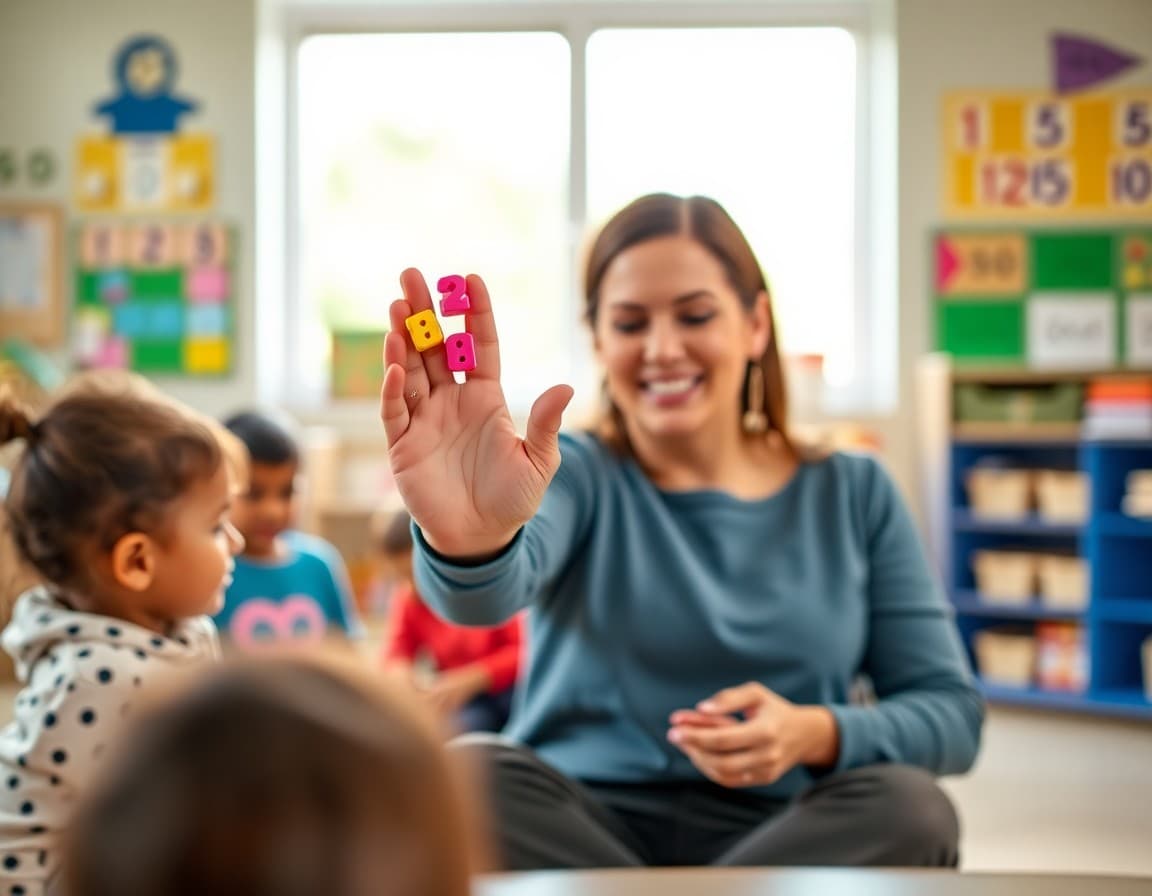
Counting is the first math skill most parents think of when they consider Pre-K readiness. But real counting, the kind that builds mathematical understanding, is more complex than reciting numbers in order. Your counting unit newsletter is a chance to explain the full picture and give families specific ways to support genuine counting development at home.
The Difference Between Rote Counting and Real Counting
Start your counting unit newsletter by drawing the distinction families most need to understand. Rote counting is saying numbers in order: 1, 2, 3, 4, 5. It is a verbal sequence, like a song, and many children can do it to 10 or 20 before they have real counting skills. Real counting requires the child to coordinate that verbal sequence with physical actions, to keep track of which objects have been counted, to understand that each object gets exactly one count, and to understand that the final number represents the total. These are separate, harder skills, and they develop on a different timeline than rote recitation.
One-to-One Correspondence in Practice
The most important counting skill you are building in the classroom is one-to-one correspondence: the ability to touch or move each object exactly once while counting, assigning exactly one number to each item. This sounds obvious to adults who have internalized it, but it requires genuine coordination for young children. The common error is counting faster than touching, so some objects get two numbers and some get none. In the classroom you are addressing this by having children move objects as they count, or tap them into a designated space. Your newsletter can describe this technique so families can use the same approach at home.
Cardinality: The Conceptual Leap
Cardinality is the understanding that the last number you say when counting tells you how many are in the set. This seems obvious but is a genuine conceptual development that not all Pre-K children have consolidated. You can test it directly: count a group of objects with your child, then ask “so how many are there?” A child without cardinality starts counting again. A child with cardinality says the last number they counted. Your newsletter can describe this as a milestone families can observe at home and celebrate when they see it emerge. It is one of the most important transitions in early numeracy.
A Sample Newsletter Excerpt to Copy
“This week we worked on one-to-one correspondence: touching each object exactly once while counting. The technique we used is to move each object from one side to the other as we count it, so every counted object goes to a new place. This prevents double-counting and skipping. At home this week: count some small objects at dinner using this technique. Put the crackers or grapes in a pile, and move each one to a new spot as you count it together. Ask your child to count and you move, or vice versa. After a few times, ask 'so how many are there?' See if they answer right away or start counting again. Both are normal, and both tell you where they are.”
Counting With Purpose, Not Just Practice
The most effective counting experiences for young children are purposeful rather than drill-based. Counting because there is a reason to know the answer is qualitatively different from counting because the teacher asked. Setting the table (how many plates do we need?), packing a backpack (do we have all five things on the list?), and distributing snacks (does everyone have the same number?) all require counting with a purpose. Your newsletter can give families specific purposeful counting moments to embed in their routines. The child who counts crackers because they want to know if they have more than their sibling is doing richer math than the child who counts objects on a worksheet.
Counting Backward and Counting On
Two more sophisticated counting skills worth mentioning in your newsletter are counting backward and counting on. Counting backward (10, 9, 8...) builds understanding that the number sequence works in both directions and that removing one item decreases the quantity by one. Counting on is the ability to start counting from a number other than one: if there are four crackers in one pile and you add two more, counting on means starting from four, not from one. Both of these skills are precursors to subtraction and addition and can be practiced with simple household routines.
When Counting Struggles Are Typical and When They Are Not
Help families calibrate their expectations in your counting unit newsletter. At age 3, most children are just developing stable order to about five and beginning one-to-one correspondence. At age 4, most children can count to ten accurately with objects, though errors are common. A 4-year-old who loses track during object counting at seven is completely typical. A 5-year-old who cannot count more than three objects without losing correspondence may warrant a closer look. Your newsletter can provide this range so families neither panic nor dismiss something worth noticing.
Sending Your Counting Unit Newsletter With Daystage
Daystage makes it easy to send a counting unit update with a classroom photo, a specific explanation of the counting principle being built this week, and one take-home activity. When families receive a newsletter that says “we are working on cardinality this week, here is what that looks like and one way to practice tonight,” they engage differently than when they receive “we counted things this week.” The specificity is what makes the connection between school and home real.
Get one newsletter idea every week.
Free. For teachers. No spam.
Frequently asked questions
What are the key components of counting development that Pre-K teachers address?
Counting development has several distinct components: stable order (numbers always come in the same sequence), one-to-one correspondence (one count per object), cardinality (the last number counted equals the total), abstraction (any collection can be counted regardless of what it contains), and order irrelevance (the count is the same regardless of which object you start with). Rote counting addresses only stable order. Real counting requires all five principles to be operational.
Why does my Pre-K student recite numbers to 20 but struggle to count objects accurately?
Rote counting and actual counting are different skills. Rote counting is a verbal sequence like a song. Accurate object counting requires synchronizing that verbal sequence with a physical action (touching or moving each object) while keeping track of which objects have been counted. These coordination demands are genuinely challenging for 3 and 4 year olds. A child who can recite to 20 but loses track during object counting at 6 is completely typical.
What at-home activities build real counting skills for Pre-K children?
Counting during everyday routines is the most natural reinforcement: counting stairs, counting bites at dinner, counting objects going into a bag. The key is pairing one touch with one count, which builds one-to-one correspondence. Counting into containers (one raisin per cup for four cups = four raisins) builds counting with purpose. Counting backward from five or ten builds stable order in both directions. All of these take less than two minutes and require no special materials.
How do I explain cardinality to Pre-K parents in a way that makes sense?
Explain it this way: after counting five objects, if you ask a child 'how many are there?' and they start counting again, they do not yet have cardinality. A child with cardinality says 'five' immediately, because they understand that the last number they said IS the answer. This is a genuine conceptual leap, not an obvious one. Many children at Pre-K age are in the process of consolidating it, and it is one of the most important milestones to watch for and celebrate.
How does Daystage help teachers communicate counting unit content to families?
Daystage makes it easy to send a counting unit newsletter with a photo of children counting manipulatives, a clear explanation of what counting skill you are working on, and one simple counting activity families can try that evening. Families receive it on their phones and can reinforce the specific counting principle being built, not just 'count things,' but count with purpose using the technique you describe.

Adi Ackerman
Author
Adi Ackerman is a former classroom teacher and curriculum writer with 8 years in K-8 schools. She writes about school communication, parent engagement, and what actually works in real classrooms.
More for Pre-K
Ready to send your first newsletter?
3 newsletters free. No credit card. First one ready in under 5 minutes.
Get started free