
How to Write an Art Exploration Newsletter for PreK Parents
Art exploration in Pre-K is one of the richest developmental activities in your classroom, and one of the most frequently misunderstood by families who expect to see finished crafts come home. Your art exploration newsletter is a chance to explain why process matters more than product, what open-ended making actually builds, and how families can support creative exploration at home with simple, accessible materials.
Process Art vs Product Art: The Core Distinction
Start your art exploration newsletter by drawing the most important distinction in early childhood art education: process vs product. Product art produces a predetermined outcome: a paper turkey, a snowflake with specific fold lines, a template with shapes to color inside. Every child's finished piece looks more or less the same. Product art teaches following directions. Process art produces something entirely different: an open-ended invitation to explore materials, make choices, and discover what happens. The child decides what to make, how to make it, and when it is finished. Process art teaches creative problem-solving, self-expression, and intrinsic motivation.
Fine Motor Development in Art Exploration
Art exploration builds fine motor control through the specific demands of art materials. Controlling a paintbrush to make a thin line vs a thick one requires the same hand stability that pencil writing demands. Cutting with child scissors builds the bilateral coordination (two hands working together on different tasks) that is essential for many daily activities. Tearing paper for a collage builds finger strength and coordination. Rolling and pinching clay builds the grip muscles used for writing. Your newsletter can name the specific fine motor work happening in the art activities of this week rather than describing them only as creative play.
Color Mixing as Science, Art as Experimentation
One of the richest intersections between art and science in Pre-K is color mixing. When a child combines blue and yellow paint and discovers green, something genuinely surprising happens. When they then test whether mixing any two colors produces a predictable result, they are doing scientific hypothesis testing in an art context. Your newsletter can describe the color mixing activities happening in your art center and explain them explicitly as science: observation, prediction, testing, and recording what was discovered. This framing helps families understand that their child is doing more than making a mess.
A Sample Newsletter Excerpt to Copy
“This week in the art center, children worked with watercolor paints and salt. When you sprinkle salt on wet watercolor, the salt absorbs the water and creates a crystal effect as it dries. The children painted first, then added salt, then waited and watched. Several children came back over and over to check on their painting as it dried. That waiting and watching is patience, scientific observation, and delayed gratification all at once. At home this week: try watercolor and salt together on any paper. Let your child discover what the salt does, without telling them first. Watch their reaction when the crystals appear.”
Self-Expression and Emotional Vocabulary Through Art
Art is one of the earliest vehicles for emotional expression and communication in young children. A child who cannot yet find words for a feeling can often represent it visually. When you ask a child to tell you about their painting, the conversation that follows often reveals thinking and feeling that would not have surfaced through direct questioning. Your newsletter can highlight this function of art: not just as a skill-building activity but as a communication channel. Families who ask “tell me about your painting” instead of “what is that?” open a door that the second question often closes.
Setting Up Art at Home Without Making a Huge Production of It
One of the most useful things your art exploration newsletter can do is lower the barrier to home art-making. Many families want to provide art experiences but feel overwhelmed by the setup and cleanup. Your newsletter can offer a simple framework: one material at a time, protected surface, specific time frame. Watercolor on a table covered with newspaper, ten minutes, cleanup with a wet rag. Playdough at the kitchen table, twenty minutes, contained on a tray. Chalk on the driveway or sidewalk, zero cleanup. Each of these is a complete art experience that requires less preparation than most families assume and produces genuine creative and developmental engagement.
Sending Your Art Exploration Newsletter With Daystage
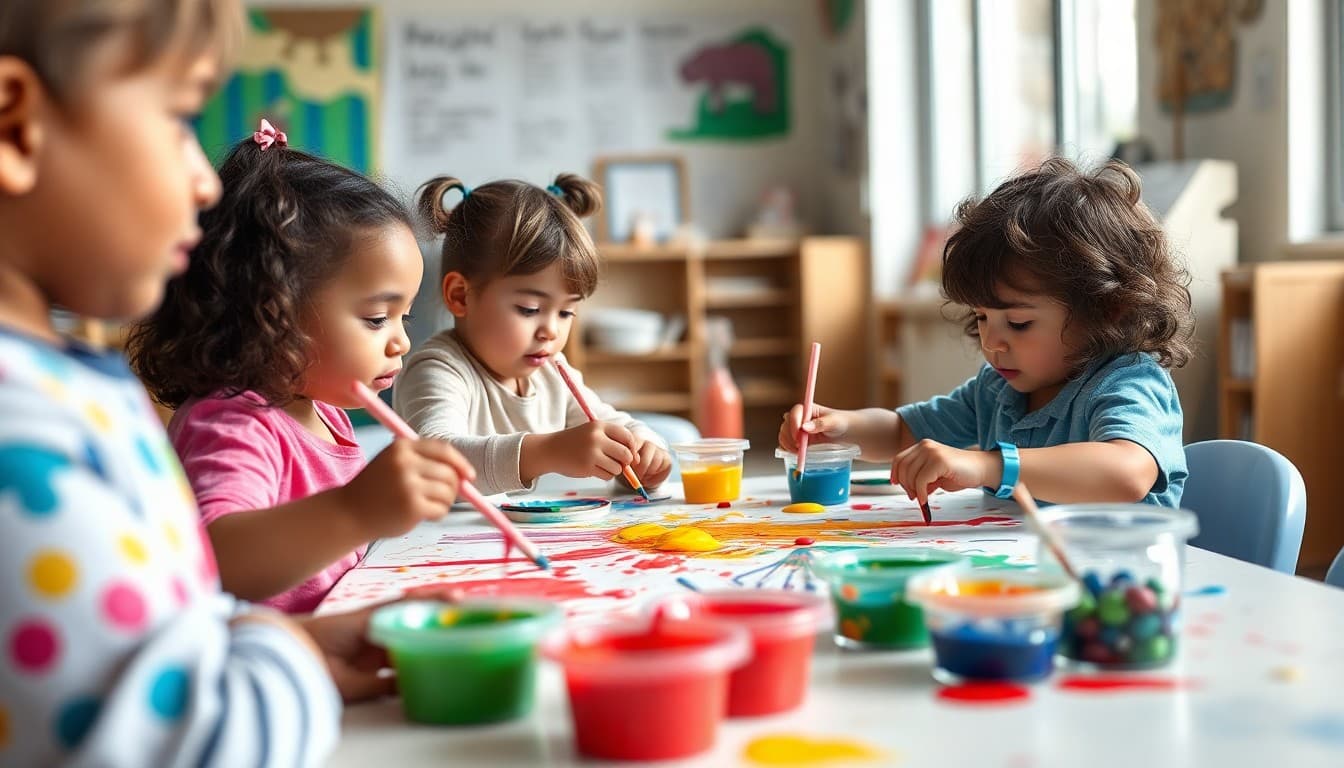
Daystage makes it easy to send an art exploration newsletter with a classroom photo of children fully immersed in making, a brief explanation of the creative and developmental work being done, and one process art activity to try at home. When families see the photo, they often respond with recognition: “this is what my child looks like when they are completely absorbed.” That engagement, that state of flow, is what art exploration produces and what your newsletter can make visible and credible to the families who wonder if it is really learning.
Get one newsletter idea every week.
Free. For teachers. No spam.
Frequently asked questions
What is the difference between process art and product art, and why does it matter?
Product art focuses on a predetermined outcome: every child makes the same construction-paper turkey, the same cotton-ball snowman. The value is in the finished object. Process art focuses on the experience of making: the child explores materials, makes choices, and creates something entirely their own. The value is in the thinking, choosing, and experimenting. Research on creativity, self-expression, and intrinsic motivation consistently favors process art for young children. Product art teaches following directions. Process art teaches creative problem-solving.
What does open-ended art exploration build in Pre-K children?
Open-ended art builds fine motor control (handling small tools, controlling brush strokes, cutting), visual-spatial thinking (composition, balance, proportion), self-expression and emotional vocabulary (naming and communicating what the art represents), creative problem-solving (what happens when I mix these colors?), persistence (trying again when the outcome is not what was intended), and early symbolic representation (drawing a person by choosing which features to include and how to place them).
How do I respond to parents who want the children to bring home cute finished crafts?
Acknowledge the appeal of the craft directly: a cute holiday project to put on the refrigerator is genuinely satisfying for families. Then explain what the child was building during process art that the craft could not produce: color mixing observation, compositional decision-making, fine motor challenge. You can offer both: a process art experience for the developmental value, and an occasional product art project for the joy of having something specific to take home. Neither invalidates the other.
What art materials should Pre-K families have at home for open-ended exploration?
The most valuable home art kit for Pre-K includes: tempera paint in primary colors plus black and white, brushes of different widths, watercolor sets, child scissors, glue sticks, collage materials (scraps of paper, fabric, leaves, magazine cut-outs), and blank paper in different sizes. A dedicated art space, even just a table with a plastic tablecloth, communicates that making is welcome. The child who knows they have a place to create and materials to use with is more likely to explore independently.
How does Daystage help teachers send art exploration newsletters to Pre-K families?
Daystage makes it easy to send an art exploration newsletter with a classroom photo of children at work making something, a brief explanation of the creative and developmental work being done, and one process art activity families can try at home. The photo is often the most powerful part: a child fully absorbed in mixing colors or tearing paper for a collage communicates engagement that words alone cannot.

Adi Ackerman
Author
Adi Ackerman is a former classroom teacher and curriculum writer with 8 years in K-8 schools. She writes about school communication, parent engagement, and what actually works in real classrooms.
More for Pre-K
Ready to send your first newsletter?
3 newsletters free. No credit card. First one ready in under 5 minutes.
Get started free