
Preschool Holiday Newsletter Ideas: Navigating Seasonal Communication Inclusively
Seasonal and holiday newsletters are a consistent challenge for preschool teachers in diverse communities. You want to create a sense of shared rhythm and celebration across the year, but the traditional holiday calendar in early childhood communication is heavily weighted toward a specific cultural and religious majority. In a classroom where families celebrate Diwali, Eid, Hanukkah, Christmas, Kwanzaa, and nothing at all, a newsletter that leads with "The holiday season is here!" is speaking to some families and implicitly excluding others.
The good news is that there is a clear and practical framework for inclusive seasonal communication that is not complicated to implement. It does not require avoiding all holidays or pretending the calendar does not exist. It requires being intentional about what you center, what you observe, and what you celebrate across the full year.
The Core Distinction: Celebrate vs. Observe
The most useful frame for thinking about holiday communication is the difference between celebrating and observing. A classroom can observe that many families celebrate Hanukkah in December without centering the classroom's December communication around it. A classroom can acknowledge that Ramadan is happening without turning it into a themed unit.
Observation is educational and respectful: "We know that some families in our classroom are celebrating Eid this week. We talked about what that means as a way of understanding the world our students come from." Celebration implies participation and shared belonging: "Let's count down to Christmas!" pulls in the families who celebrate and sidelines everyone who does not.
In a newsletter, you can observe any holiday by acknowledging it exists, noting which families or communities celebrate it, and expressing genuine interest without assuming every family is participating. You can celebrate the seasonal experiences that all children share, regardless of religion or culture.
Seasonal Frames That Work for All Families
The most inclusive approach to seasonal newsletters centers the natural world and the shared experiences of the season rather than any specific holiday. This is not a workaround or a way of erasing the holiday calendar. It is actually more meaningful for young children, who are at a developmental stage where sensory experience and concrete observation are more engaging than abstract cultural concepts.
Fall: Leaves changing, cooling temperatures, harvest themes, animals preparing for winter, the quality of fall light, the return to school routines. These experiences are universal and give children and families real things to connect over.
Winter: Weather changes, dark evenings, indoor coziness, rest and quiet, light and warmth, the idea of many different families celebrating important things in their own ways during this season. This last frame lets you acknowledge the variety of December and January celebrations without centering any one of them.
Spring: Growing things, mud season, longer days, new animal life, the shift back to outdoor time, the energy that comes with warming weather. Again, these are experiences that cross every cultural background.
What to Do with Winter in Particular
December and January are the most fraught months for inclusive holiday communication because so many significant religious and cultural holidays cluster in this window: Christmas, Hanukkah, Kwanzaa, Solstice, Orthodox Christmas, Eid in some years, and others. The instinct is either to acknowledge all of them by name or to avoid them all.
A better approach: acknowledge that this is a season when many different families celebrate something important, express genuine curiosity and warmth about that variety, and center the classroom's newsletter on what children are doing in school during this time rather than on any specific holiday.
Example language: "This is a time of year when many of the families in our community are celebrating important things. We love knowing that our students are going home to traditions that matter to their families. At school this week, we have been exploring light, which is a theme in many winter celebrations around the world. We built structures to hold candles, talked about why fire and light appear in so many different cultural stories, and made our own light sources with paper and tissue."
That newsletter acknowledges the season, connects to multiple traditions without centering any one, and reports on actual classroom learning. It works for every family in the room.
How to Handle Holiday-Specific Requests
You will sometimes receive requests from families to incorporate their specific holiday into the classroom, or to avoid activities that conflict with their religious observance. Both types of requests deserve a direct, private response, not a group newsletter.
For inclusion requests, the question to ask yourself is whether incorporating this holiday serves an educational purpose that benefits the whole class, or whether it is primarily about making one family feel seen. Both are valid, but they require different approaches. A brief lesson about Diwali that helps all children learn about a major world celebration is different from a Diwali party that most families do not have the cultural context to participate in meaningfully.
For exclusion requests (a family whose child cannot participate in Halloween activities for religious reasons, for example), handle this through a private conversation and note it in the child's file. The group newsletter is not the place to announce that some children will be doing something different during a school activity.
A Year of Seasonal Newsletters: Practical Ideas by Season
For each season, center the newsletter content on what children are experiencing in the classroom and connecting to at home, using seasonal themes that are genuinely universal.
September and October: The transition back to school, harvest and growing, fall colors, what changes in the natural world this time of year, preparing for colder weather.
November and December: Gratitude (framed around what the class is thankful for, not the Thanksgiving narrative specifically), light and warmth as themes across many traditions, rest and the shortened days, what families do when they spend more time indoors.
January and February: Winter weather and what it means for animals and plants, new beginnings (New Year is widely observed across many cultures), caring for people we love (a frame that encompasses Valentine's Day without centering the commercial version of it).
March and April: Spring's arrival, things growing and changing, rain and mud, animal babies, the longer days.
May and June: The end of the school year, what children have learned, summer plans, transition to the next grade or school.
Building the Template Once, Using It All Year
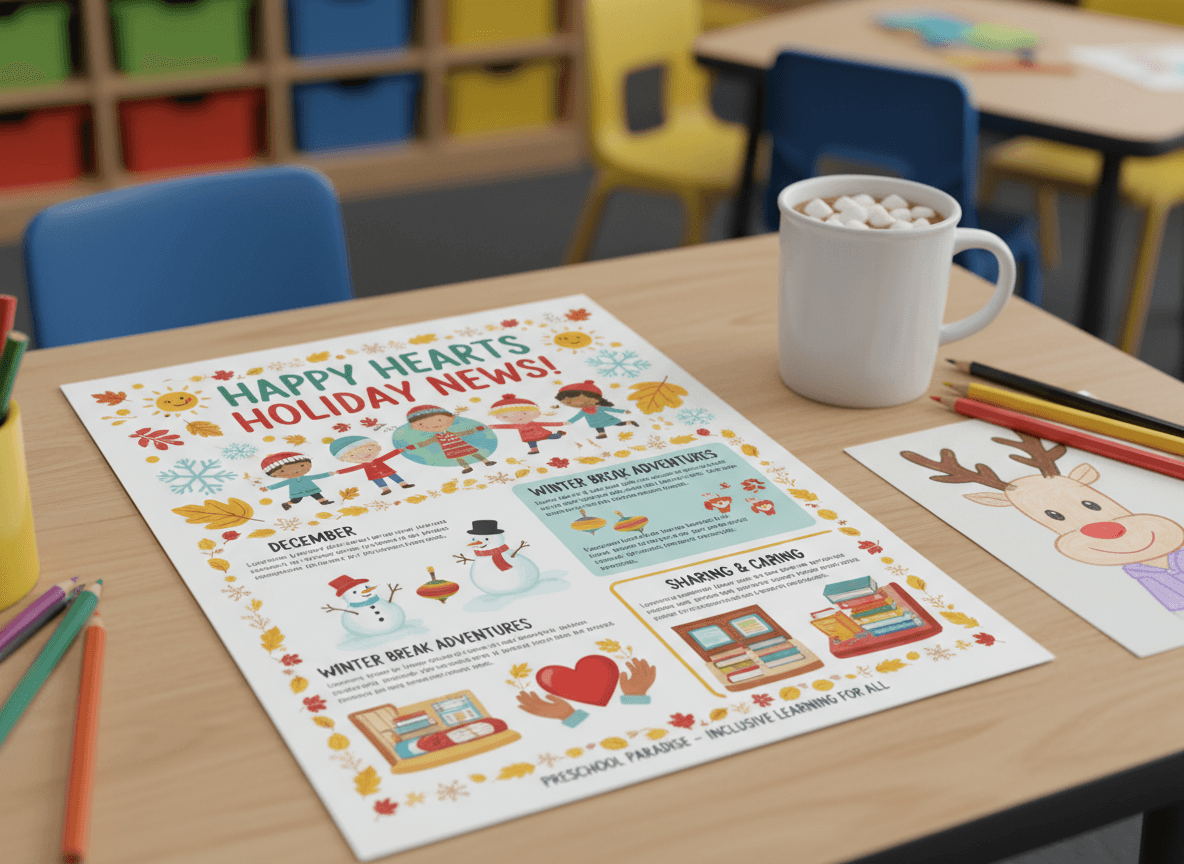
One practical approach to seasonal newsletters is to build a consistent template structure that you fill in each season: what we are exploring in the classroom, what the natural world is doing right now, what families can do at home to connect with the season, and what is coming up at school. That structure works in September and in December and in April.
Daystage lets you save a newsletter as a template and reuse the structure each time you send. You change the content, keep the format, and send directly to your classroom mailing list as a formatted email. That kind of reusable structure makes seasonal newsletters sustainable across a full year rather than something you rebuild from scratch four times and exhaust yourself.
Consistency in format, combined with content that actually reflects the season and the classroom, is what makes families read your newsletters rather than skim them. That is true in December and in every other month.
Get one newsletter idea every week.
Free. For teachers. No spam.
Frequently asked questions
When should preschool teachers send holiday and seasonal newsletters?
Send seasonal newsletters at the beginning of each season or major unit, not the week of a holiday when families are already focused on the celebration. Early November works better than the week before Thanksgiving. Early December covers the full winter celebration window without feeling rushed or exclusionary.
What should a preschool holiday newsletter include for diverse classrooms?
Include the seasonal themes the class will explore, such as light, warmth, giving, or change, and describe them in ways that are meaningful across cultural backgrounds. Name specific traditions families in the class celebrate only if you have explicit permission to do so. A section where families can share how their household marks the season creates inclusion through participation rather than assumption.
How should preschool teachers handle holiday communication inclusively?
Use secular and universal framing: seasons, light and dark, change in nature, and community are meaningful across cultures. Avoid classroom activities or newsletter language that assumes all families celebrate the same holidays. If your school has a policy about holiday observance, reference it briefly so families understand the approach is intentional rather than arbitrary.
What are common mistakes in preschool holiday communication?
The most common mistake is defaulting to a Christian-majority holiday calendar without considering how that lands for families who celebrate differently or do not celebrate those holidays at all. A second mistake is the opposite extreme of avoiding all seasonal content, which leaves the classroom feeling flat and disconnected from the rhythm of the year that children find naturally meaningful.
Is there a tool that helps preschool teachers create inclusive seasonal newsletters?
Daystage is built for early childhood teachers and supports seasonal communication that fits the real diversity of preschool classrooms.

Adi Ackerman
Author
Adi Ackerman is a former classroom teacher and curriculum writer with 8 years in K-8 schools. She writes about school communication, parent engagement, and what actually works in real classrooms.
More for Pre-K
Preschool Teacher Self-Care Newsletter: Supporting Families Through the Emotional Work of Parenting Young Children
Pre-K · 5 min read
Pre-K Newsletter Ideas for Parents: 30 Topics That Actually Get Read
Pre-K · 7 min read
Preschool Community Helper Theme Newsletter: Connecting Learning to Home
Pre-K · 5 min read
Ready to send your first newsletter?
3 newsletters free. No credit card. First one ready in under 5 minutes.
Get started free