

Pre-K Teacher Introduction Letter to Parents: How to Start the Year Right
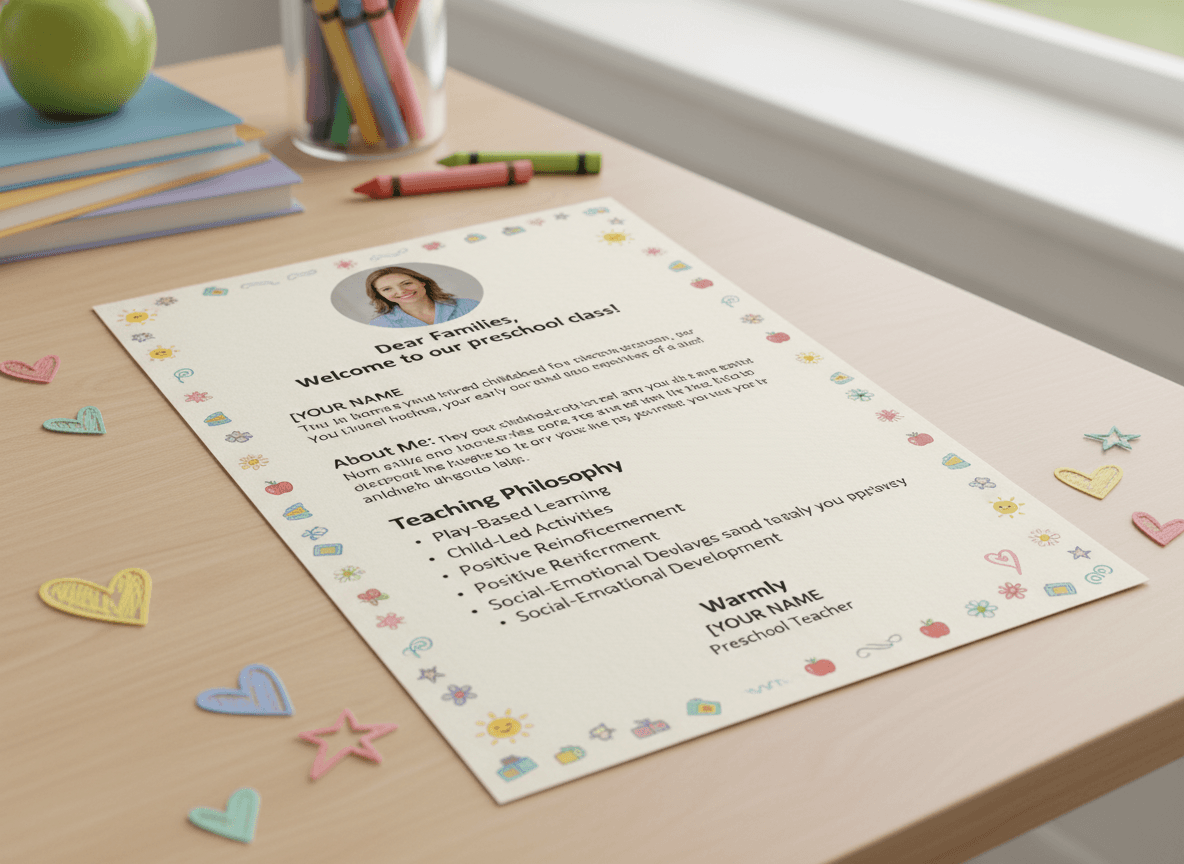
The first communication a pre-k family receives from their child's teacher sets the entire tone for the year. It is read more carefully than almost anything else you will send, because parents who are new to preschool are trying to answer a single question: "Is this the right person to leave my child with?"
A meet-the-teacher letter that answers that question well, specifically and honestly, does not just make a good impression. It begins to build the trust that makes every subsequent conversation easier. This guide covers what to include, what worries are specific to parents of 3 and 4 year olds, and a template structure you can adapt.
What Parents of 3 and 4 Year Olds Are Actually Worried About
Before writing anything, it helps to know what is going on in the reader's head. Parents sending a child to pre-k for the first time are typically carrying some version of these concerns:
- Will my child cry at drop-off? What happens if they do?
- What if my child is not potty trained or has accidents?
- Will my child make friends, or will they be lonely?
- What if my child has a hard time with the structure?
- Is the teacher going to tell me everything that happens, or will I be in the dark?
- What if my child gets hurt and I am not there?
Your introduction letter does not need to address every one of these explicitly. But it should signal that you have seen all of these situations before, that you have a plan, and that you will communicate. That signal alone handles most of the anxiety that parents bring to the first day.
Your Background: What to Include and What to Skip
Parents want to know enough about your background to feel confident, but not so much that it reads like a resume. A sentence or two on how many years you have been teaching, any specific training relevant to early childhood, and what drew you to this age group is the right scope.
What parents of young children care about most is not your credentials. It is your character. They want to know that you like small children, that you are patient, that you are not going to be dismissive of a child who is having a hard morning. If you can convey that authentically in your introduction, it does more work than a list of certifications.
Example: "I have been teaching pre-k for eight years. Before that, I studied early childhood education and worked in infant and toddler care, which gave me a real appreciation for how much changes developmentally in just twelve months. I genuinely love this age. The way four-year-olds engage with everything new is something I have not gotten tired of."
That is two sentences about credentials and one about why you do this work. The ratio matters.
Your Teaching Philosophy: Practical, Not Abstract
Do not lead with abstract statements like "I believe all children can learn" or "I am committed to meeting each child where they are." Those sentences are true but they say nothing specific.
Instead, describe what your classroom actually looks like. What do children spend their time doing? How do you handle transitions? What does a typical morning look like? How do you approach conflict between children? Parents are trying to picture their child in your classroom. Give them something to picture.
Example: "Our days have a predictable rhythm, because four-year-olds feel most confident when they know what comes next. We start with free choice, move into morning meeting, and build from there. I use a lot of music and movement throughout the day because these children need to move, and sitting still for long stretches is genuinely hard for their brains right now."
Drop-Off: Address It Directly
Separation at drop-off is the single biggest source of pre-k anxiety for both children and parents. Your introduction letter should address it directly, not in a way that dismisses the concern but in a way that shows you have a plan.
Tell parents what the drop-off procedure looks like. Tell them what you do when a child is upset. Tell them how long children typically take to adjust. And tell them how they will hear from you if their child is having an especially hard time.
That last point is critical. Nervous parents who do not hear from you after drop-off will spend the morning imagining the worst. A simple note that says "I will send a quick message if your child is still upset 20 minutes after drop-off, so you are not in the dark" gives parents something concrete to hold onto.
How You Will Communicate Throughout the Year
Tell parents explicitly what your communication plan looks like. How often will they hear from you? Through what channel? What is the best way for them to reach you? What questions belong in an email versus a conversation at pickup?
Setting these expectations in your introduction letter means you will spend less time fielding communication that does not match the channel you have set up. Parents who know you send a weekly newsletter and check email twice a day are not going to text the school office at 7am about something they could have emailed you the night before.
Template Structure
Here is a structure you can adapt for your own classroom:
- Opening (2-3 sentences): Express genuine excitement about the year, name the specific thing you love about this age group.
- About you (2-3 sentences): Years of experience, relevant background, and one honest line about why you do this work.
- Your classroom (3-4 sentences): What a typical day looks like, your approach to routines, how you handle conflict or hard moments.
- Drop-off (2-3 sentences): What the procedure is, what happens if a child is upset, how parents will hear from you.
- Communication (2-3 sentences): Your weekly newsletter, your email response time, the best way to reach you with questions.
- Closing (1-2 sentences): Invite parents to reach out before the first day if they have questions, and name a specific thing you are looking forward to.
Keep the total length to one page or the equivalent in email format. Parents will read it start to finish if it is not long. They will skim it if it is.
One Thing to Always End With
End your introduction letter with a specific invitation, not a generic "feel free to reach out." Something like: "If your child has a comfort object, a specific word for needing the bathroom, or anything about their routine that would help me know them from day one, please send me a quick note before we start. The more you tell me, the better prepared I will be."
That invitation does two things. It signals that you see each child as an individual, not just a group of pre-k students. And it gives parents a low-stakes reason to make contact before the first day, which makes the drop-off conversation less intimidating when it happens in person. That is a good start.
Get one newsletter idea every week.
Free. For teachers. No spam.
Frequently asked questions
When should a pre-k teacher send an introduction letter to parents?
Send the introduction letter one to two weeks before the first day of school so families have time to read it, share it with their child, and feel settled before drop-off. Sending it the same week school starts means it arrives when parents are already in logistics mode and will read it under stress rather than calmly.
What should a pre-k teacher introduction letter to parents include?
Include your background and what you love about teaching this age, a brief description of what a typical day looks like, your communication style and how parents can reach you, and one thing you are genuinely excited to do with the class this year. The emotional content matters as much as the logistical content for parents who are meeting you for the first time.
How should a preschool teacher write an introduction letter that builds immediate trust?
Address the anxiety parents of young children actually have: that their child will be okay without them. Say specifically how you handle separation in the first days, what you do when a child is upset, and what parents can do to help. Parents who know you have a plan for the hard moments trust you before they have ever met you.
What are common mistakes in pre-k teacher introduction letters?
Focusing entirely on logistics, supply lists, arrival times, and classroom rules, without any personal warmth is the most common mistake. A second mistake is writing at a formal register that sounds like a policy document rather than a human being. Parents of three and four year olds need to feel they can trust you as a person, not just as a credentialed professional.
Is there a tool that helps pre-k teachers create their meet-the-teacher communication?
Daystage is built for early childhood teachers and includes tools for drafting the kind of warm, structured introduction letters that set the right tone before the school year starts.

Adi Ackerman
Author
Adi Ackerman is a former classroom teacher and curriculum writer with 8 years in K-8 schools. She writes about school communication, parent engagement, and what actually works in real classrooms.
More for Pre-K
Ready to send your first newsletter?
3 newsletters free. No credit card. First one ready in under 5 minutes.
Get started free