

How to Write About Developmental Milestones in Your Pre-K Newsletter
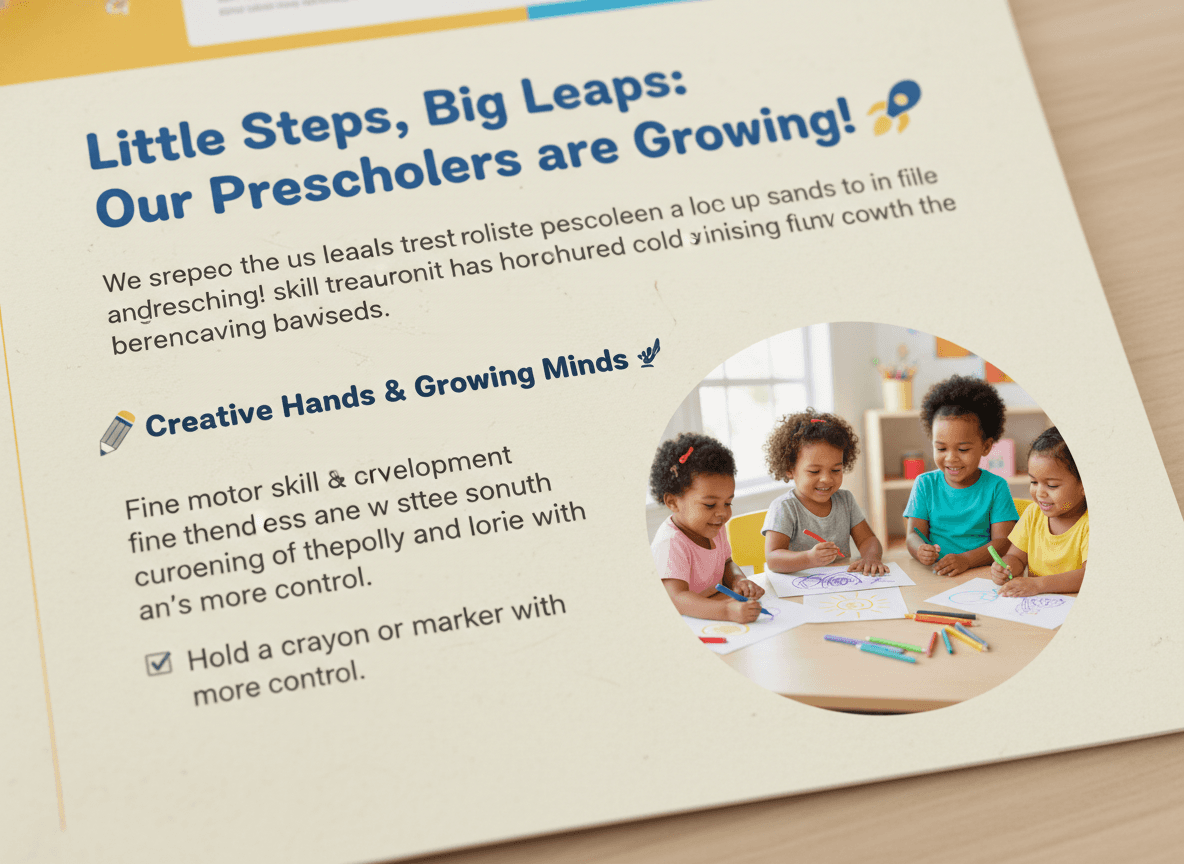
Developmental milestones are among the most useful and the most misused topics in early childhood communication. When handled well, milestone updates help families understand what their child is doing and why it matters. When handled carelessly, they create anxiety, invite comparisons, and sometimes damage the family's trust in the program.
The newsletter is a one-to-many communication tool. That constraint shapes everything about how you write about development. Individual milestones belong in individual conversations. What belongs in the newsletter is the shared developmental work happening in your classroom right now.
Group vs. Individual: The Core Distinction
The newsletter communicates what the class is working on as a group. It does not communicate what any individual child is or is not doing. This is the most important structural rule for milestone communication, and it protects both you and your families.
"We are noticing that many children in our class are working on using two-word phrases during play" tells parents what is developmentally alive in the room right now. It gives families context without labeling any child or suggesting that a particular child is behind. Compare that to "We are working on language development," which says nothing, or to any phrasing that implies a particular child's status.
The group frame also happens to be accurate. Developmental milestones are ranges, not fixed points. Your class of 18 four-year-olds spans a genuinely wide developmental range. Writing at the class level reflects that reality.
What Parents Actually Want to Know
Families of preschool-age children want to know three things about their child's development: Is my child doing okay? Is my child happy? What can I do at home? Your newsletter can address all three without touching individual milestone status.
"Okay" is communicated by describing a classroom where children are active, engaged, and cared for. "Happy" is communicated through anecdotes and specific observations from the week. "What can I do" is communicated by including one concrete family activity per newsletter that connects to what you are working on in class.
When parents have concerns that go beyond these three questions, they will ask. The newsletter creates the relationship that makes those conversations easier. It is not the place for those conversations itself.
Language That Avoids Alarm
Developmental communication in newsletters can unintentionally alarm families even when no alarm is warranted. A few specific language choices help.
Use "practicing" and "working on" rather than "developing" or "building." "We are practicing taking turns at the sensory table" frames the activity as intentional learning, not remediation. Use "many children" or "children this age" rather than "your child" or "some children." Use present tense rather than evaluative language. "This week at circle time, children are beginning to recognize their name in print" is observational. "Children should be recognizing their name in print by this point" is evaluative and has no place in a newsletter.
Avoid clinical terminology in parent-facing newsletters. Gross motor, fine motor, phonological awareness, pragmatic language: these terms have precise meaning in professional contexts and create unnecessary anxiety in parent communication. Translate them. "We are doing lots of cutting, drawing, and clay work to build the hand strength and coordination children need for writing" says the same thing as "We are working on fine motor skills" while giving parents a picture they can actually see.
When to Communicate Privately Instead
If you have a concern about a specific child's development, the newsletter is not the channel. Any concern specific to one child requires a direct conversation with that child's family. This is true even if you phrase it gently and generally in the newsletter. Families are perceptive. A parent who suspects their child is behind in speech will read "We are working on two-word phrases" and hear something directed at them, even when it is not.
The decision point is simple: if you are thinking about a specific child when you write a sentence, that sentence belongs in a private conversation, not in the newsletter. The newsletter is for information that is genuinely relevant to all families equally.
A Sample Milestone Section That Works
Here is a concrete example of a milestone update that is informative, class-level, and useful to families:
"This month we have been paying close attention to how children are working together during free play. At this age, play shifts from playing side-by-side to actually playing with other children: negotiating roles, responding to each other's ideas, and staying in the same game for more than a few minutes. We are seeing a lot of this beginning to happen in our classroom. If you want to support it at home, some unstructured time with one other child (not a group of five) is the best practice."
This paragraph names a real developmental shift, grounds it in observable behavior, and gives families something to do. It does not evaluate any child. It does not use a single clinical term. And it gives parents enough context to feel like they understand what their child's day actually involves.
Connecting Milestones to the Curriculum
One of the most effective approaches is to describe the activities first and the developmental purpose second. Families engage more readily with "we built a class grocery store out of cardboard boxes" than with "we are working on symbolic play." Both are true. But starting with the activity makes the newsletter readable, and the brief developmental connection at the end makes it useful.
"This week we turned our dramatic play area into a farmers market. Children made signs, sorted vegetables by color, and practiced exchanging pretend money. This kind of play builds the language, early math, and social negotiation skills that are the core work of pre-k." Two sentences of activity, one sentence of developmental context. That ratio works.
Frequency and Scope
One developmental focus per newsletter is enough. Trying to cover multiple skill areas in a single newsletter dilutes the message and makes the communication feel like a checklist. Pick the area that is most alive in your classroom right now and write about it with enough specificity to be useful.
Over the course of the year, you will naturally rotate through language, social development, motor skills, early literacy, and math concepts. Each one gets its month. Parents who read every newsletter will finish the year with a coherent picture of what their child's pre-k experience was actually designed to do. That picture builds confidence in the program and in you as a teacher.
Get one newsletter idea every week.
Free. For teachers. No spam.
Frequently asked questions
When should pre-k teachers write about developmental milestones in newsletters?
Include developmental context in newsletters once a month rather than every week. Monthly milestone framing gives families enough time to observe the skill at home between updates and avoids creating the impression that children are being constantly measured. Reserve individual milestone conversations for conference time or private notes, not the group newsletter.
What should a pre-k developmental milestone newsletter include?
Describe what the class is working on as a group, name the developmental domain it falls under such as language, fine motor, or social-emotional, and give families one concrete thing to look for at home. Focus on what most children in the age range are doing rather than implying that every child should be at the same point.
How should pre-k teachers communicate developmental progress without alarming families?
Write about what children are building toward, not what they have not yet achieved. 'Four-year-olds are practicing holding pencils with a tripod grip this month' is informative and calm. 'Some children are not yet meeting pencil grip expectations' is the same fact framed in a way that creates anxiety without helping anyone.
What are common mistakes in preschool developmental update communication?
Using clinical milestone language pulled directly from a developmental checklist is the most common mistake. Terms like 'gross motor delays' or 'age-appropriate phonemic awareness' belong in professional documentation, not parent newsletters. A second mistake is including individual comparisons, even implicitly, by describing what 'most children' can do in ways that make outliers obvious.
Is there a tool that helps pre-k teachers share developmental updates with families?
Daystage is built for early childhood teachers and makes it easy to share the classroom story in language that connects developmental context to what families are already seeing at home.

Adi Ackerman
Author
Adi Ackerman is a former classroom teacher and curriculum writer with 8 years in K-8 schools. She writes about school communication, parent engagement, and what actually works in real classrooms.
More for Pre-K
Ready to send your first newsletter?
3 newsletters free. No credit card. First one ready in under 5 minutes.
Get started free