
Infant and Toddler Room Newsletter Ideas: Communicating with Parents of the Youngest Children
Parents of infants and toddlers in daycare are operating under conditions that most newsletter advice ignores. They are sleep-deprived, often back at work for the first time, and spending their days worrying about a child who cannot yet tell them anything about the eight hours they were apart. The newsletter from the infant room is not just a communication tool. For many of these parents, it is a lifeline.
That context should shape everything about how you write and format it.
What Infant Room Parents Need Most
Infant and toddler parents are not looking for curriculum updates. They are tracking four things: whether their child is eating well, sleeping on schedule, staying healthy, and forming a bond with the caregivers. A newsletter that addresses those four things directly will get read. A newsletter that leads with developmental milestones without first acknowledging the basics will lose them.
Think of the infant room newsletter less like a classroom update and more like a care report with context. It should feel warm and specific, not institutional.
Keep It Short: What Fits on a Phone Screen
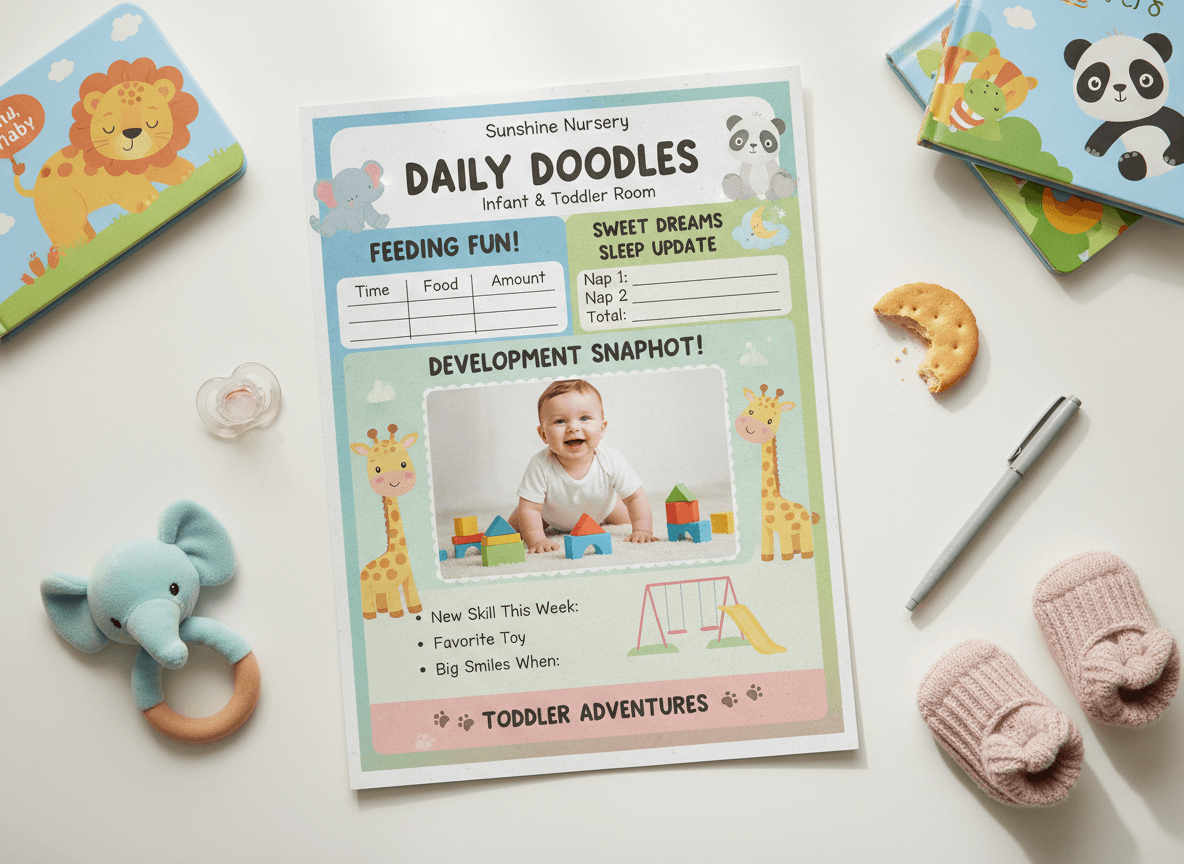
These parents are reading on their phones during a lunch break or during a night feed. A newsletter longer than 300 words will not get read in full. The format that works best for this age group is short blocks of text, a few bullet points, and at least one photo. That is it.
You do not need to write a letter. You need to communicate. Those are different goals and they produce different documents.
What to Include: A Practical List
For infants (0 to 12 months), a monthly newsletter might cover:
- Sleep and feeding notes. Not a full log (that belongs in the daily app or sheet), but a general note like "We have been working on consistent nap timing and most of our babies are settling into a two-nap rhythm."
- A developmental highlight. One specific thing you have observed across the room this month. "We are seeing a lot of object permanence play right now. Babies are delighted when things reappear."
- What they are exploring. Sensory bins, soft books, tummy time variations, outdoor time. Name it and connect it to why it matters.
- One photo with a caption. Specific and warm. "Luca discovers that the water table makes a very satisfying splash."
- A practical reminder. Clothing sizes to update, labeling reminders, supply requests.
For toddlers (12 to 36 months), add:
- Language and social development. What words are coming up, how children are playing alongside each other, what books you are reading.
- One question to ask at home. "Ask your toddler to find something red. They have been sorting by color all week and they are very proud."
- Upcoming transitions. Room moves, routine changes, or new caregivers joining the team all deserve advance notice at this age.
Photo-Heavy vs. Text-Heavy: What Works for This Age Group
For infant rooms, lean photo-heavy. Parents want to see. A newsletter with two or three strong photos and minimal text will outperform a text-heavy update every time. Captions carry the meaning. A photo of an infant lying on a play gym needs a caption that says "Working on those neck muscles during tummy time" to transform a cute image into a communication tool.
For toddlers, you can add slightly more text as children's activities become more complex and story-worthy. But the photo still leads. Always lead with the photo.
Addressing Separation Anxiety Directly
Many parents of infants in daycare are dealing with guilt. They dropped off a baby who was crying and spent the morning wondering if they made the right choice. A newsletter that acknowledges this, not with therapy language, but with a warm, matter-of-fact report of a good day, does something important.
Phrases that land well: "The room settled quickly after drop-off this morning." "Maya went down for her nap without much fuss and woke up in a great mood." Parents of this age group need reassurance that their child is okay. Build it into the newsletter naturally rather than waiting for them to ask.
Socialization Notes for Parents Who Worry About It
Parallel play is normal for toddlers. Sharing is not developmentally expected before age 3. But many parents in this age group worry that their child is "behind" socially if they are not playing with other children cooperatively. A brief note in the newsletter that names what you are seeing and explains why it is appropriate does a lot to reduce that anxiety.
Example: "You may notice that toddlers in our room often play side by side rather than together. This is parallel play, and it is exactly where children of this age should be. Watching peers, imitating them, and then playing alongside them builds the foundation for cooperative play that comes later."
Sending Consistently When Caregiving Days Are Full
Infant and toddler caregivers carry an unusually high physical and emotional load. Writing a newsletter at the end of a day of direct caregiving is hard. The solution is a simple template you fill in rather than a blank page you write from scratch each time.
Daystage works well here because the newsletter editor starts with your structure already in place. You add the month's photos, update the developmental highlight, swap out the practical reminder, and send. For caregivers managing this task without a dedicated administrator, removing the formatting overhead makes the difference between a newsletter that goes out and one that gets postponed until it never happens.
Get one newsletter idea every week.
Free. For teachers. No spam.
Frequently asked questions
When should infant and toddler room teachers send newsletters to parents?
Monthly newsletters are the right frequency for infant rooms because daily operational updates via an app or report sheet already carry the communication load. Toddler rooms can move to biweekly once children are older and the observable range of activities widens. For new families in their first month, an additional welcome note separate from the newsletter helps them orient to the room before the monthly rhythm begins.
What should an infant and toddler room newsletter include?
Include what the room has been exploring that month, such as a sensory material or movement activity, one or two photos of group play, any supply needs, upcoming schedule changes, and a short developmental note explaining why a current activity matters for this age. Keep total length short enough to read in under two minutes.
How should infant and toddler teachers write for sleep-deprived parents?
Use short paragraphs, one idea per paragraph, and a clear visual hierarchy so parents can scan in ten seconds and decide whether to read further. Avoid jargon like 'sensorimotor exploration' in favor of plain language like 'exploring textures with their hands.' A photo at the top of the newsletter significantly increases the chance the rest gets read.
What are common mistakes in infant and toddler parent communication?
Copying the format of a preschool or elementary newsletter into an infant room is the most common structural mistake. Infant parents need reassurance and warmth, not curriculum summaries. A second mistake is including information that belongs in a daily operational log inside the newsletter, which makes the newsletter feel like a report rather than a connection.
Is there a newsletter tool designed for infant and toddler rooms?
Daystage is built for early childhood teachers and works for infant and toddler rooms where newsletters need to be short, warm, and easy to produce alongside daily care responsibilities.

Adi Ackerman
Author
Adi Ackerman is a former classroom teacher and curriculum writer with 8 years in K-8 schools. She writes about school communication, parent engagement, and what actually works in real classrooms.
More for Pre-K
Ready to send your first newsletter?
3 newsletters free. No credit card. First one ready in under 5 minutes.
Get started free