
Head Start Family Newsletter: Communicating with Low-Income and Multilingual Families
Head Start programs operate under a family engagement mandate that goes beyond what most preschool programs require. The Performance Standards at 45 CFR Part 1302 require programs to actively build relationships with families, not just inform them. The newsletter is one tool in that effort, but it only works if it actually reaches the families it is meant to serve.
Many Head Start newsletters are written at a reading level that excludes a significant portion of enrolled families. Others are only in English in communities where Spanish, Somali, Haitian Creole, or Arabic is the primary home language. Here is how to build communication that works for the actual families you serve.
What the Grant Actually Requires
The Head Start Program Performance Standards require programs to establish ongoing communication with families in a language they can understand. This is not optional and it is not satisfied by a single translated enrollment packet. It applies to ongoing communication throughout the program year, including newsletters.
Programs must also support family engagement in children's learning and development, which means newsletters should include content that helps families extend learning at home. A section with one practical activity or conversation prompt tied to the current classroom theme directly supports this requirement and gives you something concrete to document.
The Office of Head Start reviews family engagement documentation during monitoring visits. A consistent newsletter archive with clear engagement data, how many families received it, open rates if using a digital tool, is useful evidence.
Reading Level: Write for Grade 5, Not Grade 8
The average adult reading level in the United States is around eighth grade. The average reading level in many low-income communities is closer to fifth or sixth grade. Most institutional newsletters are written at ninth grade or above.
This does not mean writing down to families. It means choosing shorter sentences, common words, and concrete specifics over abstract language. "Your child is building early math skills" is clearer than "children are developing foundational numeracy concepts through play-based inquiry."
A quick check: paste your newsletter draft into a free readability tool and look at the Flesch-Kincaid grade level score. Aim for grade 5 to 6. If it comes back at grade 9, shorten your sentences and replace academic vocabulary with plain language.
Multilingual Newsletters: What Is Realistic
If 30 percent or more of your enrolled families speak a language other than English at home, a translated newsletter is not a nice-to-have. It is a compliance expectation and a basic relationship-building requirement.
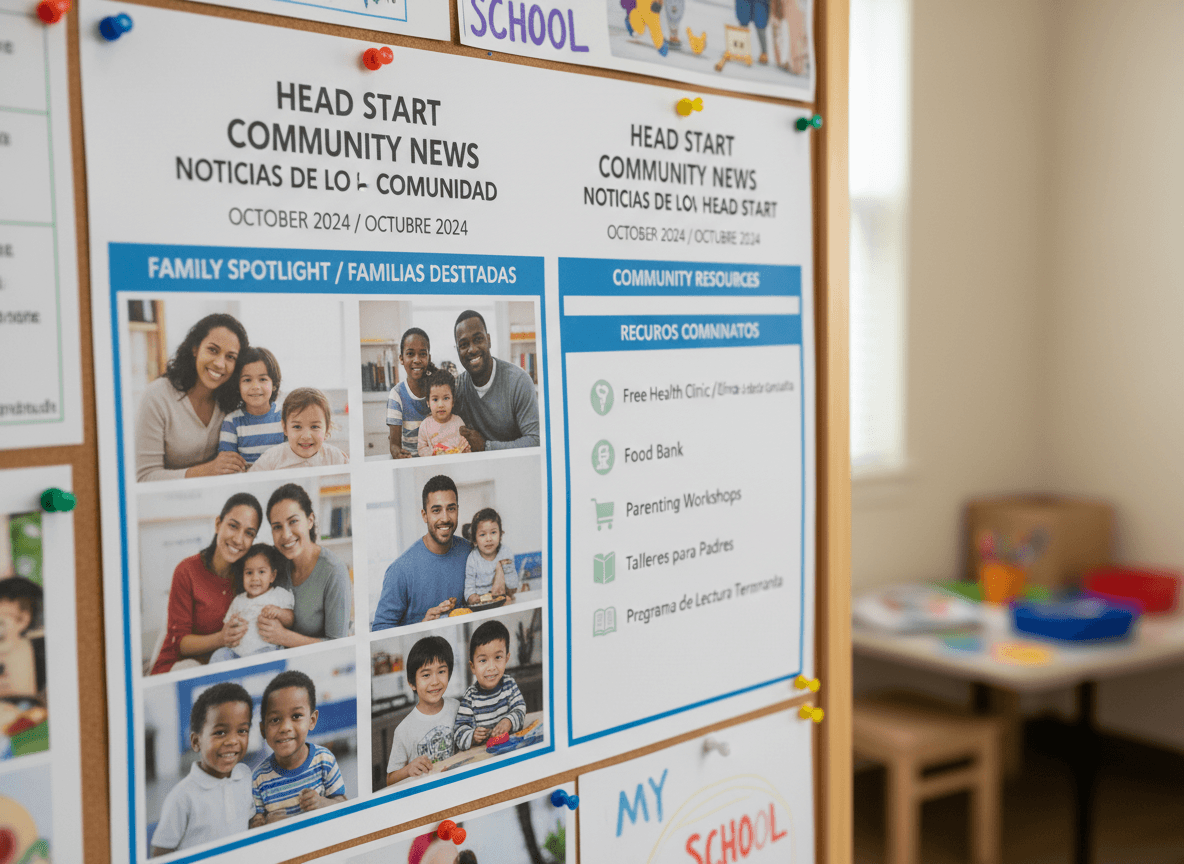
The most practical approach for most programs is a bilingual newsletter: English on one side or column, the second language on the other. For programs with more than two home languages, focus translation resources on the largest language group and use a parent liaison or community partner to verbally communicate key information to families who speak other languages.
Machine translation tools have improved significantly and are acceptable for a first draft, but they should always be reviewed by a fluent speaker before distribution. A mistranslated phrase in a family newsletter damages trust in ways that are hard to repair, especially in communities that already have reasons to distrust institutions.
Addressing Low Literacy Without Condescension
Some families in your program are not comfortable reading in any language. This is a reality in many Head Start communities and it deserves a direct response, not a workaround.
Use visuals alongside text. A calendar graphic is easier to use than a paragraph listing dates. A simple illustrated step for a home activity is clearer than a written description. Photos with captions carry information even when the surrounding text is hard to read.
Consider reading the newsletter aloud at family events, parent meetings, and during pickup conversations. Some programs record a brief audio version and share it via a WhatsApp group or text link. Families who cannot read the newsletter can still receive it if the delivery method adapts.
Community Resources Section
Head Start families often need access to services beyond early childhood education: food assistance, housing support, health care, immigration legal aid, job training. The newsletter is an efficient place to share one resource each month.
Keep it specific. A phone number and address are more useful than a general reference to "community support resources." Families in crisis do not have time to search. If your program has a family services coordinator, ask them to contribute one resource listing per newsletter. This distributes the work and keeps the information current.
What Content Builds Engagement in Head Start Specifically
Head Start families respond strongly to content that honors their role as their child's first teacher. Frame home learning activities as something they are already doing, not something they need to add to an already full life.
"When you name what your child points to on a walk, like tree, dog, bus, you are building their vocabulary. You are already teaching. This is what early literacy looks like at home." That framing is more effective than a structured activity parents may not have time or materials to complete.
Also include celebrations. A child's first day without tears at drop-off, a family who showed up to every home visit, a parent who volunteered in the classroom. Head Start is a community program. The newsletter should feel like it comes from a community, not just an institution.
Keeping the Newsletter Running When Capacity Is Thin
Head Start teachers and family service workers are often managing high caseloads with limited administrative support. A newsletter that requires an hour of formatting every month does not survive.
The format needs to be simple and repeatable: the same sections in the same order each month, with content that can be filled in rather than built from scratch. Tools like Daystage allow you to build a newsletter template once and reuse the structure every month. For programs managing multiple classrooms with different language needs, being able to duplicate and translate a base template is the difference between sending the newsletter and not.
Get one newsletter idea every week.
Free. For teachers. No spam.
Frequently asked questions
When should Head Start programs send family newsletters?
Monthly newsletters satisfy federal family engagement documentation requirements and are a realistic cadence for programs with limited staff capacity. If your program serves families with very young children or a high rate of first-time parents, adding a shorter biweekly update during the first month of enrollment helps families land in the program before switching to monthly.
What should a Head Start family newsletter include?
Include classroom activities tied to the current theme, a practical home activity families can try this week, upcoming dates and any required action items, and a community resource if relevant. The home activity component directly supports the federal requirement to extend children's learning into the home environment.
How should Head Start programs handle multilingual newsletter communication?
Translate the full newsletter into every language spoken by more than two or three families in your program, not just Spanish. Aim for a Grade 5 reading level in all languages, and have a fluent speaker review translations before sending rather than relying on machine translation alone. The federal requirement is communication families can actually understand, not communication that technically exists in their language.
What are common mistakes in Head Start family communication?
Writing at a Grade 8 or higher reading level excludes a significant portion of enrolled families without anyone noticing until engagement data reveals it. Sending English-only newsletters in multilingual programs is both a compliance gap and a practical one. A third common mistake is publishing newsletters without a consistent home learning section, which is one of the more documentable components for federal monitoring visits.
Is there a newsletter tool that works for Head Start programs?
Daystage is designed for early childhood teachers and supports the kind of consistent, accessible family communication that Head Start programs need to document throughout the year.

Adi Ackerman
Author
Adi Ackerman is a former classroom teacher and curriculum writer with 8 years in K-8 schools. She writes about school communication, parent engagement, and what actually works in real classrooms.
More for Pre-K
Preschool Learning Objectives Newsletter: Helping Families Understand What Children Are Working Toward
Pre-K · 5 min read
Preschool Storytime Newsletter: How to Extend Book Learning Into Family Life
Pre-K · 5 min read
How to Explain Play-Based Learning to Parents in Your Preschool Newsletter
Pre-K · 7 min read
Ready to send your first newsletter?
3 newsletters free. No credit card. First one ready in under 5 minutes.
Get started free