
Surface Area Unit Newsletter: Helping Families Understand 3D Math at Home
Surface area is one of the most spatially demanding units in middle school geometry. Students who are strong at computation sometimes struggle when they cannot visualize the three-dimensional shape they are working with. A newsletter that makes the visual and tactile nature of the unit explicit gives families practical tools to support their student's spatial reasoning at home, which is one of the few math skills that genuinely improves with hands-on physical manipulation rather than paper practice alone.
Surface Area Versus Volume: The Distinction That Matters
Many families confuse surface area and volume because both involve three-dimensional shapes. The distinction is simple and worth making explicit in the newsletter. Volume is the amount of space inside a shape, measured in cubic units. Surface area is the total area of all the outer surfaces, measured in square units. A beach ball has volume (the air inside it) and surface area (the material it is made of). If you wanted to inflate the ball, you care about volume. If you wanted to paint it, you care about surface area. When a shape is very thin, like a flat piece of cardboard, the surface area is large relative to the volume. Making this distinction clear helps students approach problems by first asking: is this asking me about inside or outside?
The Net as the Key Tool
The most effective conceptual tool for surface area is the net. A net is a flat two-dimensional pattern that folds to create a three-dimensional shape. When students visualize a shape as its unfolded net, they can identify every face and calculate the area of each one. The sum of all the face areas is the surface area. This approach is more reliable than formula memorization for students who are first encountering surface area because it connects directly to what the surface area concept means. A student who can unfold a rectangular prism in their mind will never forget to include the top face of the box. A student who relies only on the formula may make that error because the formula is abstract.
Physical Objects That Help at Home
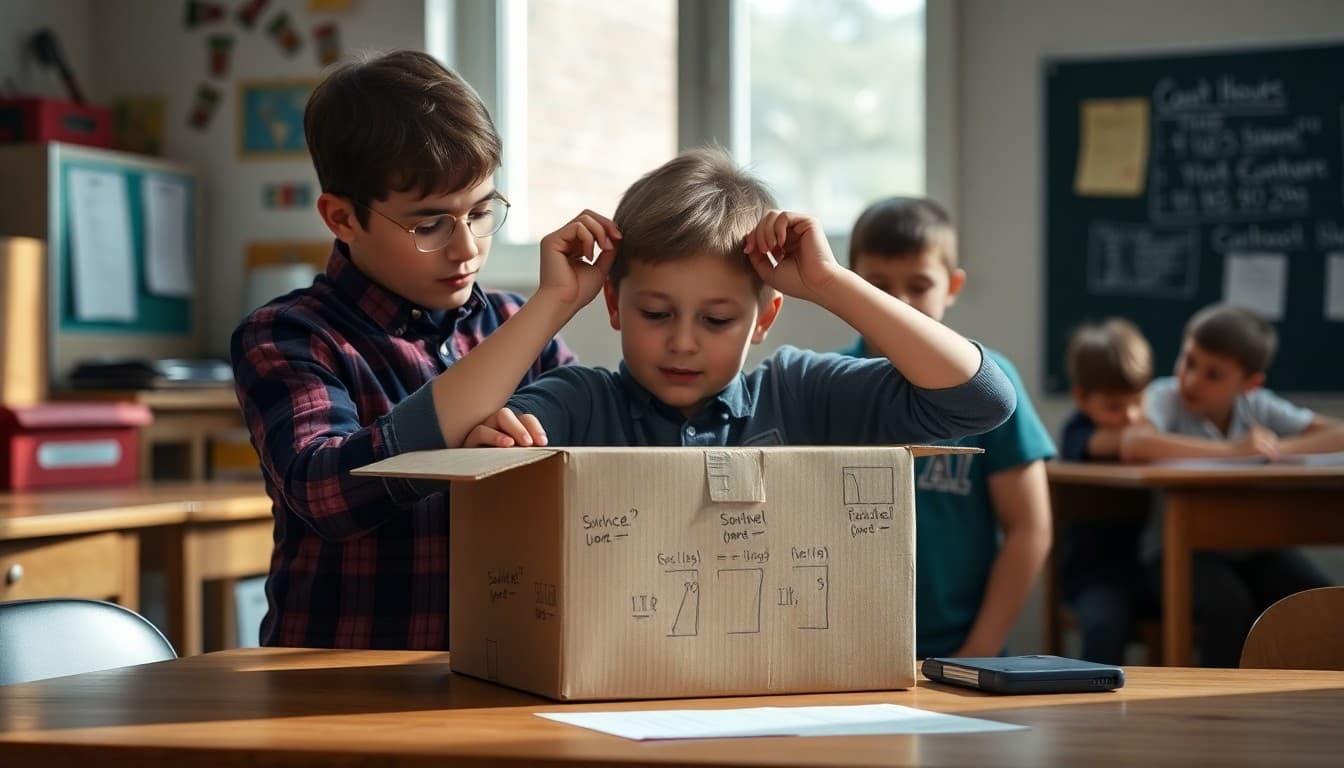
Surface area is one of the units where handling physical objects makes the biggest difference. Ask your student to bring a tissue box or cereal box home from school and work through the surface area calculation together using actual measurements. Open the box along its edges. Ask your student to identify the net. Count the faces. Measure each one. Calculate the area of each. Add them together. A student who has done this physical process with a real box has an understanding of surface area that two nights of paper practice cannot produce. It takes about fifteen minutes and requires only a ruler and the household box.
The Shapes in the Unit
Most middle school surface area units cover rectangular prisms (boxes), triangular prisms, pyramids, cylinders, and sometimes cones and spheres. The approach for each shape follows the same logic: identify the faces, calculate the area of each, sum the results. The formulas students learn for cylinders and other curved shapes apply the same principle to the curved surface. Tell families specifically which shapes are in the unit and in what order. Families who know the schedule can watch for the relevant shape in daily life and mention it to their student during the unit.
Assessment Preparation Specifically
Surface area assessments almost always include a mix of problem types: straightforward calculation from given dimensions, word problems that require identifying what surface area means in a context, and multi-step problems involving cost or material calculation. Tell families this structure so they can guide review appropriately. A student who can calculate surface area from a labeled diagram needs to also practice reading word problems that describe a situation and determining which dimensions to use. The translation from problem description to diagram is where many students lose points, and that skill improves with targeted practice rather than simply repeating calculation problems.
Why Surface Area Matters Beyond the Unit
Surface area thinking appears in real careers and daily situations more than most students realize. A house painter calculating the amount of paint needed for a room is solving a surface area problem. An engineer designing packaging is working with surface area to minimize material cost. A biologist studying cell function knows that surface area to volume ratio determines how efficiently a cell can exchange materials with its environment. Including one of these applications in the newsletter connects the unit to the real world and gives students a reason to care about the skill beyond the upcoming test.
Get one newsletter idea every week.
Free. For teachers. No spam.
Frequently asked questions
What should a surface area unit newsletter include?
Explain what surface area is in plain language, how it differs from volume, the real-world contexts where surface area calculations matter, the specific shapes students will work with in the unit, the vocabulary students are learning (net, face, edge, vertex, prism, pyramid), and practical home activities using household objects. Include the assessment date and a clear description of what the test will cover. A labeled net diagram of one of the simpler shapes, like a rectangular prism, makes the concept visual for families.
What is a net and how do you explain it to parents?
A net is a two-dimensional shape that can be folded to form a three-dimensional figure. Think of a cereal box cut along its edges and unfolded flat. That flat shape is the net of the rectangular prism. When students identify all the faces in a net and calculate their areas, they can find the total surface area by adding those areas together. The net visualization is the most intuitive path to surface area for most students, and families who understand what a net is can help their student think through problems by imagining unfolding the shape.
What common errors do students make in the surface area unit?
The most frequent errors are forgetting to include all faces of a solid (especially the top and bottom of a prism, which students sometimes forget when working from a drawing), using diameter instead of radius in cylinder surface area calculations, using linear units instead of square units for area answers, and mixing up surface area and volume formulas when both appear on the same assessment. Including these specific errors in the newsletter helps families know what to check when reviewing homework.
How can families practice surface area at home without formal math materials?
Any household box, can, or container is a physical model for surface area. Ask your student to identify the shape, name all the faces, and estimate the surface area. Opening a cereal box along its edges and spreading it flat shows exactly what a net is. Measuring the faces of a shoebox with a ruler and calculating the surface area connects the classroom skill to a tangible object. Wrapping paper calculations for a gift are a natural surface area application. Gift wrap enough paper for a box and ask your student to explain why you cut that particular amount.
How does Daystage help teachers communicate geometry units to families?
Daystage lets teachers include photos and diagrams in newsletters, which is especially useful for visual units like surface area. A photo of the nets students are working with in class, or a labeled diagram of the prism formulas, gives families a concrete reference that helps them support homework without needing to recall geometry formulas they may not remember from their own schooling.

Adi Ackerman
Author
Adi Ackerman is a former classroom teacher and curriculum writer with 8 years in K-8 schools. She writes about school communication, parent engagement, and what actually works in real classrooms.
More for Middle School
Ready to send your first newsletter?
3 newsletters free. No credit card. First one ready in under 5 minutes.
Get started free