
Percent Unit Newsletter: Connecting Middle School Math to Everyday Family Life

Percent is one of the most immediately useful math concepts students encounter in middle school, and one of the most reinforceable at home without any special preparation on the family's part. Sales, tips, taxes, statistics, and nutrition labels are all percent applications that middle schoolers encounter regularly. A newsletter that makes this connection explicit gives families genuine tools to extend classroom learning into daily life while their student is in the middle of the unit.
What Students Are Learning in the Percent Unit
The percent unit typically covers three fundamental problem types. Finding a percent of a number: what is 25% of 80? Finding what percent one number is of another: 15 is what percent of 60? Finding the whole when a percent is known: 30 is 40% of what number? These three types sound similar but require different approaches. Students also learn to convert fluently between fraction, decimal, and percent forms. Later in the unit, most curricula add percent increase and decrease, which introduces a fourth calculation type with its own common error patterns. Understanding these distinctions helps families support homework effectively.
The Connection to What Students Already Know
Percent is not a new concept arriving out of nowhere. It connects directly to fractions (50% means 50 out of 100, which reduces to 1/2) and decimals (25% is 0.25). Students who already understand fractions and decimals are ready for percent thinking. The newsletter should make this connection explicit: “If your student understood fractions and decimals from sixth grade, percent will feel familiar. The new element is the two-direction translation: moving from a stated percent to a calculation and back from a calculation to a percent expression.” Families who understand the prior knowledge requirement can assess whether their student's foundation is solid enough to support the new learning.
Practical Family Activities During the Unit
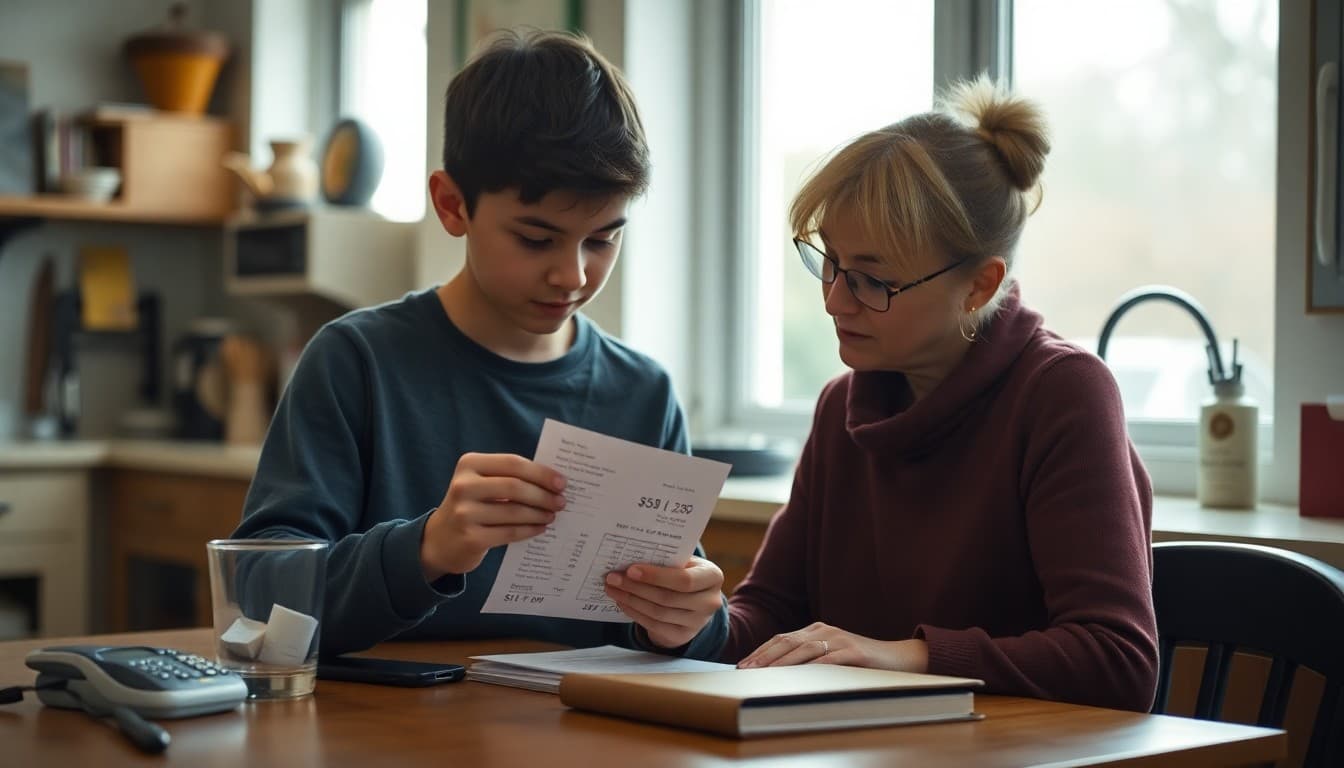
The restaurant tip is the classic percent application because it arises naturally, has a real consequence if calculated wrong, and involves a relevant dollar amount for a middle schooler. Challenge your student to calculate the tip before you do. The grocery store discount is another: when an item is marked 25% off, can your student find the sale price faster than you can? These activities work without any formal math lesson setup. They arise from daily errands and conversations. The goal is to reinforce that the math being learned in school is the same reasoning that adults use in real situations, which most middle schoolers do not automatically connect.
Addressing the Fraction-Percent Confusion
Some students leave the percent unit still confused about when to use a fraction and when to use a percent, and whether they are interchangeable. The newsletter can preempt this confusion by explaining the distinction: fractions and percents represent the same relationships but are used in different contexts. Percents are the preferred representation in many everyday situations like grades, statistics, and prices because they all use the same scale of 0 to 100, making comparison easier. Fractions are more useful in pure mathematics and in situations involving parts of a whole that do not reduce nicely to per-hundred values. Most student confusion about this resolves with more examples, which is where family practice at home helps.
The Assessment and What It Tests
Be specific about the assessment structure in the newsletter. “The percent unit assessment will include: twelve calculation problems covering all three problem types, a multi-step word problem involving percent increase or decrease in a real-world context, and three percent-decimal-fraction conversion problems. Students should be able to solve problems with and without a calculator, as the assessment has a no-calculator section.” This level of detail lets families focus their student's review time on the highest-value material rather than reviewing everything equally. Students who know the no-calculator section is coming will practice mental math methods as well as calculator-based approaches.
When the Unit Ends and What Comes Next
Percent understanding is directly foundational for the algebra units that follow in seventh and eighth grade. Students who internalized proportional reasoning in the ratio unit and percent reasoning in this unit arrive at algebraic thinking with the strongest possible foundation. Give families a brief preview of how this unit connects to the next one and what comes after. Families who understand the mathematical sequence of the year have a better sense of why current unit mastery matters and are more motivated to support the focused review that helps it stick.
Get one newsletter idea every week.
Free. For teachers. No spam.
Frequently asked questions
What should a percent unit newsletter cover for families?
Explain what percent means (per hundred), how it connects to fractions and decimals that students already know, the specific types of percent problems in the unit (finding a percent of a number, finding what percent one number is of another, and finding the whole when a percent is known), real-world applications that families can connect to, the assessment date, and one or two practice suggestions for home. Include any vocabulary students are learning, like percent increase, percent decrease, and discount, since these words appear in real contexts families can point to.
What real-world percent applications can families use for at-home practice?
Restaurant tips: ask your student to calculate a 15% and a 20% tip on the bill. Store discounts: when something is 30% off, what is the actual price? Tax calculation: if the sales tax rate is 7%, how much tax will be added? Sports statistics: a basketball player makes 72% of free throws; in 50 attempts, how many baskets do they expect? Population change: a town grew from 12,000 to 15,000 people, what is the percent increase? Families who work through one of these with their student each week during the unit reinforce the classroom learning without needing any math preparation themselves.
What common errors do students make in the percent unit?
The most frequent error is moving the decimal point in the wrong direction when converting between percent and decimal form. Students also commonly confuse finding a percent of a number with finding what percent one number is of another. Percent increase and decrease problems are particularly confusing when students are not sure which original value to use as the base for the calculation. Flagging these in the newsletter helps families know what to watch for and which types of problems deserve extra attention in homework review.
How do you help families who are not confident in their own percent math skills?
Acknowledge that not all adults learned this the same way and that methods may have changed. Give families the specific method students are learning rather than letting them default to methods they remember from their own schooling. Even if a family method gets the right answer, inconsistency between home and school methods creates confusion for the student. Provide the procedure students use, step by step, in the newsletter, so families can check homework using the same approach rather than an alternative one.
How does Daystage make it easy for math teachers to send unit preview newsletters?
Daystage's newsletter editor lets teachers build a consistent weekly format with a 'This Week' section and a 'How to Help at Home' section. The consistent format reduces the time needed to write each newsletter since the structure is already established. Teachers fill in the unit-specific content and practical family suggestions each week, and the newsletter maintains a familiar look that families come to expect.

Adi Ackerman
Author
Adi Ackerman is a former classroom teacher and curriculum writer with 8 years in K-8 schools. She writes about school communication, parent engagement, and what actually works in real classrooms.
More for Middle School
Ready to send your first newsletter?
3 newsletters free. No credit card. First one ready in under 5 minutes.
Get started free