
Math Newsletter for a Multiplication Unit: A Teacher Template

Multiplication is the unit where third grade splits into two camps: kids who memorize fast and kids who do not. The newsletter to parents has to cover both groups without panicking either one. It also has to explain why their kid is drawing arrays and breaking apart numbers instead of just reciting the table. Here is the template that survives the whole eight to ten week unit.
Open with the two phases of the unit
In the first week of the unit, lay out the map. "This unit has two parts. First, we are building fact fluency, which is knowing 6 times 7 is 42 without counting. Second, we are using the distributive property to break apart numbers, like solving 6 times 7 as 6 times 5 plus 6 times 2. Both phases matter. The second one is how kids will handle bigger numbers later." Parents now know there are two things happening, not one.
The fact fluency phase: short daily practice
Week two and three are usually fact-heavy. The newsletter should say: "Five minutes a night of practice, four nights a week. Not twenty minutes on Sunday. Short and daily wins." Then give one practical tool: "Use a deck of cards. Flip two cards, multiply them, say the answer. Three rounds. Done." That is the whole prescription. Parents love that it is concrete and small.
The distributive property phase: explain the picture
When the unit shifts to strategy, parents start asking why the homework looks different. Drop this in the newsletter: "Your child will see problems like 7 times 8 and break them apart: 7 times 8 is 7 times 5 plus 7 times 3, which is 35 plus 21, which is 56. That is the distributive property. They will use it again in algebra. It looks like extra work now, but it is the foundation for the next three years of math."
One worked example with an array
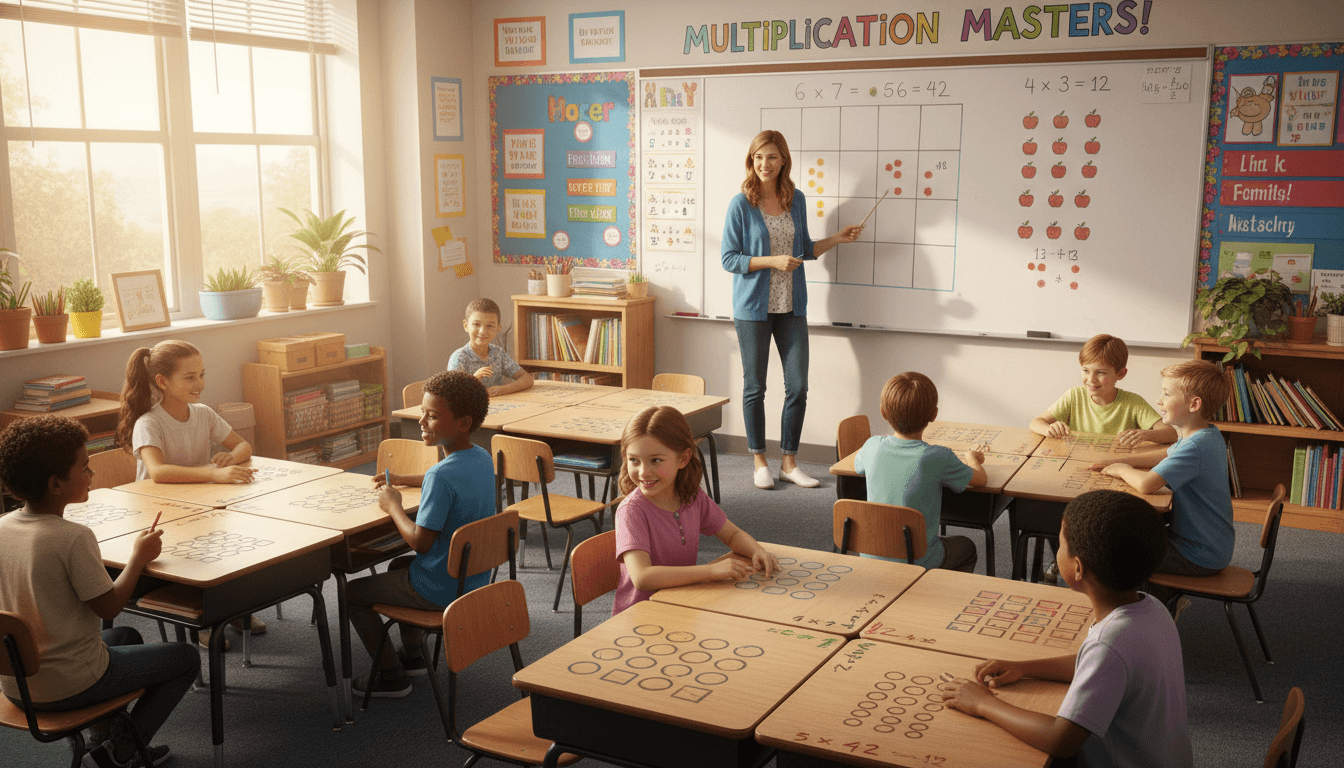
Include a sentence-version of an array drawing. "Think of 4 times 6 as a rectangle that is 4 rows of 6 dots. That is 24 dots. If your kid draws a rectangle on the homework page, they are showing the math, not stalling." Parents who see this once stop asking why the homework has so many drawings.
One home activity that fits in a kitchen
"This week, count things in groups. A carton of eggs is 12. Two cartons is 2 times 12. A pack of 6 pairs of socks is 6 times 2 socks. Ask your child to spot one multiplication problem during dinner prep." Two minutes, real-world arrays, no worksheet.
The heads-up about the timed quiz
Close with the date and a tone-setter. "Quiz on the 24th. It is a five-minute timed quiz on the 3s, 4s, and 6s. If your child is not fluent yet, that is okay. We retake until they get it." That last sentence prevents a Tuesday night meltdown.
How Daystage helps with the multiplication unit newsletter
Daystage saves your multiplication template across the whole unit. The two-phase explainer goes in week one and stays there. The fact fluency tip recycles in week two. The distributive property explainer carries weeks four through eight. You change three lines a week and hit send. Every family on your roster gets the same clean note, formatted for a phone screen, and the multiplication unit stops feeling like a mystery on the parent side.
Get one newsletter idea every week.
Free. For teachers. No spam.
Frequently asked questions
Should I tell parents to drill flash cards every night?
Only in the fact-fluency phase, and even then, five minutes a night, not twenty. Drill works for memorization, but it does not teach the meaning of multiplication. The newsletter should say: short, daily, low-stakes practice. Long flash card sessions create kids who hate math. Five minutes a night for three weeks beats an hour on Sunday.
How is multiplication taught differently today?
There are two phases. First, fact fluency: knowing 6 times 7 is 42 without thinking. Second, the distributive property: understanding that 6 times 7 is the same as 6 times 5 plus 6 times 2. The second phase is where parents get confused. Their kid is doing the right answer with a strategy that looks like extra work. Explain it in the newsletter and the confusion goes away.
What home activity works for a multiplication unit?
Count things in groups. Eggs come in cartons of 12, so two cartons is 2 times 12. A pack of socks is 6 pairs, which is 6 times 2 socks. Have your kid name a multiplication problem they see during dinner prep. It takes two minutes, builds the array picture, and connects the math to real life.
When do kids need to have all their facts memorized?
Most state standards expect fluency with single-digit multiplication by the end of third grade. That gives a kid roughly seven months to get there. Tell parents this in the newsletter so they pace the practice. A kid who panics in October because they do not know their 7s yet is fine. A kid who still does not know them in May needs a different conversation.
How do I track which parents are reinforcing facts at home?
You do not directly, and you should not. What you can do is send a short check-in newsletter every two weeks. Daystage shows you open rates, so you know which families are reading the cadence. The parent who never opens the multiplication newsletter is the parent you call before conferences, not the one you guilt at pickup.

Adi Ackerman
Author
Adi Ackerman is a former classroom teacher and curriculum writer with 8 years in K-8 schools. She writes about school communication, parent engagement, and what actually works in real classrooms.
More for Math Newsletter
Ready to send your first newsletter?
3 newsletters free. No credit card. First one ready in under 5 minutes.
Get started free