

Math Newsletter for a Geometry Unit: Ideas That Help at Home
Geometry is the unit that gives the math newsletter its easiest week of the year. The math is visual, the home activities write themselves (measure a thing), and parents who have been quietly nervous about fractions and decimals suddenly feel competent again. A good math newsletter for a geometry unit takes advantage of all of that. Here is what to include, by grade band, and how to send it without overthinking.
Open with what kind of geometry this is
Geometry covers a lot. Tell parents in the first sentence which slice your unit is. "This unit is about perimeter and area of rectangles." Or, "This unit is about angle measurement and types of triangles." Or, "This unit is about volume of rectangular prisms, which is the math of a moving box." Parents who know the slice stop expecting Pythagoras in third grade.
The fence-and-grass move for area and perimeter
If your unit is perimeter and area, include this sentence verbatim: "Perimeter is the fence around the yard. Area is the grass inside." For a kid in Room 12 trying to find the area of a 6 by 4 rectangle, the picture is a 24-square-foot patch of grass with a 20 foot fence around it. Parents read this once and they have the analogy for life.
One worked example with a real object
Pick something the kid can see in your classroom or their kitchen. "This week your child measured our classroom rug. It is 6 feet by 4 feet. Perimeter: 6 plus 4 plus 6 plus 4 equals 20 feet. Area: 6 times 4 equals 24 square feet. Same rug, two different questions, two different units (feet and square feet)." Parents see why the units are different and the homework starts to make sense.
One home activity with a tape measure
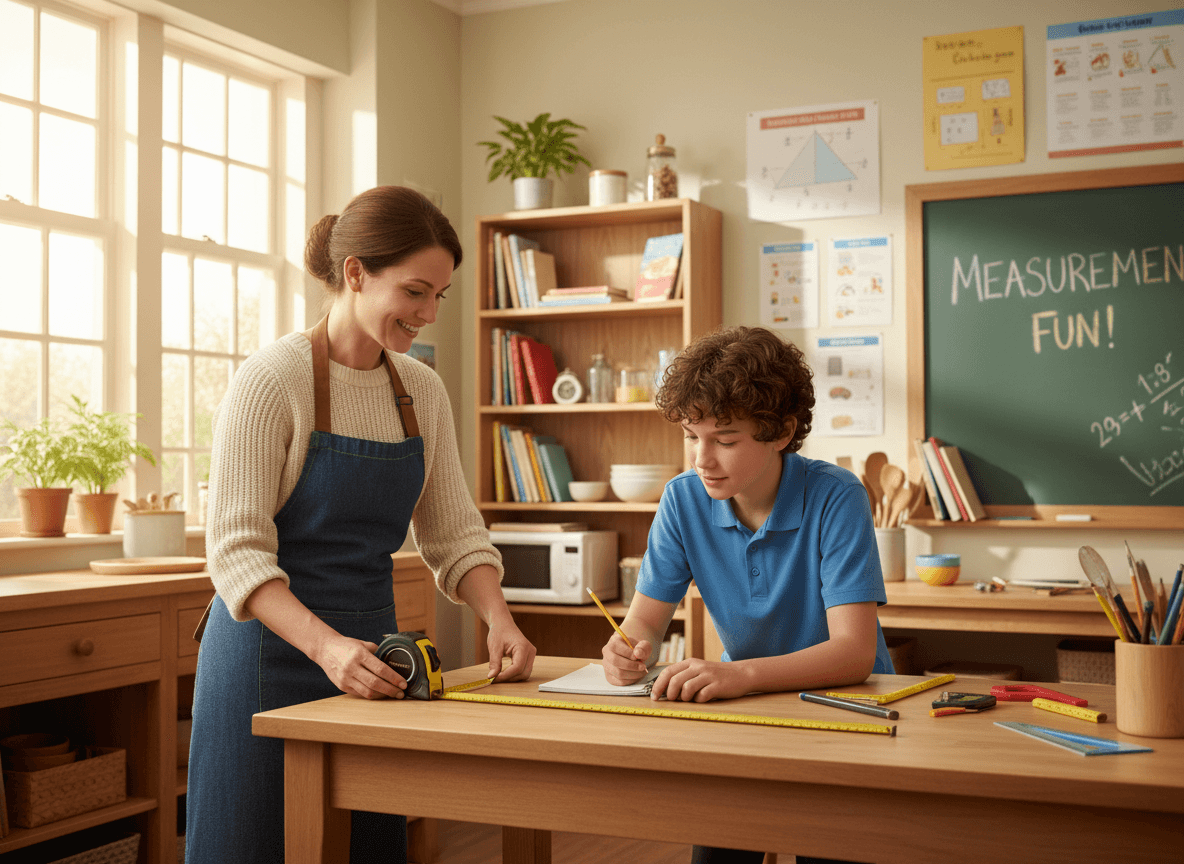
This is the easiest activity prompt of the year. "Tonight, hand your child a tape measure. Pick one thing in the house: a doormat, a picture frame, a couch cushion, a moving box. Have them find the perimeter, the area, or, for volume units, the length times width times height. Real numbers, real object." Five minutes, no printable, kids love it.
Angles and protractors, if that is your unit
If you are in the angle slice of geometry, swap in: "This week we are measuring angles with a protractor. Angles smaller than 90 degrees are acute (like a slice of pizza). Angles equal to 90 degrees are right (like the corner of a book). Angles bigger than 90 are obtuse (like a door that is mostly open)." Three pictures, one paragraph, parents are set.
The heads-up about the quiz
Close with one line. "Quiz on the 28th, covering perimeter and area of rectangles. Review page comes home Wednesday. Bring a ruler." That last word saves you four parent emails about supplies.
How Daystage helps with the geometry unit newsletter
Daystage holds the geometry shell across the whole unit. The fence-and-grass paragraph, the angle types paragraph, the volume paragraph: each one lives in the template and you swap in the relevant slice for the week. The measurement activity stays the same shape (pick a thing, measure it) and the worked example updates. Fifteen minutes a week, every family on your roster, the geometry unit feels approachable from the kitchen table.
Get one newsletter idea every week.
Free. For teachers. No spam.
Frequently asked questions
What does geometry look like by grade level?
In early elementary, geometry is shape recognition and basic properties. In third and fourth grade, the focus shifts to perimeter and area of rectangles. Fifth and sixth grade bring volume and the start of angle measurement. Middle school adds the Pythagorean theorem, surface area, and the area of triangles and circles. The newsletter should say which slice of this your unit is covering so parents know what to expect.
What is the best home activity for a geometry unit?
Measure something in the house. The kitchen table, the doormat, a picture frame, a moving box. Have your kid find the perimeter, the area, or the volume depending on the unit. Real measurement, real numbers, a real reason to use the formula. Five minutes with a tape measure does more than a worksheet because the answer matters to a kid (does the rug fit?).
How do I explain area versus perimeter without confusing parents?
Use the fence-and-grass analogy. 'Perimeter is the fence around the yard. Area is the grass inside.' That sentence works for every grade level. Drop it in the newsletter the week perimeter and area show up together. Parents read it once, remember it forever, and stop mixing up the two when helping with homework.
Should I include geometry vocabulary lists?
No, but weave the vocabulary into sentences. 'This week we are using the words perpendicular (two lines that meet at a right angle, like the corner of a book) and parallel (two lines that never meet, like train tracks).' That kind of inline translation does more than a glossary at the bottom that nobody reads.
How do I keep this short across a long geometry unit?
Use a saved template. Daystage holds the structure across the unit, and you fill in the concept of the week, one example, and one measurement activity. Fifteen minutes on Sunday. The geometry unit is one of the most visual units of the year, which makes it the most fun to write the newsletter for if the format is already set.

Adi Ackerman
Author
Adi Ackerman is a former classroom teacher and curriculum writer with 8 years in K-8 schools. She writes about school communication, parent engagement, and what actually works in real classrooms.
More for Math Newsletter
Ready to send your first newsletter?
3 newsletters free. No credit card. First one ready in under 5 minutes.
Get started free