
Math Newsletter Explaining Illustrative Math: A Template With Sections

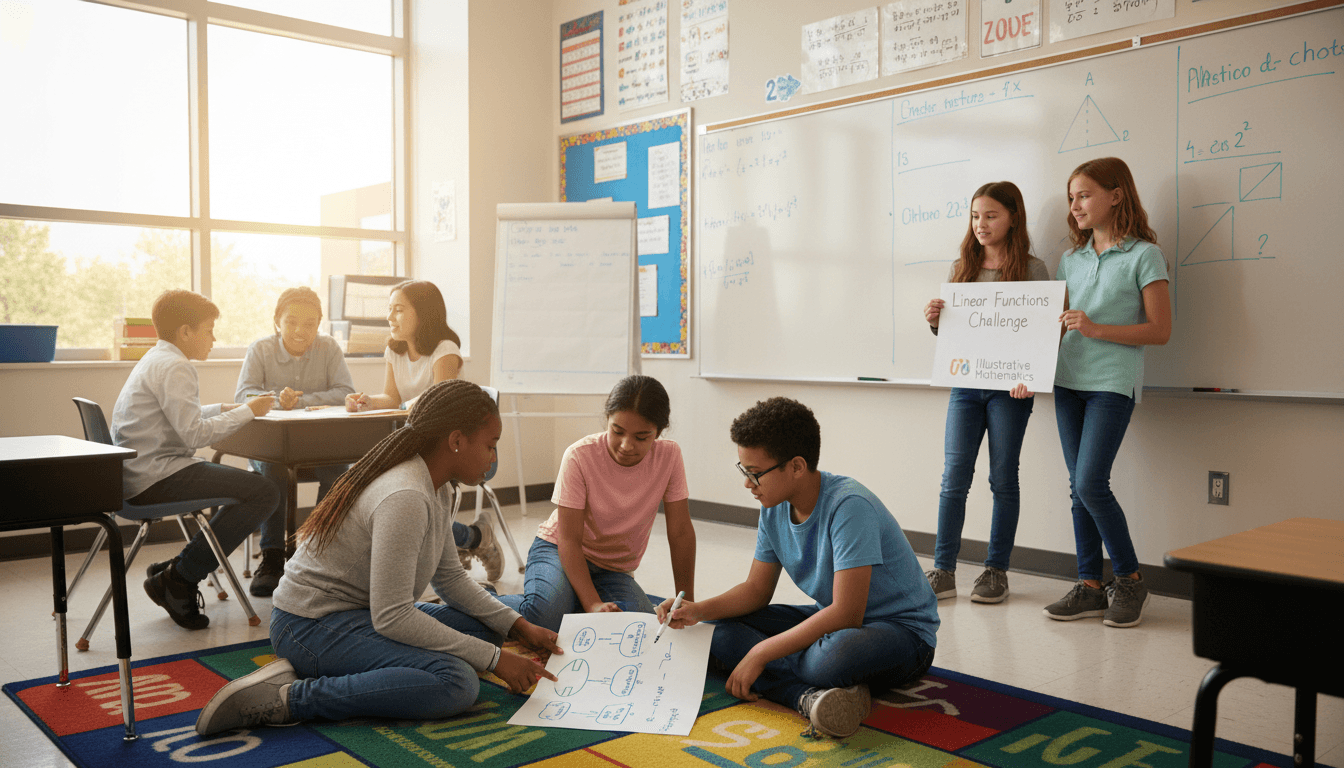
Illustrative Math, also called IM, is the curriculum behind a lot of middle and high school math classrooms now. Parents who walk into the room see kids talking in groups, chart paper on every wall, and almost no textbook. A short newsletter explaining the structure and the strategy makes the whole thing click. Here is what to include.
Define the lesson shape in one paragraph
"Every math lesson has the same three parts. A warm-up that wakes up math thinking, two or three activities where kids work in pairs or small groups, and a cool-down at the end where each student answers a quick check on their own. Your child sees that same rhythm every single day." Parents now have a frame for the question, "what did you do in math today?" They can ask, "which activity?"
Translate the five practices for parents
"The teacher's job during the activity portion is to walk around, watch what students are doing, pick which student work to put up on the board, decide the order to share them, and connect the ideas at the end. Researchers call this the five practices. You do not need the name. You just need to know the loud-looking small group time is structured." That paragraph lands the strategy without needing the textbook reference.
Address the "they just talked" concern
"Your child may come home and say, 'we just talked about math today.' That is the class working as designed. The talking is the thinking. When a student explains their method to a partner, listens to a different method, and revises, that is the learning. Silent practice has its place. It is not the main course in this curriculum." That paragraph saves the teacher 20 emails per semester.
Show parents where the practice problems live
"Each lesson ends with a few practice problems your child can do at home. There are also end-of-section reviews. The volume is lower than older textbooks on purpose. Your child is doing fewer problems, more carefully. If the homework page looks short, that is the design." Parents stop wondering whether their kid is cutting corners.
Give one specific home routine
"At home this week: after dinner, ask your child to teach you one math thing they did today. Five minutes. You are the student. They are the teacher. If they can teach it, they know it. If they cannot, that is the signal to read the lesson summary with them." That is real practice that requires zero math knowledge from the parent.
A working Illustrative Math explainer template
Subject: "How math class works this year (and what to ask at dinner)"
Body:
"Hi families,
Our math class follows the Illustrative Math curriculum. Every lesson has the same three parts: a warm-up, two or three activities in pairs or small groups, and a cool-down quick check at the end.
You will hear your child say things like, 'we talked about a problem in groups today.' That is the design. The discussion is the learning.
Practice problems live at the end of each lesson. The volume is lower than older books on purpose.
Try this at dinner once this week: ask your child to teach you one math thing from today. Five minutes. They are the teacher.
Reply with questions. Ms. K."
One concrete example: the kid who taught his dad
Last spring a seventh grade dad emailed me to say his son had spent 12 minutes teaching him about slope at the dinner table. The kid drew two points on a napkin, calculated the rise and run, and then quizzed his dad on a second pair of points. The dad wrote, "I learned more math from him than he learned from me." That is the curriculum doing its job. The newsletter is what gave the dad permission to ask the question in the first place.
How Daystage helps with an Illustrative Math explainer newsletter
Daystage lets you build the curriculum explainer as a once-per-year send, separate from the weekly note. Schedule it for the first week of school, then again for the start of second semester for new families. The shell stays clean, the structure stays the same, and parents who only read one math email all year still get the one that matters most.
Get one newsletter idea every week.
Free. For teachers. No spam.
Frequently asked questions
What is the warm-up activities cool-down structure?
Every Illustrative Math lesson has the same shape. A short warm-up to wake up math thinking. Two or three activities where kids work on problems together. A cool-down at the end, which is a quick check the teacher uses to see who got it. Your child sees that rhythm every day. Naming it for parents makes the class feel less mysterious.
What are the five practices and why do parents need to know about them?
The five practices are the moves a teacher makes during an Illustrative Math lesson. Anticipate, monitor, select, sequence, connect. In plain English, the teacher plans the discussion before class, watches what kids do, picks which student work to highlight, decides the order, then connects the ideas. Parents do not need to memorize them. They just need to know that the loud-looking conversation in math class is on purpose.
Why is there so much talking in Illustrative Math class?
Because the curriculum is built around mathematical discussion, not silent practice. Your child is expected to explain their thinking out loud, listen to a classmate, and revise. The talk is the learning. If your child says, 'we just talked about math today,' that is the class working as designed, not a missed lesson.
Where is the homework in Illustrative Math?
Illustrative Math has practice problems at the end of each lesson and end-of-section reviews. The volume is lower than older curricula on purpose. Your child should be solving fewer problems, more carefully, with attention to method. Quality of thinking over quantity of pages.
How often should a teacher send Illustrative Math updates?
Once per unit, plus a single explainer at the start of the year. That is enough. Daystage lets you save the structure-explainer separately from the weekly newsletter so parents who want the deep dive can find it, and weekly readers keep getting the short version.

Adi Ackerman
Author
Adi Ackerman is a former classroom teacher and curriculum writer with 8 years in K-8 schools. She writes about school communication, parent engagement, and what actually works in real classrooms.
More for Math Newsletter
Ready to send your first newsletter?
3 newsletters free. No credit card. First one ready in under 5 minutes.
Get started free