

Teacher Newsletter for AP World History Units: Communicating Global Thinking to Families
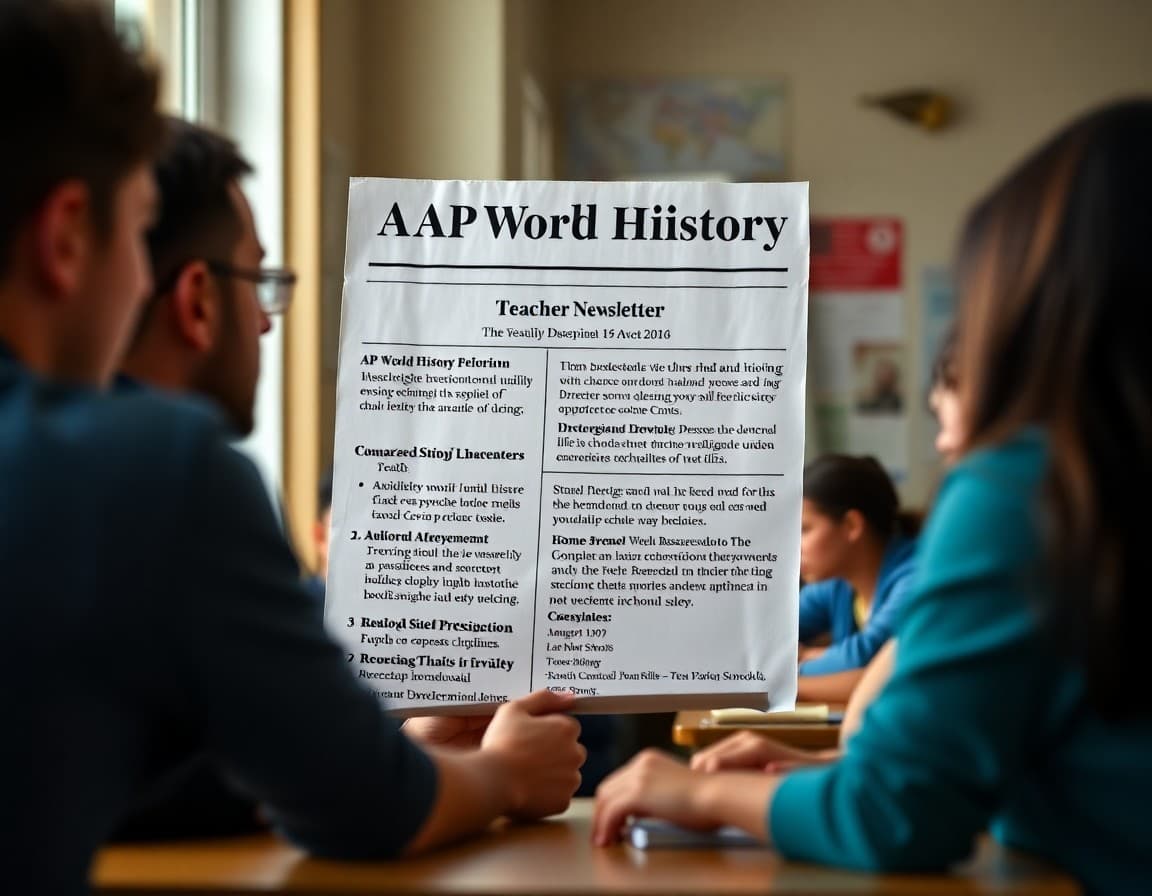
AP World History as a Skills Course
AP World History is structured around historical thinking skills that students apply to global content spanning eight centuries. Students do not simply memorize the events of world history; they analyze causes, compare developments across regions, trace continuity and change over time, and argue from evidence. A newsletter that frames the course as a skills course rather than a content survey helps families understand why analysis matters as much as knowledge.
The Current Unit: Period, Region, and Key Developments
Each unit newsletter should name the historical period, the geographic regions in focus, and the three to five major developments that students are analyzing. Connecting those developments to something visible in today's world, a current trade relationship, a border whose origins trace to the period, or a conflict with historical roots, makes the content feel connected to real consequences.
The Document-Based Question and Why Students Practice It All Year
The DBQ is the most demanding writing task in AP World History. Students receive seven documents covering a historical question and must write a full essay that contextualizes the question, uses at least six documents as evidence, incorporates outside knowledge the documents do not provide, and demonstrates historical thinking skills throughout. This takes sustained practice. Students who write their first DBQ under exam conditions in May will not perform as well as those who have practiced regularly across the year.
Geographic Breadth and Why It Matters
AP World History requires students to engage with civilizations, states, and developments across Africa, Asia, Europe, the Americas, and Oceania. Students who default to the European-centric framework of many earlier courses need to deliberately expand their geographic range. A newsletter that names the regions in focus each unit helps students and families track the breadth of coverage.
Comparison and Continuity-Change Essays
The long-essay question asks students to compare developments across time periods or regions or to trace patterns of continuity and change. Students who practice structuring comparison arguments throughout the year arrive at the exam ready to write an organized, evidence-based essay rather than a list of similarities and differences. Your newsletter should note when comparison or continuity-change is the analytical focus of the unit.
Short-Answer Questions and Conciseness
The three short-answer questions on the AP World History exam require precise, evidence-based responses in three to four sentences. Students who write long general answers lose time without gaining points. Practicing concise, specific historical argument is a skill that takes development. Let families know when short-answer practice is a major class activity so they can encourage their student to seek feedback on their responses.
Communicating With Families Through Daystage
AP World History moves through significant global content quickly. Daystage makes it easy to send a unit newsletter at each new period so families stay oriented and can support their student with context rather than simply asking if homework is done.
Get one newsletter idea every week.
Free. For teachers. No spam.
Frequently asked questions
What should an AP World History unit newsletter explain to families?
An AP World History unit newsletter should explain the historical period and geographic scope in focus, the key developments and processes students are analyzing, which historical thinking skills the unit develops, and how the unit connects to the exam essay types. Families who understand the global scope of the course can support their student differently than those who expect a course focused on American or European history.
What time periods does AP World History cover?
AP World History: Modern covers three broad periods: from approximately 1200 to 1750, from 1750 to 1900, and from 1900 to the present. Students analyze major global developments across these periods using the six historical thinking skills. The modern focus means the course emphasizes trade networks, state formation, industrial and colonial change, and twentieth-century global conflicts.
What are the AP World History essay types?
AP World History includes three essay types: a document-based question (seven documents, 60-minute essay), a long-essay question (one of three comparative or continuity-and-change-over-time prompts), and three short-answer questions. Students must use historical thinking skills in all essay types, not just state facts.
How can families support AP World History students with the reading load?
AP World History reading is dense and covers unfamiliar regions and cultures for many students. Families can support by asking students to explain what region or period they are studying and one thing they found surprising or interesting. Connecting world history content to current global events when possible helps students see the historical context behind news they encounter.
What tool helps AP teachers send newsletters efficiently?
Daystage is built for school communication. AP World History teachers use it to send formatted newsletters with unit overviews, historical thinking skills explained, and exam preparation notes directly to parent email lists.

Adi Ackerman
Author
Adi Ackerman is a former classroom teacher and curriculum writer with 8 years in K-8 schools. She writes about school communication, parent engagement, and what actually works in real classrooms.
More for High School
Teacher Newsletter for AP US History Units: Keeping Families Informed All Year
High School · 6 min read
Teacher Newsletter for AP European History Units: What Families Need to Know
High School · 6 min read
Teacher Newsletter for AP History Units: Communicating Skills and Content to Families
High School · 6 min read
Ready to send your first newsletter?
3 newsletters free. No credit card. First one ready in under 5 minutes.
Get started free