

Teacher Newsletter for ACT Prep Programs: Helping Families Understand Test Preparation
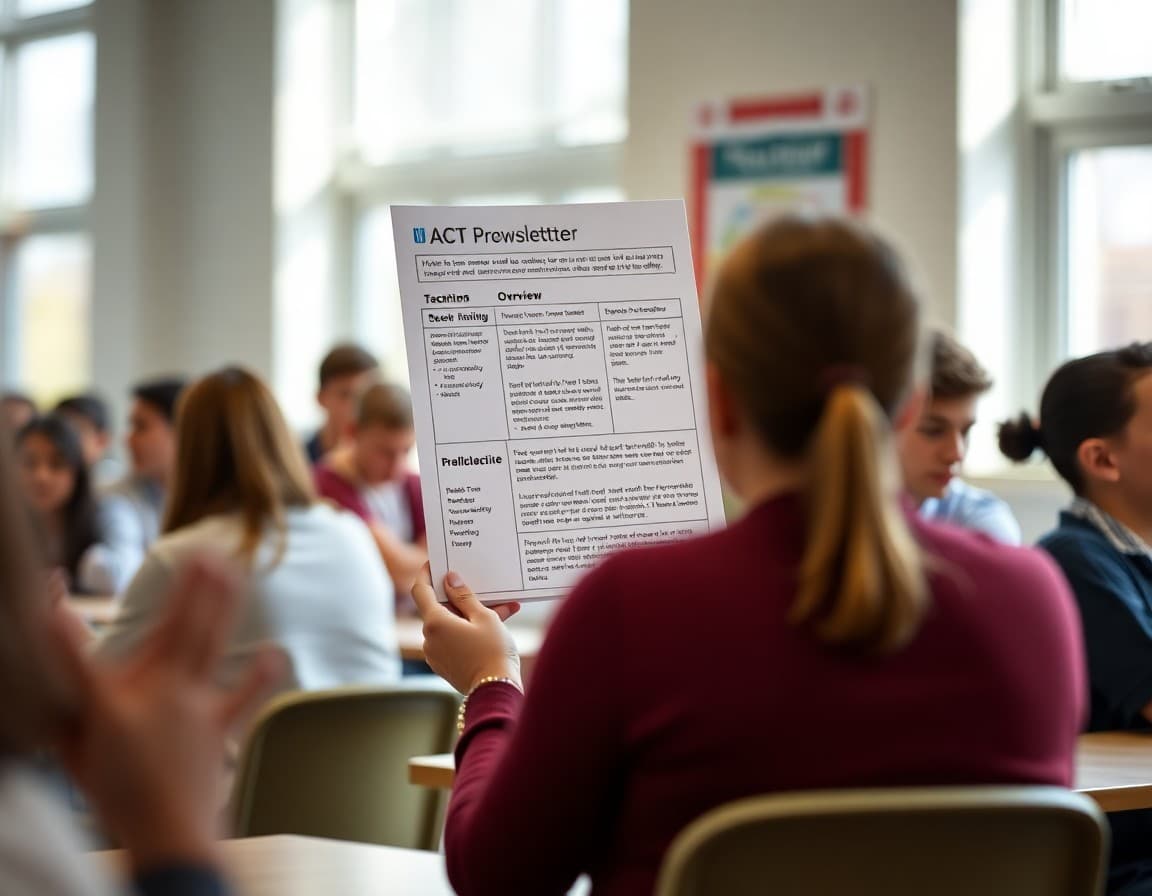
Understanding the ACT Before Preparing for It
Many families hear "standardized test" and assume preparation for the SAT and ACT is interchangeable. It is not. The ACT has a distinct format, a different pacing challenge, and a Science section that tests reasoning from data rather than science content knowledge. Students who approach ACT preparation without understanding these distinctions spend time preparing for the wrong things. Your newsletter can correct this before it affects how families talk about and support their student's preparation.
The ACT Format: What Students Are Working With
The ACT has four sections, each with a fixed number of questions and a strict time limit. The English section tests grammar and editing in the context of passages. The Math section covers algebra, geometry, and some pre-calculus content. The Reading section tests comprehension and inference. The Science section presents data from experiments and asks students to interpret and compare it. The composite score averages the four section scores on a 1-36 scale.
The Science Section: The Most Commonly Misunderstood Section
Students often approach ACT Science as if it requires memorized science content. It does not. The Science section presents graphs, tables, and experimental descriptions and asks students to read and reason about data. Students who practice reading and interpreting scientific data quickly, regardless of the specific science topic presented, consistently outperform those who review biology and chemistry facts in preparation. Your newsletter should name this distinction clearly because it changes how students prepare.
Pacing: The ACT's Biggest Challenge
The ACT is known for tight time constraints, particularly in the Reading and Science sections. Students who cannot answer efficiently under time pressure will leave questions unanswered regardless of their knowledge. Full-length timed practice is essential for developing the pacing students need. Families who encourage practice sessions with strict time limits help their student build the speed the test requires.
Score Goals and Composite Score Strategy
The ACT composite score is the average of four section scores. Students who have a significantly stronger section, such as a high English score and a weaker Math score, have a different preparation priority than students who are equally strong across sections. A newsletter that explains how the composite is calculated helps families understand why section-specific preparation often matters more than overall review.
SAT vs. ACT: Helping Students Choose
Most colleges accept both tests equally. Students who have not taken both should take one official practice test for each to identify which format fits their skills better. A newsletter that explains how to compare percentile scores from each test, rather than raw scores, gives families the tool to have that conversation productively with their student.
Consistent Updates Through Daystage
High school teachers and counselors who use Daystage for ACT prep newsletters ensure that families receive accurate, timely information throughout the preparation process. Regular updates on test dates, practice test schedules, and score goal guidance reduce the anxiety that comes from family uncertainty about a process they have not navigated before.
Get one newsletter idea every week.
Free. For teachers. No spam.
Frequently asked questions
What should an ACT prep newsletter explain to families?
An ACT prep newsletter should explain how the ACT differs from the SAT, what the four sections cover and how they are scored, what the composite score means, how practice tests should be used, and what families can do to support consistent preparation without generating counterproductive anxiety.
How is the ACT different from the SAT?
The ACT has four sections: English (75 questions, 45 minutes), Mathematics (60 questions, 60 minutes), Reading (40 questions, 35 minutes), and Science (40 questions, 35 minutes). It scores on a 36-point scale and does not adapt between sections. The Science section, which tests data interpretation and reasoning rather than science content knowledge, often surprises students. The ACT is generally considered more curriculum-based than the SAT.
When should students take the ACT?
Most students take the ACT for the first time in spring of junior year, with the option to retake in fall of senior year. Students who have completed Pre-Calculus or higher are better prepared for the ACT Math section. Taking the test before junior year is possible but rarely optimal because coursework that the test measures is still in progress.
Should a student take the SAT or ACT?
Students who are strong in science reasoning and prefer a consistent-format test often score better on the ACT. Students who prefer a shorter test and find adaptive formats comfortable often prefer the SAT. Taking one official practice test for each and comparing the resulting score percentiles is the most reliable way to identify which test a student should emphasize.
What tool helps teachers send newsletters efficiently?
Daystage is built for school communication. High school teachers use it to send formatted newsletters with ACT prep schedules, section tips, and test date reminders directly to parent email lists.

Adi Ackerman
Author
Adi Ackerman is a former classroom teacher and curriculum writer with 8 years in K-8 schools. She writes about school communication, parent engagement, and what actually works in real classrooms.
More for High School
Teacher Newsletter for SAT Prep Programs: What Families Need to Know About Test Preparation
High School · 6 min read
Teacher Newsletter for PSAT Preparation: Helping Families Understand the National Merit Connection
High School · 6 min read
Teacher Newsletter for College Application Timelines: Keeping Senior Families on Track
High School · 6 min read
Ready to send your first newsletter?
3 newsletters free. No credit card. First one ready in under 5 minutes.
Get started free