

9th Grade Homework Policy Newsletter: Setting Clear Expectations for Freshman Parents
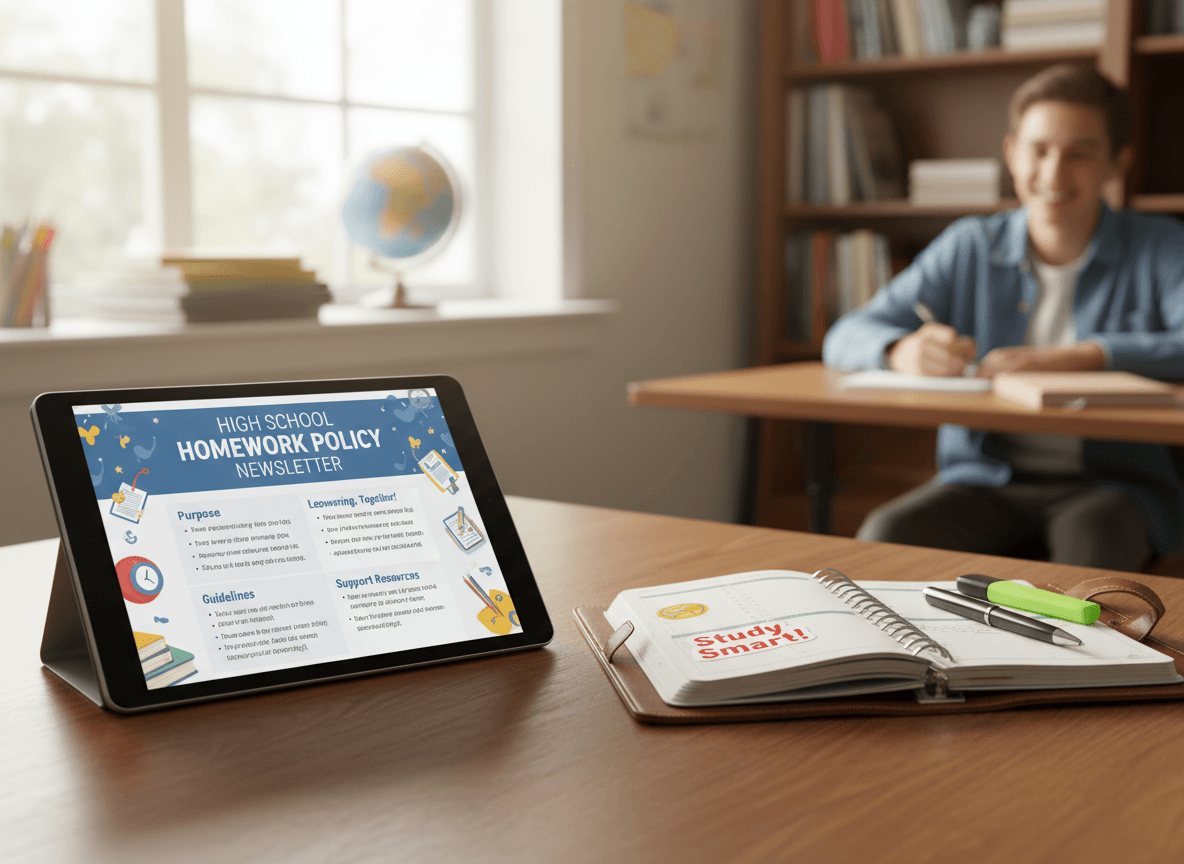
Homework is one of the most contested topics in education, and freshman parents have strong opinions about it. Some worry their student is not doing enough. Others are watching their 14-year-old work until midnight and wondering if that is normal. A clear, proactive homework policy newsletter helps parents calibrate their expectations, understand your policies before problems arise, and know how to support their student without crossing the line into doing the work for them.
Why Homework Communication Matters More in 9th Grade
The jump from 8th to 9th grade homework expectations is real. Middle school homework was often shorter, more structured, and more scaffolded. High school homework requires more independent thinking, more reading, and more time managing multi-step projects. Students who managed middle school homework with minimal effort sometimes hit a wall in freshman year when the workload actually requires consistent effort.
Parents are often the first to notice when something is off, but they do not always know what "off" looks like in 9th grade versus 8th grade. A newsletter that sets baseline expectations for your class lets parents calibrate. If their student says they never have homework and you assigned reading every night, that is a conversation starter. If their student is spending four hours on work you expected to take forty-five minutes, that is information worth acting on.
Setting Honest Expectations for Homework Volume
Tell parents how much homework your class typically assigns per night, per week, and what heavier periods look like. Be specific. "Students should expect approximately 25 to 35 minutes of English homework on most nights, with longer assignments during essay weeks or before major tests" is far more useful than "students will have homework regularly."
Also flag predictable heavy periods in advance. If the first major essay is due in mid-October and you know that week tends to be stressful, mention it now. Parents who know a heavy week is coming can plan around it, encourage their student to start early, and create space at home for focused work time. The parents who email you in a panic during that week are usually the ones who had no warning.
Explaining Your Late Work Policy Clearly
Late work policies are one of the most common sources of parent-teacher conflict in high school. The conflict almost always comes from a policy that was never communicated clearly in writing. Your newsletter is the fix for that.
State your policy exactly as it works. Does late work lose points per day? Is there a hard cutoff? Are there exceptions for documented absences? What is the process for requesting an extension? Write it out plainly and specifically. Then briefly explain your reasoning. A policy that comes with a rationale feels fair even when parents disagree with it. A policy that arrives with no explanation feels arbitrary, and parents push back on arbitrary policies.
If your school has a district-wide late work policy, reference it and then clarify how you apply it in your specific class. Parents who receive three different late work policies from three different teachers will be confused regardless, but at least they will understand yours.
Digital Submission Versus Paper: Setting Clear Expectations
Most 9th grade classes now use some form of digital submission, but the platforms vary, and parents often do not know which platform their student is using for which class. Your newsletter should name the platform, explain what a submitted assignment looks like, and describe what happens if a student submits to the wrong place.
A line like "All assignments for this class are submitted through Google Classroom. An assignment is only considered turned in once it appears as 'Turned In' in the student's Google Classroom portal. Sending an email attachment is not a substitute for a Classroom submission" removes ambiguity completely. If you also have paper submissions for certain assignments, describe those separately and make clear which applies when.
Tell parents whether they can monitor their student's submissions through the platform. Many LMS tools have parent portal views. If yours does, include a brief note on how to set it up. Parents who can see what is submitted (and what is not) require fewer status-update emails from you.
How to Communicate Missing Homework Without Creating Drama
Describe your system for handling missing assignments proactively. Do you contact parents when an assignment is not submitted? At what threshold? Some teachers email after every missing assignment. Others wait until a pattern develops. Either approach is defensible, but parents should know which one to expect.
If you use a gradebook that parents can access in real time, mention that and encourage parents to check it regularly rather than waiting for you to flag a problem. A parent who checks the gradebook and sees two missing assignments can have a productive conversation with their student that evening. A parent who did not know about two missing assignments for two weeks is starting from a much harder position.
How Parents Can Support Homework Without Doing the Work
This section matters enormously and rarely appears in homework policy newsletters. Parents of high schoolers often do not know what helpful involvement looks like. They either do too much or disengage entirely because they do not want to interfere.
Practical at-home support that does not cross the line: asking their student what assignment they are working on and what the goal of it is, asking their student what they have done so far and what they are still figuring out, providing a quiet workspace and a consistent homework time, and checking in after the student says they are done by asking one question about what they learned rather than reviewing the work itself.
What does not help: explaining concepts that the teacher should be explaining (this creates dependency and sometimes contradicts what was taught in class), checking or correcting work before submission, or accepting "I did it at school" or "I don't have any" without a quick look at the LMS to verify.
Communicating About Homework During the Year, Not Just at the Start
A homework policy newsletter sent in September is valuable. But homework communication should not stop there. When you are about to assign something unusually demanding, a brief heads-up in your regular newsletter is worth sending. If you notice a pattern of incomplete homework across the class, a short note to parents about what you are seeing and what you would like their help with is more effective than individual parent contacts for every student.
Mid-year homework check-ins also give you a chance to acknowledge students who are consistently turning work in on time. Positive notes to parents carry weight, and they take less than two minutes to include in a newsletter update. Parents who only hear from you about problems will dread your newsletters. Parents who also hear about wins will look forward to them.
Get one newsletter idea every week.
Free. For teachers. No spam.
Frequently asked questions
How much homework is typical for 9th graders each night?
Most educational researchers recommend no more than 10 minutes of homework per grade level per night as a general guideline, which puts 9th grade at roughly 90 minutes total across all subjects. In practice, that varies widely by subject and teacher. A typical 9th grade night might include 20 to 30 minutes of reading for English, 20 minutes of math practice, and a bit of studying for an upcoming quiz. Heavy project weeks can push that higher. Telling parents an honest range for your specific class helps them understand whether their student's workload is normal or a sign of something that needs attention.
How should I communicate my late work policy in a way parents will actually remember?
State your policy in one clear sentence, then explain the reasoning in the next. For example: 'Assignments submitted after the due date receive a 10% deduction per day up to three days, after which the assignment earns a zero.' Then explain: 'This policy reflects real-world expectations while still giving students a chance to catch up when life happens.' Parents remember policies that have a reason attached to them, not just rules that feel arbitrary. If your school has a district-wide late work policy, reference that policy and clarify how your class applies it.
Should 9th grade homework be submitted digitally or on paper?
That depends on your class and your school's infrastructure, but whatever you decide, communicate it clearly to parents. If you use Google Classroom, Canvas, or another platform, tell parents the name of the platform, that their student has or will receive login credentials, and that submissions there are the official record. If paper submissions are required, describe where and how. If late paper submissions are a problem, a digital backup policy (submit a photo if the original is missing) can reduce friction and is worth mentioning. Inconsistency between digital and paper expectations is a common source of confusion that a clear newsletter paragraph can prevent.
How can parents support homework completion without doing the work for their student?
This is one of the most common questions parents of 9th graders ask, and your newsletter is a great place to address it. Useful support looks like: asking their student to explain what they are working on rather than explaining it themselves, helping their student identify what they understand versus what they are stuck on, and then encouraging them to ask the teacher for help rather than getting the parent to solve it. Logistical support matters too: a consistent study time, a quiet workspace, and making sure the student has eaten and is not exhausted before sitting down to homework. What does not help: doing any part of the assignment, or accepting 'I don't have any homework' without checking the LMS.
What newsletter platform makes it easy to keep freshman parents informed about homework expectations all year?
Daystage is designed for exactly this kind of ongoing parent communication. You can send a homework policy newsletter at the start of the year, then follow up with homework-related updates mid-semester when patterns emerge. The platform is easy to format, mobile-friendly, and lets you include links to your class LMS, assignment calendars, or tutoring resources. Many high school teachers use Daystage to communicate homework policy changes, upcoming heavy assignment weeks, and resources for students who are falling behind, all in one place that parents can reference throughout the year.

Adi Ackerman
Author
Adi Ackerman is a former classroom teacher and curriculum writer with 8 years in K-8 schools. She writes about school communication, parent engagement, and what actually works in real classrooms.
More for High School
Ready to send your first newsletter?
3 newsletters free. No credit card. First one ready in under 5 minutes.
Get started free