
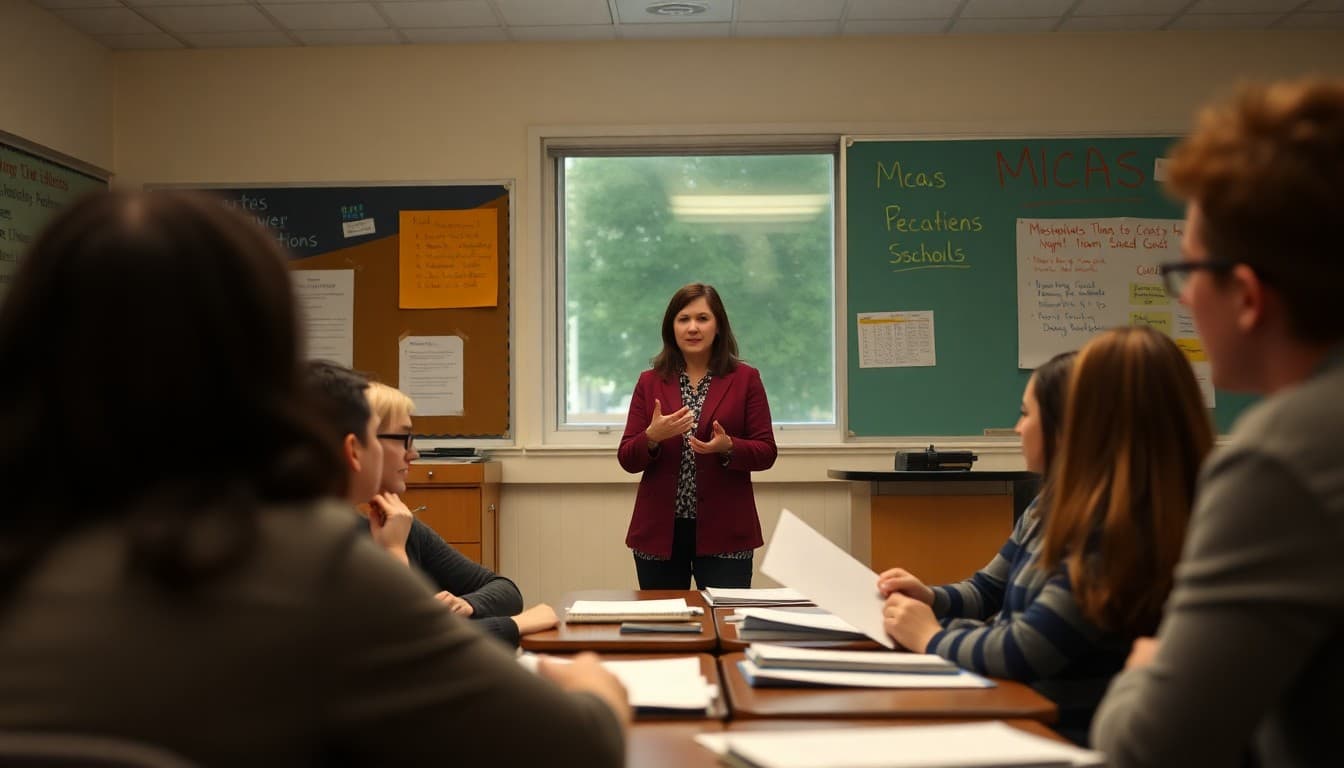
Massachusetts High School Parent Communication Guide for Teachers

Massachusetts has some of the highest academic standards in the country, and the MCAS graduation requirement is the centerpiece of that accountability system. A student who does not pass the grade 10 MCAS in ELA and math cannot receive a Massachusetts high school diploma, regardless of their grades. That is a high-stakes fact that every Massachusetts parent needs to understand, and every Massachusetts teacher has an obligation to communicate clearly.
Explain the MCAS Graduation Requirement Without Alarm
The grade 10 MCAS in ELA and math is a graduation requirement in Massachusetts. Students who do not pass the first time have multiple opportunities to retake the assessment, and the state provides extensive support for students who are not yet meeting the standard. Tell parents when the 10th grade MCAS is administered, what the passing standard requires, and what happens next if their student does not pass initially. Explain that most students pass with adequate preparation, that retake opportunities exist, and that additional support resources are available through the school. Calm, factual communication is far more useful than either minimizing the stakes or creating unnecessary anxiety.
Communicate the Adams Scholarship Threshold Strategically
The Adams Scholarship provides free tuition at Massachusetts public colleges for students who score in the top 25 percent in ELA and math on 10th grade MCAS. This is a meaningful financial benefit, and many Massachusetts families do not know it exists until after the test has already happened. Put the Adams Scholarship in your newsletter before the 10th grade MCAS. Tell families what the qualifying score ranges are and that aiming for the top quartile can reduce college costs substantially. A student who knows about Adams Scholarship before the test has motivation that a student who does not know about it lacks.
Address the High Expectations of Massachusetts Suburban Communities
Suburban Massachusetts communities have some of the most engaged and demanding parent populations in the country. Parents in districts like Lexington, Needham, Westborough, and Newton expect substantive, detailed communication from teachers. Your newsletter should match that expectation. Cover the specific standards your course addresses, how assessments connect to AP or college admission criteria, and what distinguishes strong performance in your course. Vague or generic newsletters in these communities reduce trust; specific, rigorous communication builds it.
Reach Boston and Urban Massachusetts Families
Boston Public Schools, Springfield, Worcester, and Lowell serve highly diverse urban populations where many families have limited English proficiency. For teachers in these districts, bilingual newsletters or translated key points significantly expand effective reach. The achievement gap between suburban and urban Massachusetts is one of the most documented in the country, and teachers who communicate proactively with urban families provide something that the broader system often does not: individual attention and specific, actionable information.
Make Dual Enrollment and Community College Access Visible
Massachusetts has strong community colleges and state universities, and dual enrollment programs allow high school students to earn college credits before graduation. For families in lower-income communities where the cost of attending a four-year university is a barrier, dual enrollment through a Massachusetts community college is a practical path to credential attainment. Put dual enrollment information in your newsletter during course selection season. Tell families how credits transfer to UMass, Framingham State, or other Massachusetts public institutions.
A Sample Massachusetts High School Newsletter Section
Here is what an MCAS-aware section looks like:
"A reminder for 10th grade families: the grade 10 MCAS ELA assessment is scheduled for March 23 and 24. Passing the 10th grade MCAS is a Massachusetts graduation requirement. Students who score in the top 25 percent in both ELA and math may qualify for the Adams Scholarship, which provides free tuition at Massachusetts public colleges. We are practicing MCAS-style evidence-based writing throughout this semester. I will send a specific preparation update in February."
Connect to Massachusetts' History and Academic Culture
Massachusetts has an unusually rich academic and historical context. Teachers who connect their curriculum to Massachusetts's intellectual heritage, from the American Revolution to the abolitionist movement to the innovation economy of Route 128 and Cambridge, give students and parents a local frame for content that might otherwise feel abstract. A history teacher connecting to the Lowell mill system, a science teacher referencing MIT or the Broad Institute, and an economics teacher using the Massachusetts healthcare system as a case study all make the content feel grounded in a place families recognize.
Send Consistently With Daystage
Massachusetts families expect consistent, professional communication from teachers. Daystage gives Massachusetts teachers a fast way to meet that expectation without spending an hour formatting emails. You write your content, add your key dates, and deliver to all families at once. For teachers in both high-expectation suburban districts and under-resourced urban schools, consistent communication is what builds the parent relationships that support student success over time.
Get one newsletter idea every week.
Free. For teachers. No spam.
Frequently asked questions
What should Massachusetts high school teachers prioritize in parent communication?
MCAS (Massachusetts Comprehensive Assessment System) is a graduation requirement in Massachusetts, and students must pass the grade 10 MCAS in ELA and math to receive a high school diploma. Teachers should communicate the MCAS schedule, what the passing standard requires, and what happens if a student does not pass on the first attempt. The Adams Scholarship, which provides free tuition at Massachusetts public colleges for students who score in the top 25 percent on MCAS, is also worth communicating specifically because it can be a significant financial benefit.
What is the Adams Scholarship and why should Massachusetts teachers communicate about it?
The John and Abigail Adams Scholarship awards free tuition (not room and board) at Massachusetts state universities and community colleges to students who score in the top 25 percent in ELA and math on 10th grade MCAS. Many Massachusetts families, particularly lower-income families, do not know this scholarship exists. A teacher who communicates the Adams Scholarship threshold before the 10th grade MCAS gives students time to aim for the qualifying score.
How do Massachusetts teachers communicate with diverse urban families?
Boston, Springfield, Worcester, and other Massachusetts cities have highly diverse populations with significant Spanish, Vietnamese, Cape Verdean Creole, Haitian Creole, Chinese, and Somali-speaking communities. Teachers in these cities who provide bilingual communication or who coordinate with school interpreters reach families who might otherwise miss critical information. Boston Public Schools and other urban Massachusetts districts often have translation resources available.
What graduation requirements beyond MCAS should Massachusetts teachers explain?
Massachusetts districts set their own credit requirements beyond the state MCAS mandate. Many districts require specific course sequences, capstone projects, and community service hours. Teachers should communicate which courses count toward graduation requirements, what the timeline looks like, and what support exists for students who are not on track. Early communication prevents the senior-year crisis that results from discovering a missing requirement too late.
What tool helps Massachusetts high school teachers send newsletters to their communities?
Daystage is a teacher-focused newsletter platform that delivers professional, readable results quickly. For Massachusetts teachers who need to reach both engaged suburban parents and harder-to-reach urban families, a reliable digital communication tool that works on any device is the practical choice.

Adi Ackerman
Author
Adi Ackerman is a former classroom teacher and curriculum writer with 8 years in K-8 schools. She writes about school communication, parent engagement, and what actually works in real classrooms.
More for High School
Ready to send your first newsletter?
3 newsletters free. No credit card. First one ready in under 5 minutes.
Get started free