

Hawaii High School Newsletter Guide for Teachers
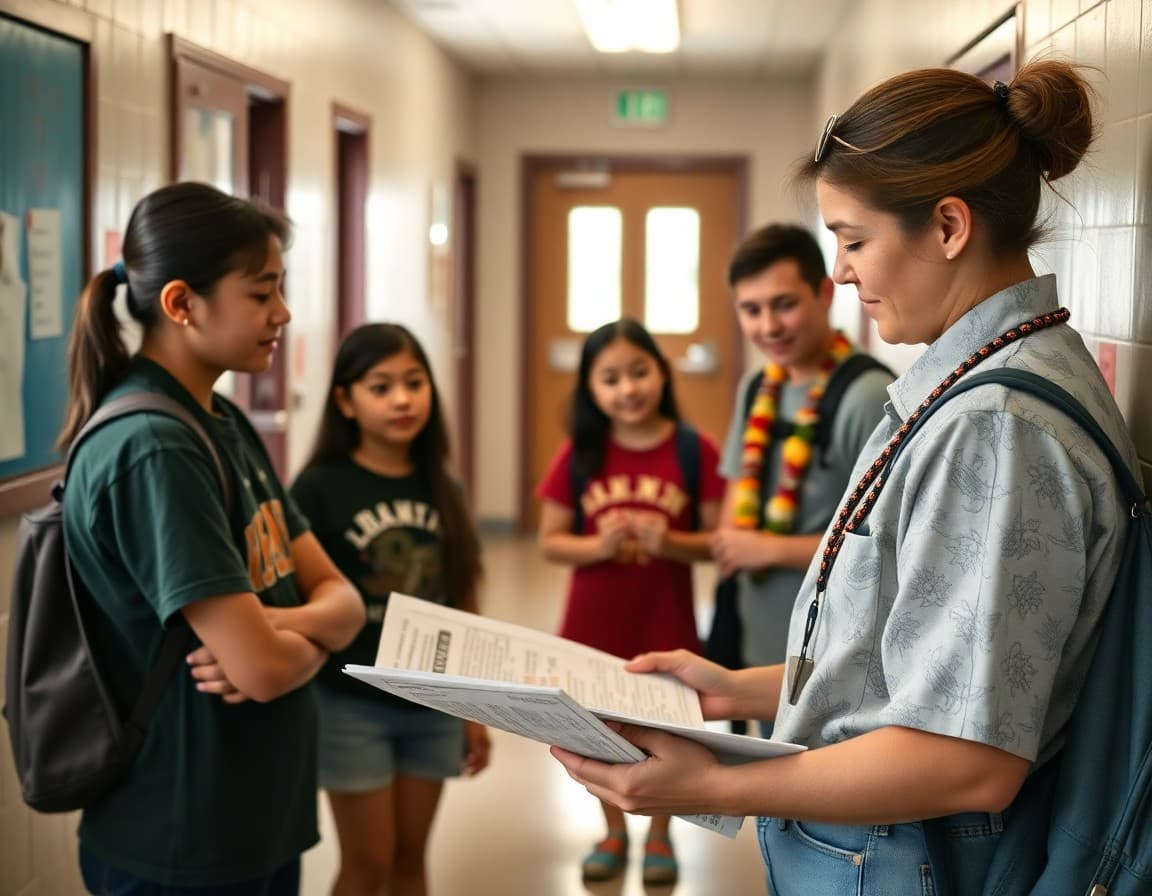
Hawaii high school families deal with the same engagement drop-off that happens everywhere in grades 9-12. Students are more independent, assignments are harder to track from home, and the school feels less personal. For Hawaii teachers, an additional layer is the state's unique DOE structure -- there is no county-level school board, which means communication expectations come directly from the statewide DOE. A well-structured monthly newsletter gives families the access to information they need without requiring students to be the primary conduit.
Hawaii DOE Graduation Requirements: What Families Need to Know Early
Hawaii requires 24 credits for high school graduation, and the specific credit distribution is more complex than many families realize. Four math credits are required, with the expectation of Algebra II or higher for students on a college preparatory track. Three science credits, including physical science or chemistry. Social studies credits that include world history, U.S. history, Hawaii history, and government. One PE credit and a health requirement. Fine arts or CTE. These requirements sound straightforward, but many families discover credit gaps in senior year because nobody laid out the four-year roadmap in 9th grade. Your September newsletter for freshmen should include a credit accumulation checklist families can use throughout high school.
University of Hawaii System: The Local College Pathway
The University of Hawaii system is the primary post-secondary pathway for most Hawaii high school graduates. UH Manoa, UH Hilo, UH West Oahu, and the seven community colleges serve different student populations and have different admission requirements. Your newsletter should address the UH system's requirements by junior year: SAT/ACT scores or test-optional pathways, GPA requirements for UH Manoa's most competitive programs, and the Hawaii Opportunity Program in Education (HOPE) scholarship available to Hawaii residents. Many families assume their student will attend UH Manoa but are surprised by the selectivity of programs like the John A. Burns School of Medicine or the College of Engineering.
Hawaii CTE Pathways: Communicating the Value to Families
Hawaii's Career and Technical Education programs are among the more developed in the Pacific region, with pathways in health sciences, information technology, agricultural and natural resources, and hospitality and tourism (significant in Hawaii's economy). Many families view CTE as a fallback option rather than a deliberate pathway. Your newsletter can change that perception by including a monthly spotlight on what CTE pathway students are learning and where those pathways lead. A CTE student on the health sciences track who earns CNA certification before graduation has a direct employment pathway -- that is worth two sentences in your newsletter.
Dual Enrollment Through UH Community Colleges
Hawaii's dual enrollment program allows eligible high school students to take University of Hawaii Community College courses for free, earning both high school and college credit simultaneously. The program is underused partly because families do not know about it. A fall newsletter section covering the basics -- who is eligible (typically 11th and 12th graders with qualifying GPA), which courses are available, how credits transfer, and how to apply -- reaches families while the application window is still open. Including a link to your school counselor's contact information makes it actionable rather than just informational.
Template Excerpt: November Hawaii 10th Grade Newsletter
A sample opening section:
"November is the midpoint of the first semester. In ELA, we are finishing our argumentative essay unit and moving into research writing in December. In science, we complete our chemistry unit with a lab practical on November 18. Please make sure your student is attending office hours if they are below 75% -- I am available Mondays from 3:30 to 4:30 PM and by appointment. Graduation credit check: 10th graders should have 6-8 credits completed after this semester to stay on track for a 2029 graduation. If you are unsure of your student's credit total, log in to Campus Parent or email me."
Senior Year: A Parallel Communication Track for Hawaii Families
Hawaii seniors and their families need a separate information stream. FAFSA priority deadlines, UH application deadlines (typically November 1 for UH Manoa early action), graduation rehearsal logistics, cap and gown ordering, and senior celebration planning all need to reach families clearly. If you teach seniors, a monthly senior-specific update from September through May -- separate from your general class newsletter -- ensures this information does not get buried in content meant for 9th graders.
Reaching Hawaii's Diverse High School Families
Hawaii high schools serve families from Filipino, Japanese, Native Hawaiian, Samoan, Micronesian, and many other cultural backgrounds. Many families, particularly in Micronesian communities, have extended family caregiving structures where grandparents or aunts and uncles are actively raising students. Addressing your newsletter to "families" rather than just "parents" is a small but meaningful acknowledgment. Translating key sections into Tagalog, Ilocano, or Chuukese for schools with significant populations speaking those languages signals genuine inclusion and builds the kind of trust that improves family participation in school events.
Get one newsletter idea every week.
Free. For teachers. No spam.
Frequently asked questions
What should a Hawaii high school teacher newsletter include?
Hawaii high school newsletters should cover current course content and upcoming assessments, Hawaii DOE graduation requirements, dual enrollment and early college opportunities, college application timelines for juniors and seniors, and extracurricular news. A section on Hawaii's career and technical education (CTE) pathways is especially useful for families whose students are enrolled in CTE programs, since many families do not fully understand how CTE credits connect to post-secondary options.
What are Hawaii's high school graduation requirements?
Hawaii DOE requires 24 credits for graduation, including 4 English, 4 math (through Algebra II or higher for college prep), 3 science, 3 social studies, 1 PE, 0.5 health, 1 fine arts or CTE, and electives. Students must also meet the Smarter Balanced proficiency benchmark or complete an approved alternative. Explaining these requirements in your newsletter -- particularly for 9th graders -- helps families track credit accumulation over four years rather than discovering gaps in senior year.
How does Hawaii's DOE structure affect high school newsletter requirements?
Hawaii operates as a single statewide school district, so family engagement guidelines come directly from the DOE rather than from county or district boards. High school teachers should check with their school's counseling team and family engagement coordinator for any school-specific communication expectations. Title I high schools in Hawaii have additional family engagement plan documentation requirements.
Should Hawaii high school newsletters cover dual enrollment options?
Yes. Hawaii offers dual enrollment through the University of Hawaii Community College system, and many high school families are unaware of the opportunity or the eligibility requirements. A newsletter section in the fall covering which community college courses are available to high school students, what the GPA requirements are, and how credits transfer toward a UH associate or bachelor's degree is valuable for families who want to reduce their child's college costs.
What tool makes sending high school newsletters easier in Hawaii?
Daystage is a straightforward option for Hawaii high school teachers who want to send professional newsletters without spending an hour on formatting every month. You set up your template once and reuse it each issue. For teachers managing large class rosters across multiple sections, having a reliable delivery and tracking system is especially useful during busy assessment periods.

Adi Ackerman
Author
Adi Ackerman is a former classroom teacher and curriculum writer with 8 years in K-8 schools. She writes about school communication, parent engagement, and what actually works in real classrooms.
More for High School
Ready to send your first newsletter?
3 newsletters free. No credit card. First one ready in under 5 minutes.
Get started free