
School Newsletter vs. Social Media: Which Channel Reaches Parents Better?
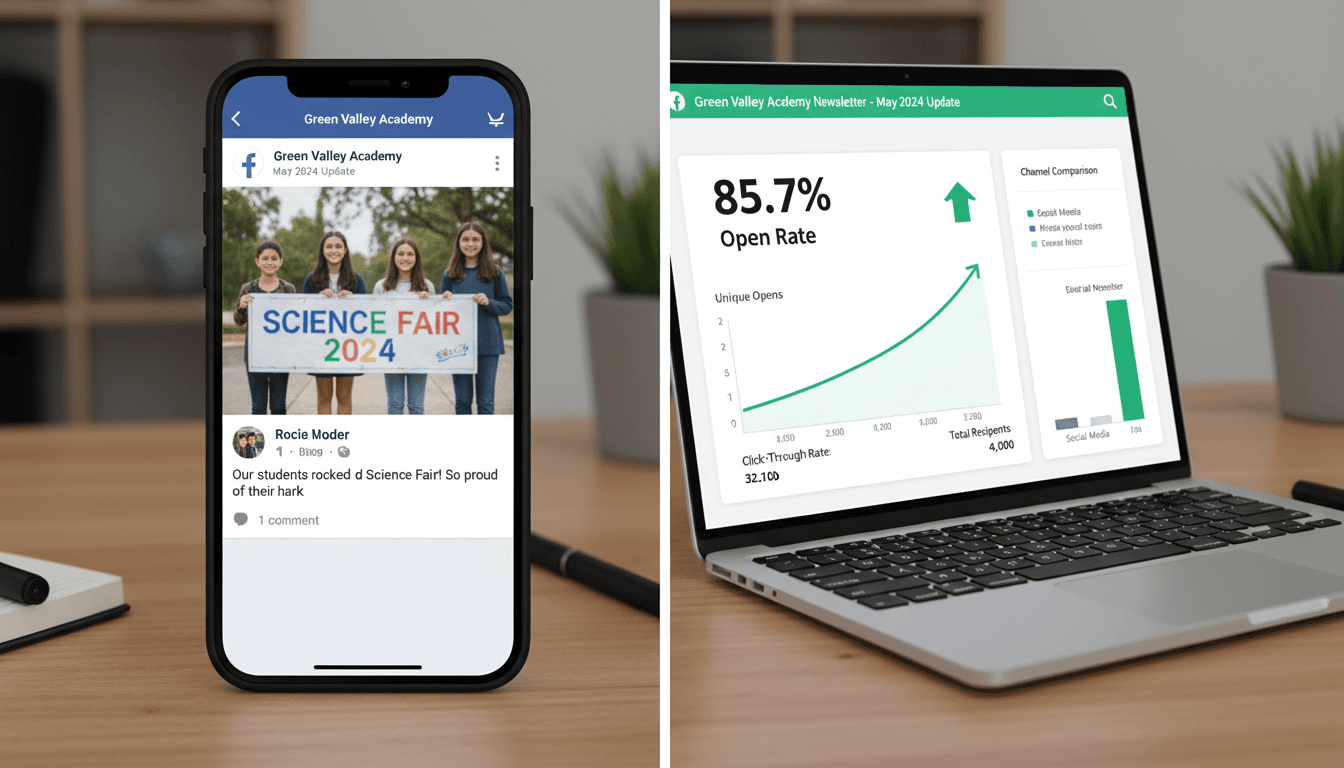
Most schools use both email newsletters and social media to communicate with parents. Very few have thought clearly about what each channel is for, which parents it reaches, and what happens when the two overlap. The result is often duplicated effort, inconsistent messaging, and neither channel performing as well as it should.
Here is how to think about the choice clearly.
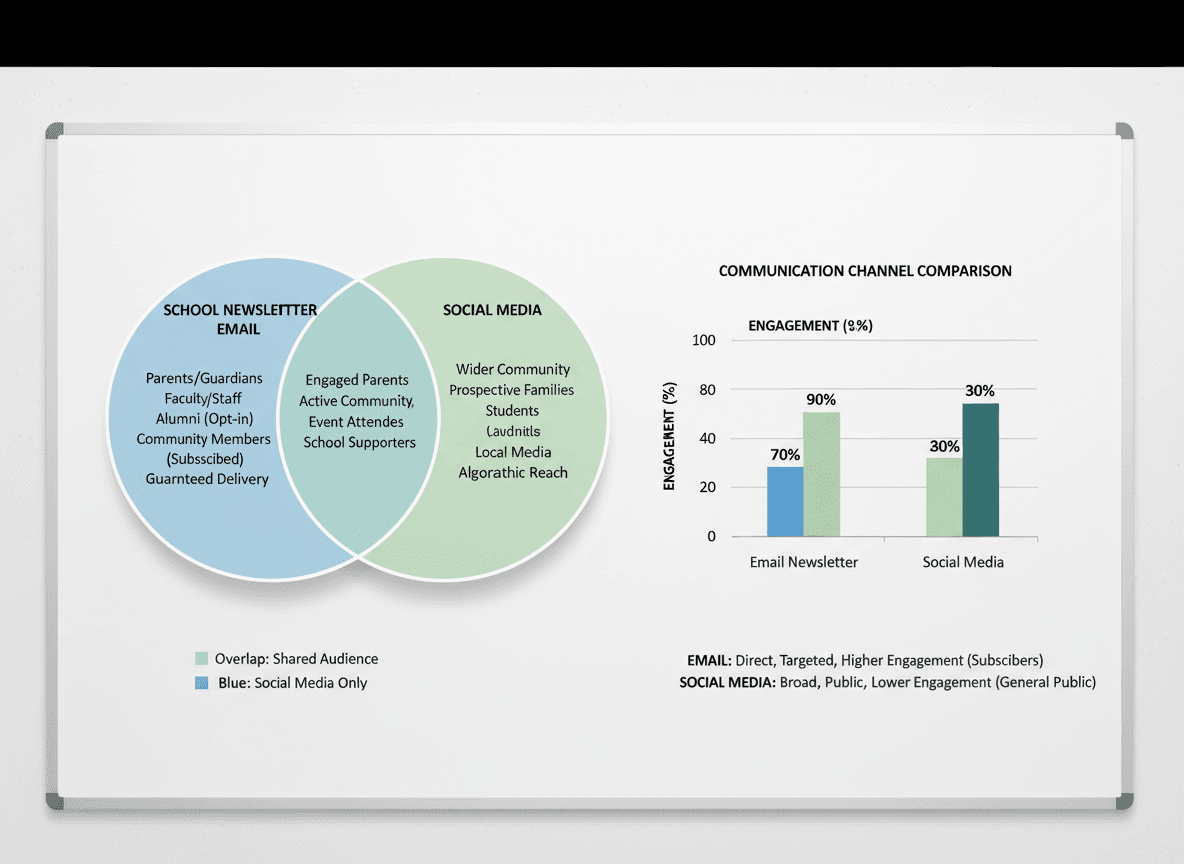
Who email newsletters reach
Email newsletters reach parents who opted in to receive them. This sounds obvious, but it is important: every person on your newsletter list made a deliberate choice to receive your communication. That is a very different relationship than someone who follows a school Facebook page while scrolling.
Email skews toward parents who are already organized and proactive about school communication. They provided an email address, accepted the subscription, and open communications from the school. Research on school-parent communication consistently shows that email reaches parents who need less follow-up because they are already engaged.
Email also reaches parents across age demographics more consistently than any social media platform. Grandparents who are primary caregivers, parents in their 40s and 50s, and parents who do not use Facebook or Instagram all tend to have email and to use it regularly.
Who social media reaches
Social media, particularly Facebook and Instagram, reaches parents who happen to follow the school account and who happen to see the post in their feed at the right time. Both of those dependencies make social media a weaker channel for critical information.
Social algorithms decide what each follower sees. A school Facebook post may reach 20 percent of followers organically or 5 percent, depending on engagement patterns and algorithm changes that the school has no control over. Unlike email, you cannot guarantee that a post reached a specific parent.
Social media reaches parents who are already heavy social media users. That skews younger, and it skews toward parents who are engaged with digital content. It misses parents who are not on social media or who use it differently (following brands and public figures rather than community pages).
Privacy and archiving
Email has structural privacy advantages over social media for school communication. A newsletter goes to the parents on your list. A Facebook post is visible to anyone who follows the page, and depending on privacy settings, potentially to anyone who finds the page.
For a classroom teacher, this matters significantly. Posting photos from the classroom to a Facebook page with open settings could expose student images to an unknown audience. Email newsletters go only to the families you have on your list, with consent you have documented.
Archiving is also different. Emails stay in inboxes. Parents can search for the newsletter from three months ago and find it. Social media posts scroll off within hours and are practically invisible within days unless someone specifically searches for them. For information parents may need to reference later (event dates, policy changes, supply lists), email is the more durable medium.
Why email is the only channel you actually own
The most important structural difference between email and social media is this: you own your email list. If your school's Facebook page is taken down, suspended, or changes its algorithm dramatically, you lose access to your audience. The relationship disappears.
Your email subscriber list belongs to you. You can export it, move it to a different platform, or continue using it regardless of what any social media company decides. This is not an abstract concern. Schools that built their entire parent communication strategy around Facebook groups or Remind found themselves in trouble when those platforms changed terms of service or parents stopped using them.
Email is also the channel where you set the terms. You decide the send time, the format, the subject line, and the content. No algorithm mediates the relationship between your newsletter and your subscribers.
What social media is actually good for
Social media serves different purposes than newsletters, and it serves them well. It is good for: sharing celebratory moments (a team win, a school achievement, a community event), driving newsletter sign-ups from followers who are not yet subscribers, giving the school a public-facing presence for prospective families and community members, and informal quick updates that do not warrant a full newsletter.
Social media is community theater. It is visible, shareable, and designed for discovery. Newsletter is direct mail. It is private, deliverable, and designed for the specific people who asked to receive it. Both are useful. Neither replaces the other.
How to use both without doubling your work
The most efficient approach is to write the newsletter first and adapt from it for social. After the newsletter goes out Monday morning, pull one interesting item from it (a classroom photo, a notable achievement, an upcoming event) and post that to social with a line like "Full details in this week's newsletter. Link in bio to subscribe." This drives newsletter sign-ups from your social audience while requiring almost no additional content creation.
Do not try to post the full newsletter content to social. Social posts are short-form. Newsletter content is long-form. Trying to do both with the same content produces something that works for neither format.
The newsletter is your primary channel. Social is a distribution amplifier for your most shareable content and a sign-up driver for parents who are not yet subscribers. Keep those roles clear and you will get more out of both without spending more time.
The practical recommendation
For teachers: build your email newsletter list and maintain it carefully. Use social media to remind followers that the newsletter exists and to share one or two shareable moments per week. Email is your core communication. Social is your reach.
For principals and district communications teams: own the email list at the school level, build cross-classroom newsletter infrastructure, and use social media for school-wide visibility and community presence. Never let social media become the primary channel for information parents need to act on.
Get one newsletter idea every week.
Free. For teachers. No spam.
Frequently asked questions
When should schools use email newsletters instead of social media for parent communication?
Use email newsletters when the communication requires parent action, includes time-sensitive deadlines, needs to reach all families equally, or contains information parents need to reference later. Email is the only channel you own. Social media reach depends on algorithm decisions and whether parents follow the account. For required information, email is the reliable channel.
What does a school newsletter reach that social media does not?
Email reaches every subscriber directly, regardless of when they check their phone. Social media posts reach only the fraction of followers the algorithm shows them to, which is typically 5 to 15 percent of total followers for organic posts. A school newsletter to 200 parents delivers to all 200. A social media post to 200 followers may reach 20 to 30.
How should schools use both email newsletters and social media without creating a double workflow?
Write the newsletter first, then pull 1 to 2 highlights from it for social media rather than creating separate social content. This treats social as a distribution amplifier for newsletter content rather than a parallel content creation task. The newsletter is the source of truth. Social is the promotion layer.
What are common mistakes schools make when relying on social media for parent communication?
Assuming that parents who follow the school account are seeing posts is the most common mistake. Algorithm reach for organic social content is consistently lower than expected. A related mistake is posting time-sensitive information like weather cancellations or permission slip deadlines only on social media, which reliably misses a portion of families.
What is the best tool for schools that want to use email as their primary parent communication channel?
Daystage is built specifically for email newsletter distribution to school families. You maintain a subscriber list, send formatted newsletters directly to inboxes, and track open rates per send. This gives you a communication channel you control, rather than one subject to platform algorithm changes.

Adi Ackerman
Author
Adi Ackerman is a former classroom teacher and curriculum writer with 8 years in K-8 schools. She writes about school communication, parent engagement, and what actually works in real classrooms.
More for Guides
Ready to send your first newsletter?
3 newsletters free. No credit card. First one ready in under 5 minutes.
Get started free