
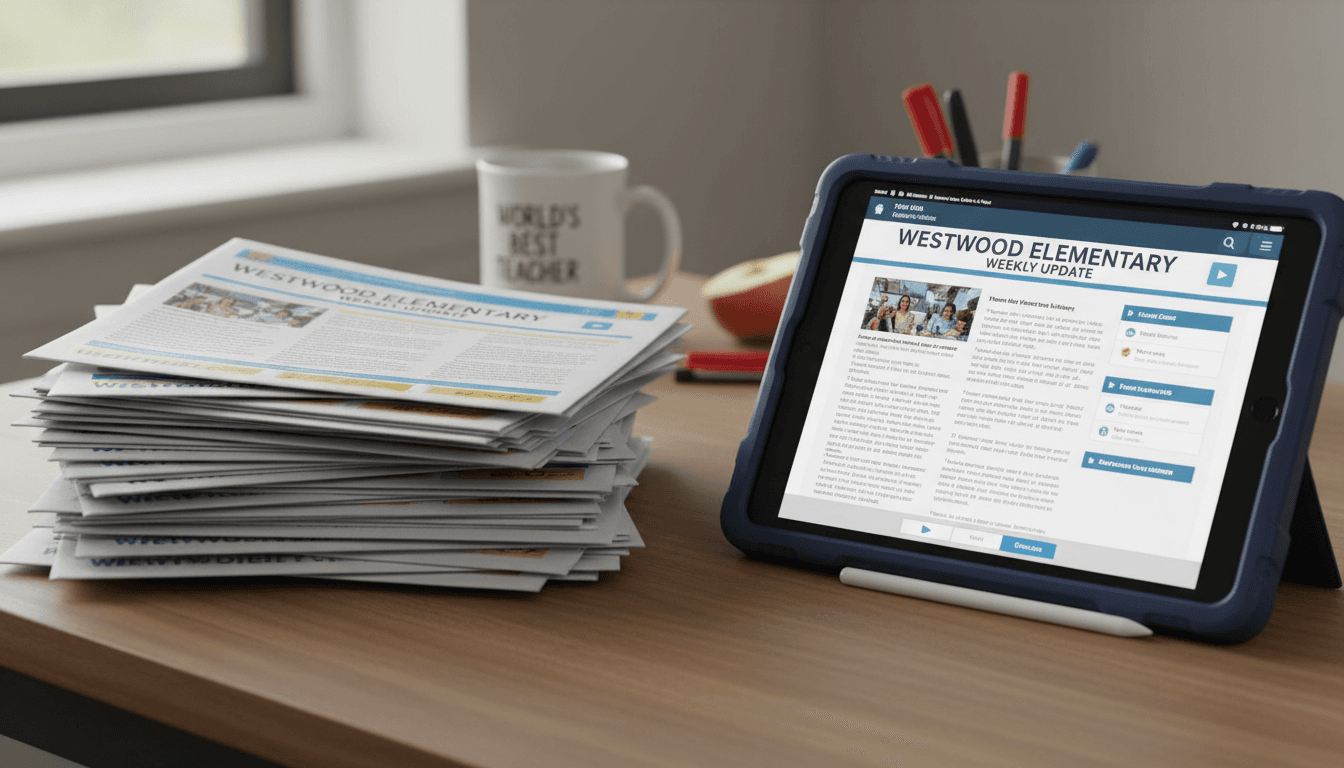
Print vs. Digital School Newsletters: When to Use Each (And When to Use Both)
The conversation about print versus digital school newsletters often assumes these are competing options where one should win. In practice, the decision is more nuanced. Digital is the right primary channel for most schools today. But print is not obsolete, and dismissing it entirely means leaving some families behind.
Who still needs paper newsletters
The answer is not "no one." Several specific circumstances make paper newsletters the better choice for reaching families:
Families without reliable email access. This is less common than it was a decade ago, but it is not zero. Families in rural areas with limited broadband, families who share one phone and do not use email regularly, and elderly grandparents who are primary caregivers may not check email reliably. If any of these describe a portion of your school community, paper is not optional.
Title I schools with significant technology gaps. The Federal Communications Commission's data on the homework gap shows persistent internet access disparities in lower-income communities. Schools serving these communities often find that paper maintains better communication equity than digital-only approaches, particularly for families without smartphones or home internet.
Specific community preferences. Some communities (certain immigrant communities, specific religious communities with limited technology use, communities with strong privacy concerns about digital tracking) have genuine preferences for physical mail. It is worth knowing whether your specific parent community includes groups with these preferences before going fully digital.
The case for digital as the primary channel
For most schools, email is the right primary channel for newsletters. It is faster, cheaper, measurable, searchable, and more flexible than print. A parent who misses Monday's newsletter can find it by searching their inbox on Thursday. A parent who loses the paper version cannot retrieve it.
Digital newsletters also arrive in the parent's preferred environment. Email is where most parents already manage their daily information. Competing with it by asking them to check a separate physical mailbox adds friction that most parents will not sustain past the first few months of school.
The environmental and cost arguments for digital are also straightforward. Paper, ink, and printing time add up significantly across a school year. A school that sends a two-page newsletter to 400 families weekly spends real money and real teacher time on printing and distribution. Digital eliminates both.
Cost and environmental tradeoffs
A realistic cost comparison for a weekly classroom newsletter sent to 30 families:
- Print: Roughly $0.05 to $0.10 per page in ink and paper costs. A two-page newsletter is $3 to $6 per week, $90 to $180 per semester, per classroom. Multiply that across a school with 20 classrooms and the numbers become significant.
- Digital: Near zero marginal cost beyond the email platform subscription, which typically covers the whole school.
The environmental impact is harder to quantify but real. Paper newsletters that are read and discarded (the majority) represent ongoing material waste. Digital newsletters do not.
However: if the choice is between a free paper newsletter that reaches every family and a digital newsletter that misses 15 percent of families, the communication equity argument can outweigh the cost and environmental arguments. Know your numbers before making this tradeoff.
The hybrid approach: digital primary, paper for key announcements
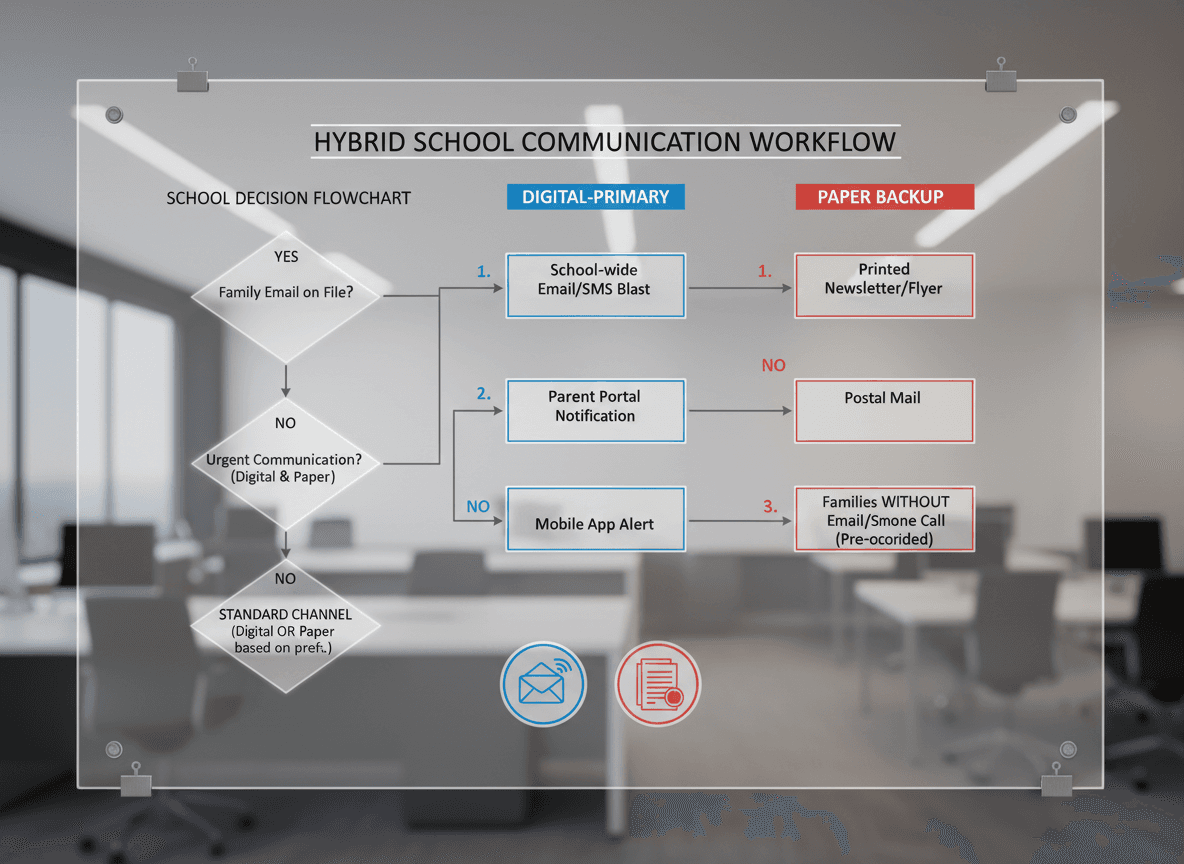
Many schools that have thought carefully about this settle on a hybrid model. The weekly classroom newsletter is digital. Paper goes home for specific circumstances:
- The beginning-of-year welcome packet (families who are new to the school, technology setup is not yet confirmed)
- Annual events that affect all families and require maximum reach (picture day, standardized testing schedule, required consent forms)
- Any physical form that requires a signature and must be returned
- Targeted paper communications for families identified as having limited digital access
This approach concentrates the printing budget on high-stakes communications while maintaining digital efficiency for routine weekly updates. It also does not require maintaining two parallel newsletter systems.
How to maintain both without doubling work
If you decide to run both digital and print newsletters, the only sustainable approach is designing once and outputting twice. Write the newsletter digitally, in your newsletter platform, as you always would. Then print from the same source. Do not maintain two separate documents or two separate writing workflows.
Platforms like Daystage generate clean, printable versions of newsletters. The same newsletter you send by email can be printed to PDF and sent home in backpacks for families who need it, without any reformatting. The writing happens once. The distribution happens in two formats.
Assign a clear trigger for who receives paper. The most common approach is to maintain a list of families who have requested paper or been identified as having limited digital access, and add those families to the print run automatically. This list is usually small (5 to 15 percent of families in most schools) and makes the printing burden manageable.
Checking in annually
The right balance between print and digital shifts as your parent community changes. A family that needed paper newsletters in 2023 because they were new to the country and did not yet have a reliable email address may have digital access by 2026. A school in a community with growing broadband access may find that its paper print run decreases naturally each year.
Check in at the start of each school year. Ask families directly (via a simple enrollment form or back-to-school packet) whether they prefer digital or paper newsletter delivery. Update your distribution accordingly. The data will tell you more than assumptions about what your community needs.
Get one newsletter idea every week.
Free. For teachers. No spam.
Frequently asked questions
When should schools continue sending paper newsletters alongside digital ones?
Continue paper newsletters for families who do not have reliable email access, do not own smartphones, or have repeatedly not received digital versions due to technical barriers. In most schools, this is 5 to 15 percent of families. Identify this group directly at enrollment and make paper the secondary channel for them rather than the default for everyone.
What are the main advantages of digital school newsletters over printed ones?
Digital newsletters are delivered instantly to every family on the list simultaneously, cost nothing to send, provide open rate and click data, can include active links, and can be resent or corrected if there is an error. Printed newsletters have none of these properties and cost between $0.05 and $0.20 per copy when you factor in printing and distribution.
How should schools handle the transition from print to digital newsletters?
Announce the transition at least 4 weeks in advance. Collect email addresses from families who only had mailing addresses on file. Send 2 to 3 overlapping newsletter sends as both print and digital during the transition period. Identify families who still have not opened a digital newsletter after 4 weeks and follow up directly.
What are common mistakes schools make when switching from print to digital newsletters?
Assuming all families have functional email accounts is the most common mistake. School enrollment forms often have email fields that families leave blank or fill with addresses they do not actively use. Before transitioning, verify that you have working email addresses for every family that currently receives print newsletters.
What is the best tool for schools that want to manage digital newsletter distribution while supporting families who need print?
Daystage manages digital distribution with subscriber lists and sends formatted email newsletters directly to parent inboxes. For the families who need paper, the newsletter can be printed from a browser, making it easy to maintain a small paper run for specific households without managing a separate design workflow.

Adi Ackerman
Author
Adi Ackerman is a former classroom teacher and curriculum writer with 8 years in K-8 schools. She writes about school communication, parent engagement, and what actually works in real classrooms.
More for Guides
Ready to send your first newsletter?
3 newsletters free. No credit card. First one ready in under 5 minutes.
Get started free