
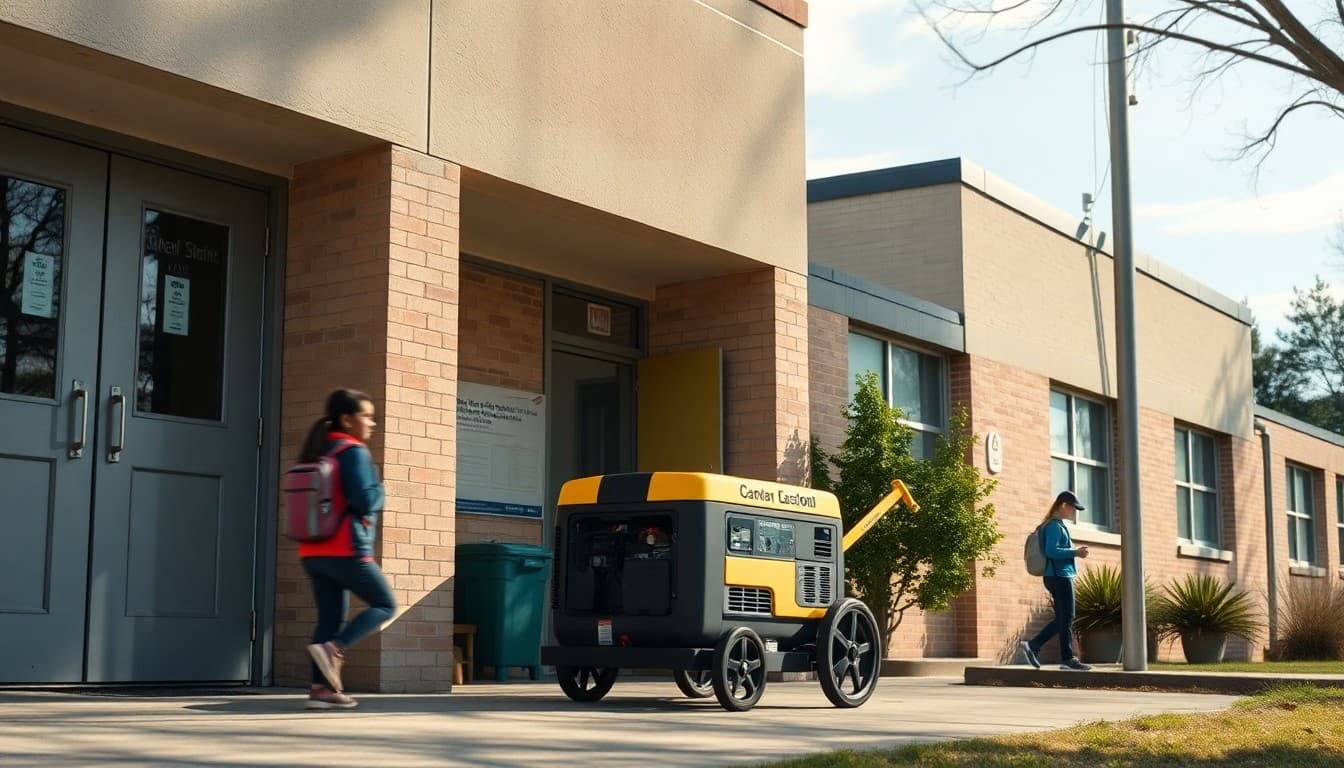
School Newsletter: Power Outage at School Communication Template

A power outage at school puts parents in immediate anxiety mode. They know something happened, they do not know whether their child is safe, and they are weighing whether to leave work. The first communication during a power outage has one job: confirm that students are safe and tell families what to expect next. Everything else is operational detail that can follow once the situation is clear.
This template covers both the initial alert and the follow-up newsletter for a school power outage.
The initial alert (send within 30 minutes)
The initial alert should be brief. "This is [Principal Name] from [School Name]. Our school is currently experiencing a power outage that began at approximately [time]. All students are safe and in their classrooms. Emergency lighting and security systems are operating normally. We are working to determine the cause and the expected restoration time. I will send a full update within the next hour. Please do not come to the school for pickup at this time unless you receive a separate early dismissal notification. Thank you for your patience." That message takes under a minute to read and answers the three questions families have: Is my child safe? Should I come get them? When will I know more?
The follow-up newsletter (send within 2 hours)
Once you have more information, send the full newsletter. Open with a status update. "Update as of [time]: Power has [been restored / is expected to be restored by X time / remains out with no estimated restoration time]. Students are [continuing the school day normally / being held in supervised locations / being dismissed early]." State the current situation clearly before providing any background.
Explain what caused the outage
If you know the cause, say so. "The outage was caused by [a utility equipment failure on the main street adjacent to the school / a tripped circuit breaker in the east wing / storm damage to the power line serving the school]. [Utility company name] is on site and has estimated restoration by [time]." If you do not know the cause, say that too. "The cause of the outage has not yet been confirmed. We are in contact with [utility company] and will update families when we have more information." Stating uncertainty honestly is more credible than avoiding the question.
Describe what the school is doing during the outage
Tell families how instruction and safety are being handled. "Teachers have transitioned to non-electronic instruction. Classrooms with natural lighting are continuing normal lessons. Classrooms without windows are using emergency lighting and conducting discussions and group activities that do not require electronic materials. The cafeteria is [serving lunch as scheduled / serving cold lunches that do not require cooking / conducting lunch in shifts to manage capacity in the available lit spaces]. Students with medical needs that require powered equipment have been moved to [location] where generator power is available."

State the early dismissal plan if applicable
If you are dismissing early, be extremely specific. "Early dismissal is scheduled for [time]. Bus riders will board buses at [time] from the main entrance. Car riders may be picked up beginning at [time] from [location]. Students who will not be picked up by [time] will wait in [supervised location] until pickup. Families who cannot arrange pickup by [time] should call [number] to confirm. After-school care will operate normally, starting at [time] in [location]."
Address what happens to missed academic time
If the outage disrupts scheduled assessments or significant instruction time, note how the school will address it. "The math benchmark originally scheduled for today will be rescheduled. Teachers will communicate the new date by [day]. No academic activities will be marked late or incomplete due to today's outage." That brief reassurance prevents the cascade of follow-up emails from families whose students had something important scheduled today.
Close with your contact information and the next update time
"I will send another update by [time] or sooner if the situation changes. For immediate questions, please call the main office at [number]. Do not use email during active emergencies as I may not be able to monitor it. Thank you for your patience and for your trust in our team."
Get one newsletter idea every week.
Free. For teachers. No spam.
Frequently asked questions
When should a school send a newsletter about a power outage?
Send an initial communication within the first 30 minutes of confirming that the outage is affecting the school building and may impact the school day. This initial communication does not need to be a full newsletter. A brief text or push notification stating what happened, that students are safe, and that you will send a full update within the next hour is sufficient as an immediate response. The full newsletter with all details should follow within two hours. Families who do not hear anything assume the worst, so the initial communication serves primarily to confirm student safety.
What should a school do with students during a power outage?
Safety protocols during a school power outage depend on the building and the duration. For a brief outage, students typically stay in their classrooms while teachers transition to non-electronic instruction. For a prolonged outage (more than two hours), decisions about early dismissal or remote learning depend on building conditions: temperature control, cafeteria operations, medical equipment for students with health needs, and lighting in windowless areas. Any decision to dismiss early must follow your district's emergency dismissal protocol, including confirmation through the emergency contact system before students are released.
How do you explain a power outage to families without creating unnecessary alarm?
Lead with student safety. 'All students are safe and accounted for. The school experienced a power outage at [time] affecting [scope]. Emergency systems including emergency lighting and building security are operating normally.' That opening addresses the only question families have in the first five seconds. Then move to the cause, the current status, and the expected resolution. Families who know their child is safe can process the operational details calmly. Families who read three paragraphs before reaching a safety confirmation experience unnecessary anxiety.
What do families need to know about early dismissal during a power outage?
If you are dismissing early, state the specific dismissal time, the dismissal location if it differs from normal, and the pickup process. 'Early dismissal will begin at [time]. Students who ride buses will be dismissed first. Students who are car riders will be dismissed from [location] beginning at [time]. Families who cannot arrive by [time] should call the main office at [number] to arrange supervised waiting for their student. Students enrolled in after-school care will be held by after-school staff and families will be contacted directly.' That level of specificity is what families need to change their day around.
Can Daystage help schools send power outage communications quickly?
Daystage is useful for follow-up communications after the initial emergency alert. Once the situation is stabilized and you have full information, a Daystage newsletter gives you a professional format for explaining what happened, what the school did, and what the plan is going forward. The initial alert is best sent through your school's emergency notification system. The follow-up explanation benefits from the structured newsletter format.

Adi Ackerman
Author
Adi Ackerman is a former classroom teacher and curriculum writer with 8 years in K-8 schools. She writes about school communication, parent engagement, and what actually works in real classrooms.
More for Guides
Ready to send your first newsletter?
3 newsletters free. No credit card. First one ready in under 5 minutes.
Get started free