
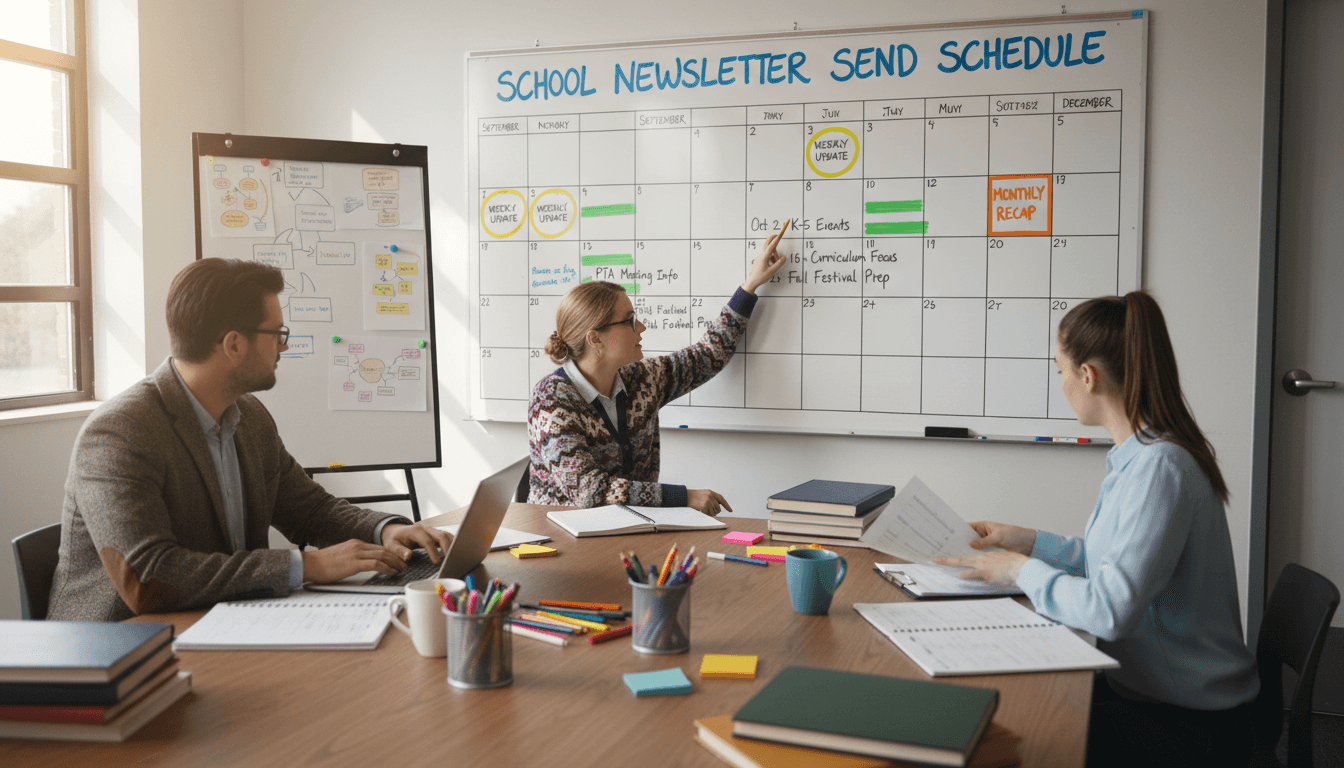
How Often Should You Send a School Newsletter? A Practical Guide by Grade Level
Send too often and parents tune out. Send too rarely and the newsletter becomes irrelevant. The right frequency depends on the grade you teach, the time of year, and how much genuinely useful information you have to communicate.
There is no single answer, but there is a framework that makes the decision straightforward.
What the research says about newsletter fatigue
Email engagement research across industries consistently shows that sending frequency is less important than content relevance. People unsubscribe from newsletters not because they arrive too often but because they arrive without enough value.
For school newsletters specifically, parent engagement studies show that families with children in earlier grades (PreK through 2nd) open classroom newsletters at higher rates and tolerate higher frequency. Families with older children (6th grade and above) show lower open rates at every frequency and respond better to information-dense, less frequent sends.
The practical implication: the younger the students, the more frequently you can send without fatigue. The older the students, the more you need to earn each send with specific, actionable content.
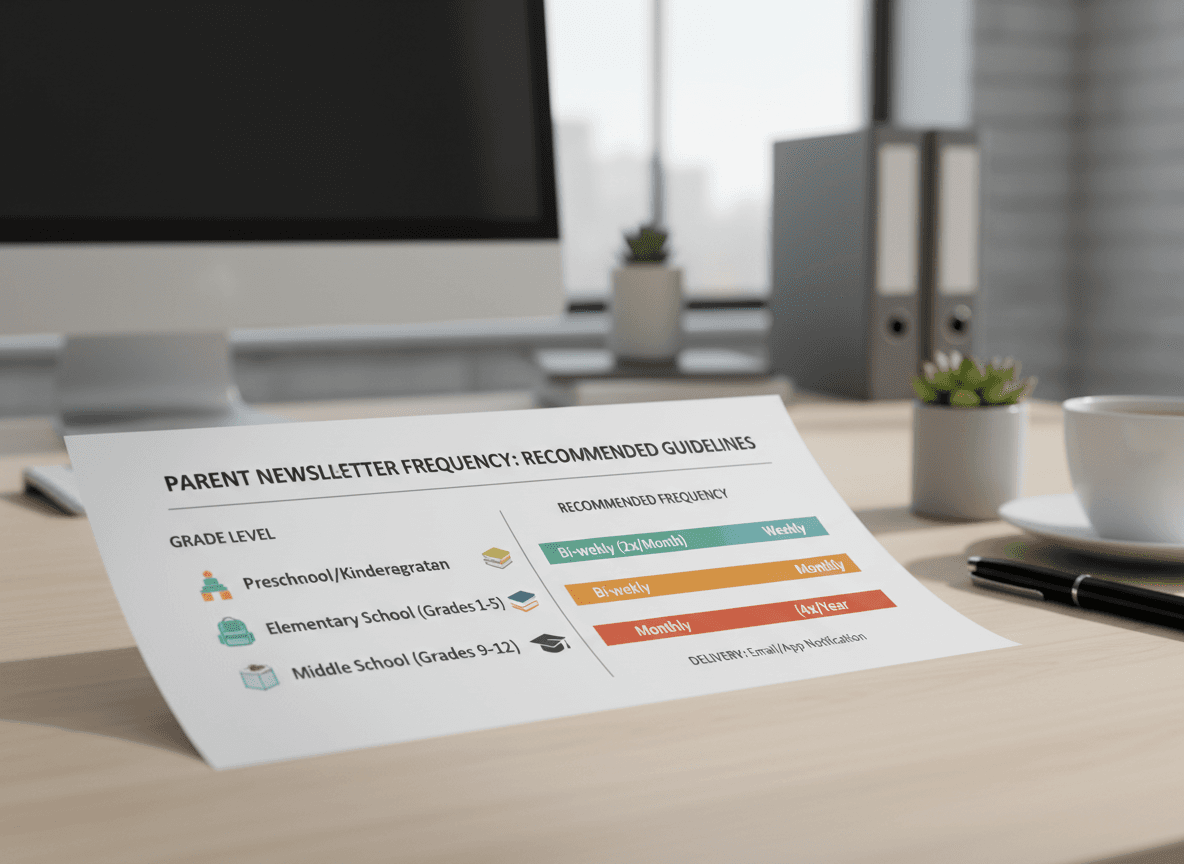
Frequency recommendations by grade level
PreK and Kindergarten: weekly. Families of young children are in a high-attention mode at the start of schooling. They want frequent updates on what their child is doing, learning, and experiencing. Weekly newsletters perform well at this level, and parents rarely report fatigue. Keep newsletters short (under 400 words) and include at least one classroom photo when possible.
Elementary (grades 1-5): weekly or biweekly. Weekly sending works for most elementary teachers, especially in grades 1-3. In grades 4-5, where parents are slightly less involved in day-to-day classroom activity, biweekly is acceptable if the newsletter is content-rich. If you find yourself padding to fill a weekly send, switch to biweekly. Thin newsletters hurt engagement more than lower frequency does.
Middle school (grades 6-8): biweekly or monthly. Parent-teacher communication at the middle school level shifts toward email threads and parent portal messages. A standalone newsletter competes with those channels. Biweekly works if the newsletter is focused on what parents cannot get elsewhere: curriculum context, community photos, upcoming deadlines. Monthly works for subject-area newsletters that summarize a unit and preview the next.
High school (grades 9-12): monthly or event-driven. High school families respond best to newsletters tied to specific events: college application deadlines, semester exam schedules, athletic seasons, or departmental news. A generic monthly update gets low opens. An event-anchored send ("AP Testing Starts in 3 Weeks: What Your Student Should Know Now") performs significantly better.
What changes newsletter frequency needs
Several predictable moments in the school year justify changing your usual cadence.
- Start of school year. Send weekly for the first four to six weeks regardless of grade level. Families are establishing routines and have higher appetite for school communication. Use this window to train parents to expect your newsletter.
- Testing season. In the weeks surrounding state testing, report card distribution, or major project deadlines, increase frequency temporarily. Parents want specific information about what to expect and how to support their child.
- Before long breaks. Send a pre-break newsletter summarizing what is coming up after the break, any materials students should bring home, and whether there is summer reading or supply preparation needed.
- After a significant event. A field trip, guest speaker, science fair, or special project deserves a dedicated follow-up newsletter within two to three days. These are high-engagement sends because parents want to hear what happened.
- End of year. Increase frequency in the final three to four weeks. There are more deadlines, transitions, and logistical details than any other time of year.
Weekly digest vs. daily updates
Some teachers experiment with short daily messages rather than a weekly digest. This works in very specific circumstances: PreK and Kindergarten classes where parents want near-real-time updates, or classrooms with a high proportion of dual-language families who benefit from more frequent, shorter text to process.
For most teachers and most grade levels, the weekly digest outperforms daily updates. Parents consolidate their attention rather than reading individual daily sends, and the cumulative engagement on one weekly send is higher than the sum of five daily ones.
The exception is urgent one-off communications. A field trip update, a weather-related schedule change, or a head lice notification should never wait for the weekly newsletter. Send it separately, immediately, with a specific subject line.
School-wide vs. classroom frequency
Principals and district communication teams face a different frequency problem. They are sending to every family in the building, not a single classroom, which means any fatigue is amplified.
School-wide newsletters perform best at biweekly. Monthly is acceptable if the school also sends event-driven one-offs. Weekly school-wide newsletters require strong content discipline to avoid padding, and most schools do not sustain that standard past October.
If both a classroom teacher and the school office are sending to the same families, coordinate. Families who receive four or five school-related emails per week from different senders, even if each individual one is useful, start filtering everything into folders they never check.
The simplest way to choose your frequency
Start with weekly and watch your open rates. If they are holding above 35% after six weeks, keep the cadence. If open rates drop below 25% and you are not in a traditionally low-engagement season (February, after spring break), switch to biweekly and see if engagement recovers.
Daystage shows open rate data for every send, so you can make this decision based on your actual audience rather than guessing. The right frequency is the one your specific parent community opens consistently.
Get one newsletter idea every week.
Free. For teachers. No spam.
Frequently asked questions
When should teachers send school newsletters, and how often?
Weekly is the right frequency for most classroom teachers. Thursday or Friday sends give parents time to plan for the following week. Monthly newsletters are too infrequent to keep parents informed about classroom life. More than weekly creates fatigue unless the extra sends are reserved for specific events or urgent items.
What factors should schools consider when deciding how often to send a newsletter?
Grade level matters: elementary parents want weekly updates, while high school parents are satisfied with twice per month or monthly. Class size affects how much is happening each week. Available time for writing matters because a newsletter you do not have time to write well is worse than a less frequent one that is accurate and useful.
How does newsletter frequency affect parent engagement rates?
Consistent frequency increases engagement more than any single frequency choice. Parents who receive a newsletter every Thursday at 8am develop a reading habit. Those who receive newsletters on random days at random times treat each arrival as a one-time event and open rates are typically lower. Predictability is more important than whether you send weekly or every two weeks.
What are common mistakes teachers make when deciding how often to send a school newsletter?
Sending more frequently during busy school periods and going silent during slow weeks creates an unpredictable pattern that reduces parent trust. Another mistake is choosing a high frequency like three times per week because of enthusiasm at the start of the year, then burning out and going dark by November. Choose a frequency you can maintain in your busiest week.
What is the best tool for teachers who want to maintain a consistent school newsletter schedule?
Daystage supports scheduled sending and newsletter duplication. You set a send day and time, duplicate last week's newsletter as your starting structure, update the content, and send. This reduces the activation energy required to send consistently, which is the main reason teachers maintain a regular schedule.

Adi Ackerman
Author
Adi Ackerman is a former classroom teacher and curriculum writer with 8 years in K-8 schools. She writes about school communication, parent engagement, and what actually works in real classrooms.
More for Guides
HIPAA, FERPA, and School Newsletters: What Teachers and Administrators Must Know
Guides · 8 min read
School Newsletters for Special Education Teachers: What to Include and What to Keep Private
Guides · 6 min read
Daystage vs. Mailchimp for School Newsletters: Why Schools Need a Dedicated Tool
Guides · 8 min read
Ready to send your first newsletter?
3 newsletters free. No credit card. First one ready in under 5 minutes.
Get started free