
School Newsletters for Multilingual Families: A Practical Translation and Localization Guide
Multilingual schools face a communication problem that has no perfect solution: producing quality newsletters in multiple languages requires time, skills, and often budget that most schools do not have. Machine translation has improved dramatically since 2020, but it still fails in specific ways that matter for school communication. Understanding those failure modes helps you build a translation workflow that is both practical and trustworthy.
Translation vs. localization: the difference matters
Translation converts words from one language to another. Localization adapts content to be culturally appropriate and natural in the target language. For school newsletters, both matter but in different ways.
Translation handles the factual content: dates, event names, deadlines, subject-area descriptions. A correct translation of "Permission slips due Friday" is useful and accurate in any target language.
Localization handles tone, cultural assumptions, and idioms. "Ask your child tonight what caused the Civil War" assumes a cultural context that may be unfamiliar to families from other countries. "We are starting a unit on American history including the Civil War" is both easier to translate and more accessible to families without that background.
Writing with localization in mind before translation starts makes every translation easier and more accurate. Avoid idioms ("knock it out of the park"), culturally specific references, and phrases that depend on shared background knowledge. The resulting English is also clearer for native speakers.
Machine translation quality in 2026
Google Translate and DeepL have both improved significantly in recent years. For common school newsletter languages (Spanish, Mandarin, Vietnamese, Portuguese, Arabic), machine translation now produces output that is usually accurate for straightforward factual content.
Where machine translation still fails consistently:
- Educational jargon and grade-level-specific terminology (IEP, RTI, PBIS, differentiated instruction)
- Warm or personal opening paragraphs that depend on tone and cultural register
- Any content involving idioms, humor, or culturally specific references
- Arabic, which requires formal and informal register decisions that machine translation handles poorly
- Languages with significant regional variation (Spanish in Mexico vs. Spain vs. Puerto Rico can differ enough to confuse or alienate specific communities)
DeepL generally outperforms Google Translate for European languages. For Chinese, Vietnamese, and Arabic, human review of machine-translated content is still strongly recommended for any communication that will affect parent decisions.
Which content needs professional translation
Not all newsletter content carries equal stakes. Use this framework to decide when professional translation is worth the cost:
- Always professional: legal notices, consent forms, special education communication, disciplinary notices, any content with legal implications
- Professional when possible: initial welcome communications, annual school policy summaries, any content that shapes parent expectations for the year
- Machine translation with review: regular weekly newsletters for Spanish, Mandarin, Vietnamese (with a bilingual community member reviewing)
- Machine translation acceptable: event reminders, deadline notices, supply lists, purely factual content with no tone-dependent language
Many schools with active multilingual communities have bilingual staff members or parent volunteers who can review machine-translated content quickly. A 10-minute review by a fluent speaker catches the most serious errors without requiring a professional translation budget for every newsletter.
Building a translation workflow
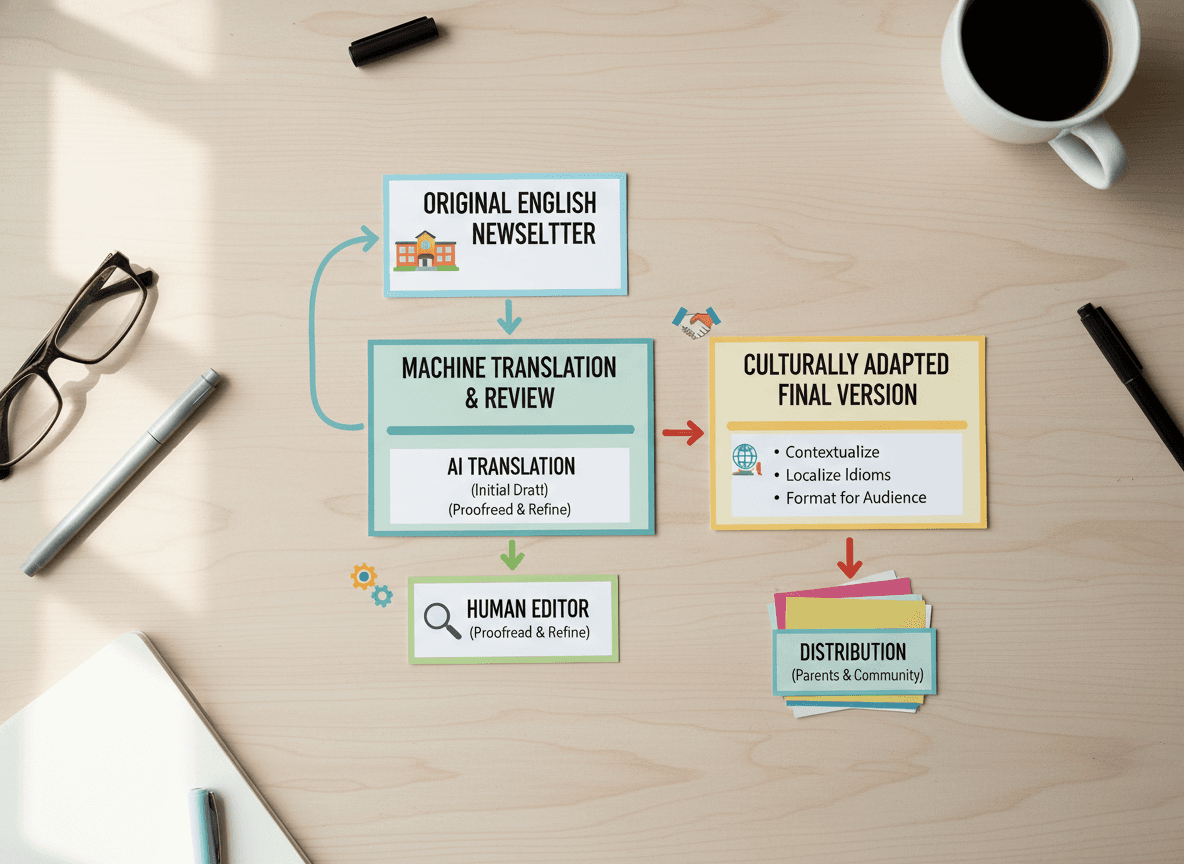
A realistic translation workflow for a school with two or three primary home languages looks like this:
- Write the newsletter in English with localization in mind (no idioms, clear sentences, factual language for the critical sections)
- Run through DeepL or Google Translate for each target language
- Send the machine-translated draft to a designated bilingual reviewer for each language (staff member, trained parent volunteer, or community liaison)
- Reviewer corrects errors, adjusts tone, and flags anything culturally problematic
- Send the final version alongside or instead of the English version to appropriate subscriber segments
Daystage supports multiple subscriber lists, which makes this workflow practical: you can maintain separate lists for families who prefer Spanish vs. English vs. Chinese newsletters, and send each group their version without managing three separate email accounts.
Cultural tone differences to know
Different cultural contexts expect different communication tones from schools. Families from East Asian backgrounds often expect more formal, hierarchical communication from educational institutions. Families from Latin American backgrounds often respond better to warm, relationship-focused language. Families from South Asian backgrounds may expect detailed academic information and explicit expectations.
These are generalizations, not rules. But they are useful reminders that the warm, casual tone that works well with some parent communities may read as disrespectful or unprofessional to others. If your school community is diverse, ask multilingual staff members whether the newsletter's tone lands well across your parent base.
What to do when translation is not possible
Some schools face languages they cannot translate to consistently (a small number of families speaking a less common language, with no available bilingual resource). In these cases:
- Use machine translation with a clear disclaimer that the translation is automated
- Supplement with visual communication where possible (event flyers with dates and images rather than text-heavy descriptions)
- Identify school or district multilingual liaisons who can follow up by phone for critical communications
- Contact local community organizations or universities that may have translation resources for your specific language
An imperfect translated newsletter is better than no translated newsletter. Families who receive communication in their home language, even imperfect translation, feel more included than families who receive only English. The effort signals care even when the output is not perfect.
One language per newsletter issue
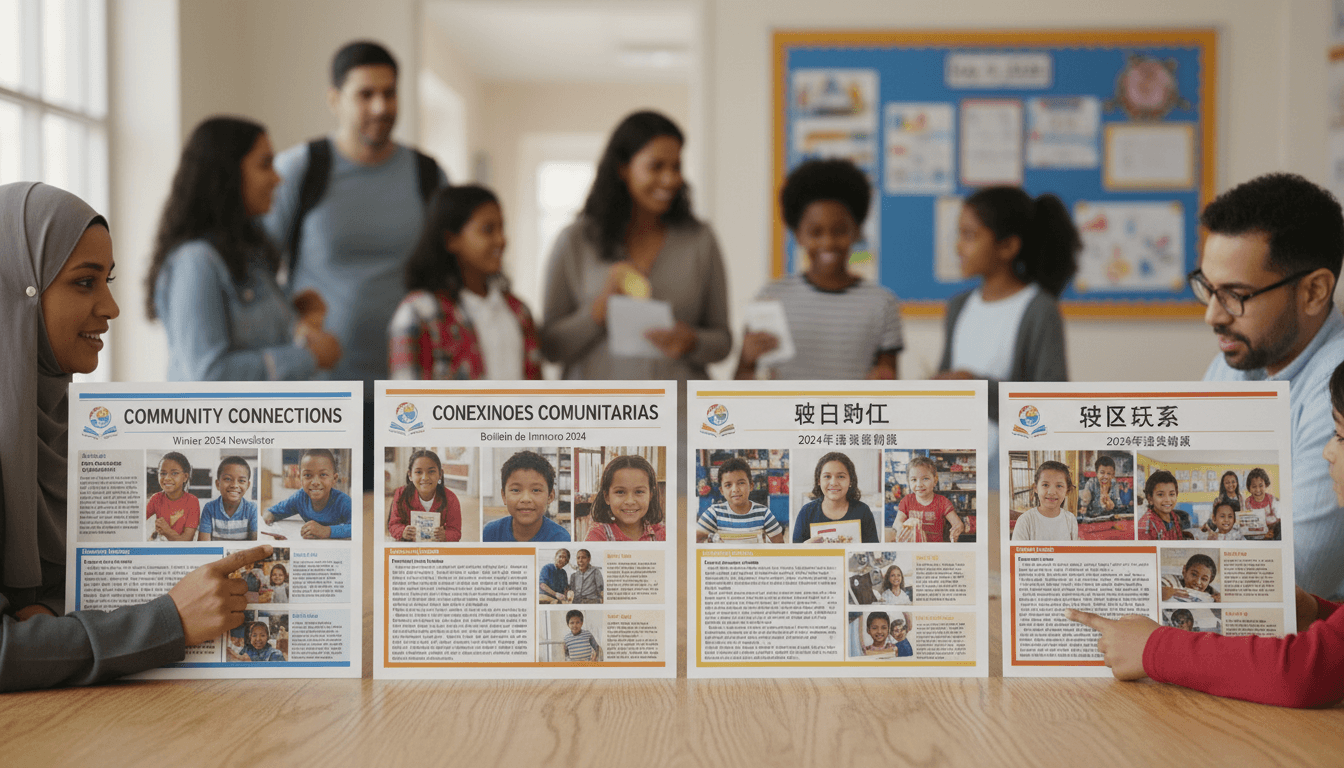
Some schools attempt to combine multiple languages in a single newsletter, with English followed by Spanish followed by Chinese. This approach is well-intentioned but produces newsletters that are too long and that require non-English-speaking families to scroll past content they cannot read to reach their language.
Separate newsletters by language whenever possible. It is more respectful of each parent's time and produces cleaner, shorter communications. The additional work of maintaining separate issues is offset by better engagement from each language community.
Get one newsletter idea every week.
Free. For teachers. No spam.
Frequently asked questions
When should a school start translating its newsletter for multilingual families?
Start translating as soon as you have families whose primary language is not English, even if it is just one or two households. Delayed translation communicates a lower priority for those families, which affects trust and engagement from the beginning of the school year. A basic machine translation with human review is better than waiting until you have the resources for professional translation.
What should a multilingual school newsletter include to serve non-English-speaking families well?
Include a translated header and introduction, all action items and deadlines in the family's primary language, event information with dates and what parents need to do, and any safety or health notices. Full translation of every section is ideal but not always feasible. Prioritize the sections that require parent action over informational content.
How should schools structure newsletters when serving families who speak multiple languages?
Send separate newsletters by language group rather than combining multiple languages in a single newsletter. Multilingual newsletters that alternate between languages create visual confusion and make it harder for parents to find the content in their language. Separate sends also allow you to track engagement per language group.
What are common mistakes schools make when translating newsletters for multilingual families?
Relying entirely on machine translation without review is the most common mistake. Machine translation in 2026 is significantly better than it was 5 years ago, but it still makes errors on school-specific vocabulary, cultural references, and formal register. Always have a bilingual staff member or community volunteer review machine-translated content before sending.
What is the best tool for teachers who want to send school newsletters in multiple languages?
Daystage supports separate subscriber lists and newsletters by language group, which allows you to manage English and translated versions independently. Combined with a translation workflow using a bilingual reviewer, you can send distinct newsletters to different family groups from the same account.

Adi Ackerman
Author
Adi Ackerman is a former classroom teacher and curriculum writer with 8 years in K-8 schools. She writes about school communication, parent engagement, and what actually works in real classrooms.
More for Guides
Ready to send your first newsletter?
3 newsletters free. No credit card. First one ready in under 5 minutes.
Get started free