
How to Write School Newsletter Copy That Parents Actually Read
The gap between a newsletter that parents read all the way through and one they close after the first paragraph is not design. It is writing. Specifically: how long the sentences are, where the important information sits, and whether the newsletter reads like a person wrote it or like a district memo.
This guide covers the writing decisions that actually determine whether parents read the newsletter.
Write for a sixth-grade reading level
Sixth-grade reading level is not a slight against parents. It is recognition that adults reading on a phone while managing their day read fastest when sentences are short and words are common. The Flesch-Kincaid readability formula gives you a number, but you do not need to calculate it. The practical version: use short sentences, cut words that mean nothing, and replace formal language with the words you would use out loud.
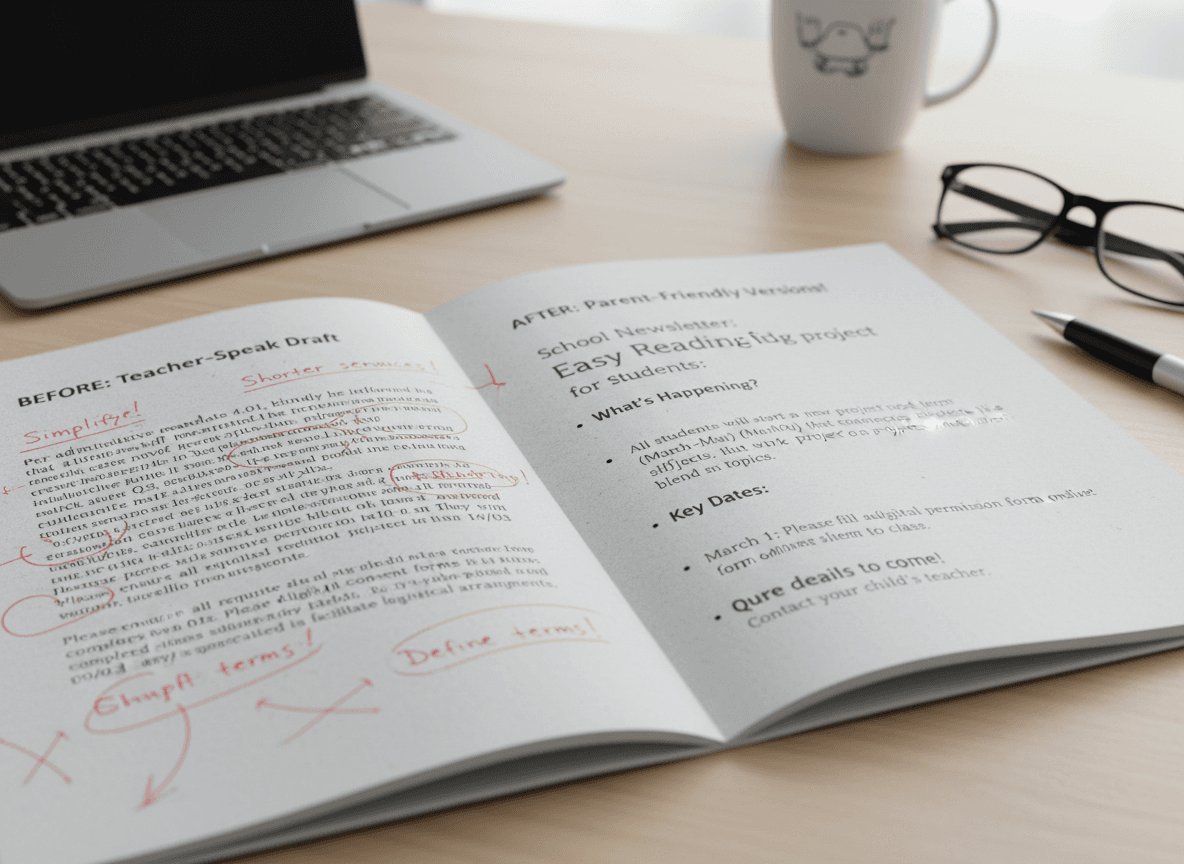
Compare these two sentences:
- "Students will be engaging in a variety of activities designed to support the development of their reading comprehension skills during the upcoming unit."
- "We are starting guided reading groups this week. Each child reads books matched to their level."
The second version is shorter, clearer, and more specific. It is also more likely to be read because it does not require effort to parse.
Action-first sentence structure
In school newsletters, most sentences bury the point. "Due to the upcoming field trip on Friday, October 10th, permission slips need to be returned by Wednesday." What parents need to know is: permission slips due Wednesday. That is the first three words of the sentence, not the last.
Rewrite action items by leading with the action: "Permission slips due Wednesday, October 8. Field trip is Friday, October 10." Two sentences. Both clear. Neither one requires the parent to hold information in their head while waiting for the point.
This applies to every sentence that asks parents to do something. Put the verb first. Put the deadline second. Cut everything else unless it is essential context.
How to write the opening paragraph
The opening paragraph is the hardest part of the newsletter to write because it is the most personal. It also does the most to determine whether parents read the rest. A strong opening paragraph does three things: it acknowledges what week it is in the school year, it previews the most important thing in this issue, and it sounds like a person.
Keep it to two or three sentences. Do not open with "I hope this newsletter finds you well." Do not open with "As we continue our journey through the school year." Both phrases say nothing and signal that the newsletter is going to be generic.
Better openings are specific: "We finished our fractions unit this week and most students nailed it. Two things I need from you before Friday are in the section below." That opening tells parents something real and immediately signals that there is an action item. Parents keep reading.
The 3-sentence event format
Every event announcement in a newsletter should follow a three-sentence format:
- What the event is and when it happens
- What parents need to know or do
- Who to contact with questions
Example: "Science Fair presentations are Thursday, November 14 at 6pm in the gym. All families are welcome and seating is first-come, first-served. Questions? Email Mr. Torres at the address below."
Three sentences covers everything. Parents do not need more context than that for most events. If an event requires more explanation, create a separate document and link to it rather than embedding a long explanation in the newsletter.
Eliminate these phrases from every newsletter
Certain phrases appear in school newsletters constantly and add no information. Remove every instance of:
- "I hope this finds you well"
- "As always, thank you for your continued support"
- "Please do not hesitate to reach out"
- "We are so excited to share"
- "Students will be engaging in activities designed to"
- "It is our pleasure to inform you"
Replace each one with the actual thing you want to say. "Please do not hesitate to reach out" becomes "Email me at [address] with any questions." The second version is more useful and no less friendly.
Proofing for clarity, not just correctness
Standard proofreading catches spelling and grammar errors. Clarity proofing catches something different: sentences that are grammatically correct but hard to understand on first read.
After you write the newsletter, read it out loud. Any sentence where you have to slow down, re-read, or breathe mid-sentence is a sentence to rewrite. If a sentence requires a second read to understand, it will not be read twice by a parent in a hurry. It will be skipped.
Daystage's editor shows you a word count for each newsletter. Keep each issue under 500 words. Newsletters that require scrolling on a phone lose readers at the scroll point.
Tone: warm without being vague
School newsletters often fail at tone in one of two directions: too formal (reads like a policy document) or too warm in a way that says nothing (reads like a greeting card). The right tone is direct, specific, and personal without being unprofessional.
Warm and specific: "The kids worked really hard on the weather unit this week. Ask your child tonight what causes thunder. Guaranteed you will get an answer that impresses you."
Vague warmth: "We had a wonderful week filled with many exciting learning opportunities."
The first version makes parents feel like they know something real about their child's week. The second tells them nothing. Writing specifically is what makes a newsletter feel warm rather than generic, even when the writing is efficient and short.
The test before you send
Before sending any newsletter, ask yourself: if a parent read only the first two sentences and the action items section, would they have the information they need? If the answer is yes, the newsletter is well-written. If the answer is no, move the critical information higher and shorten the context around it.
Most parents will read the whole newsletter if the first two sentences give them a reason to. Give them that reason.
Get one newsletter idea every week.
Free. For teachers. No spam.
Frequently asked questions
When should teachers edit their newsletter copy before sending?
Edit after writing the first draft, not while writing it. Write the full draft first, then go back and cut sentences longer than 25 words, remove vague phrases like 'exciting opportunities', and verify that every action item has a specific date. Editing while drafting slows you down and makes the writing less natural.
What makes school newsletter copy easy for parents to read?
Short sentences at a sixth-grade reading level, action verbs at the start of sentences, specific dates and details instead of vague references, and a single main ask per newsletter. Parents read school newsletters on phones in under 2 minutes. Every sentence that does not inform or direct is competing with the sentences that do.
How long should newsletter copy be, and how should it be structured?
Keep total copy under 500 words, organized into labeled sections. The opening paragraph should be 2 to 3 sentences. Each section should have a header, 2 to 4 sentences of content, and any action items listed separately with specific dates. Buried information in paragraph form is the main reason parents miss important deadlines.
What are common copywriting mistakes in school newsletters?
Starting the newsletter with 'I hope this email finds you well' or 'It has been a great week' delays the actual information parents need. Using passive voice for action items, like 'permission slips should be returned', is less clear than 'Return permission slips by Friday March 14th'. Vague openings and passive instructions are the two most common copy problems.
What is the best tool for teachers who want to write cleaner school newsletter copy faster?
Daystage uses labeled block sections that prompt you to write in the right format for each part of the newsletter. The structure itself guides you toward concise, action-first copy rather than free-form paragraphs that bury the key information.

Adi Ackerman
Author
Adi Ackerman is a former classroom teacher and curriculum writer with 8 years in K-8 schools. She writes about school communication, parent engagement, and what actually works in real classrooms.
More for Guides
Ready to send your first newsletter?
3 newsletters free. No credit card. First one ready in under 5 minutes.
Get started free