

How to Measure Whether Your School Newsletter Is Actually Working
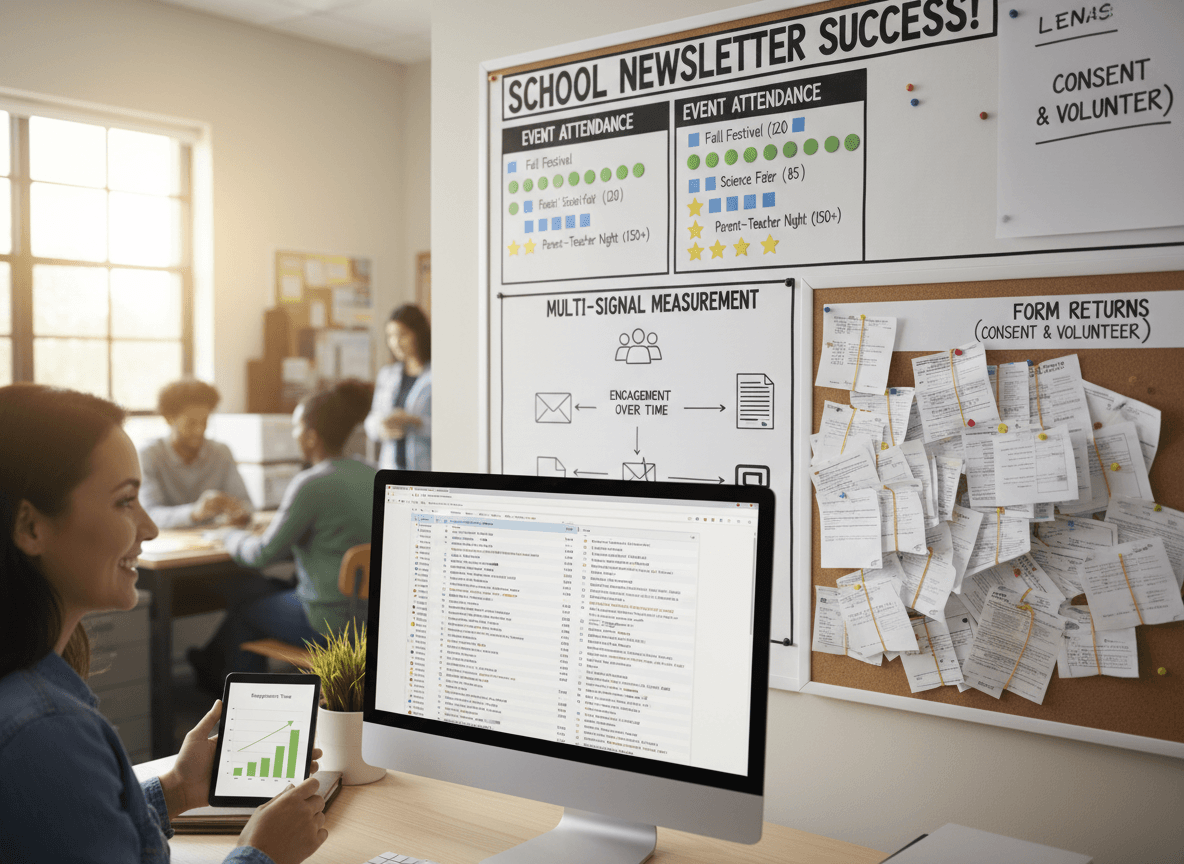
Most teachers and principals check one number after sending a newsletter: the open rate. If it is above 50 percent, the newsletter feels like a success. If it is below 40 percent, something feels wrong. Neither conclusion is quite right. Open rates tell you who opened the email. They tell you almost nothing about whether the newsletter is doing its job.
Here is how to measure school newsletter effectiveness in a way that connects to what actually matters: whether parents are informed, engaged, and taking action.
Why open rates are a weak signal
Open rates are tracked by loading a tracking pixel, a tiny invisible image embedded in the email. When the email loads the image, a record registers as an open. Apple's Mail Privacy Protection, introduced in 2021, pre-loads emails and fires tracking pixels before the user even opens the message. That inflates open rates significantly for any audience using Apple Mail.
An open also does not mean the newsletter was read. A parent can open an email, glance at it for three seconds, and close it without reading a single sentence. What you actually want to know is whether the newsletter communicated something useful that parents acted on.
Measure parent action, not parent attention
The most direct measure of newsletter effectiveness is whether parents do the things the newsletter asked them to do. Track these numbers for each issue you send:
- Permission slips returned by the deadline mentioned in the newsletter
- Event attendance at events announced in the newsletter
- Forms submitted or links clicked for items highlighted in the newsletter
- Responses to requests you made (supply donations, volunteer sign-ups, survey completions)
You do not need to track all of these every week. Pick the one or two requests in each newsletter that matter most and note the response rate. If you mention a field trip permission slip in the newsletter and 90 percent of forms come back by Friday, the newsletter worked. If only 40 percent come back and you have to send individual reminders, the newsletter did not work, regardless of what the open rate said.
Track reply rates
Parents who reply to your newsletter are telling you something important: they read it, it prompted a thought or question, and they felt comfortable enough to respond. Reply rate is a stronger engagement signal than open rate.
Most email platforms, including Daystage, show reply activity or can direct replies to your inbox. Track how many replies each newsletter generates. Over a semester, a rising reply rate suggests the newsletter is building the kind of relationship where parents feel connected enough to respond.
A reply rate of zero for months at a time is a signal that the newsletter reads as a one-way broadcast rather than communication. That is worth paying attention to.
Qualitative signals: what parents actually say
Numbers only capture part of the picture. The qualitative signals matter too.
Listen for these at pickup, during conferences, and in email responses:
- Parents who mention something from the newsletter unprompted ("I saw in your newsletter that you're starting fractions")
- Parents who ask follow-up questions based on newsletter content
- Parents who reference past newsletter items accurately
- Teachers who hear from parents that they feel more informed this year than last
Negative signals are equally informative: parents who consistently say they did not see the newsletter, parents who ask about events already announced, parents who say they feel out of the loop despite regular sending. These patterns indicate a delivery, format, or distribution problem worth investigating.
Set a baseline before you improve anything
Measurement only works if you have something to compare against. At the start of each semester, record your current numbers: average open rate, average reply rate, and the response rate for your last two or three newsletter requests. Write them down.
Then make one change. Send at a different time. Shorten the newsletter. Move action items to the top. Change the subject line format. Track for four weeks. Compare against your baseline.
This approach is slower than changing everything at once, but it tells you what actually moved the numbers. If you change six things simultaneously and the open rate goes up, you have no idea which change caused the improvement.
Semester-over-semester tracking
Single-newsletter metrics fluctuate based on timing, content, and what else is happening in parents' lives that week. The more meaningful signal is a semester-long trend.
At the end of each semester, calculate your averages: average open rate, average reply rate, average permission slip return rate for newsletter-announced deadlines. Compare fall to spring, and this year to last year.
A newsletter program that is working should show steady improvement over time. If your numbers have been flat for two years, the newsletter format or distribution method likely needs a change.
A simple survey at the end of the year
Once a year, ask parents directly. A three-question survey distributed at the end of the school year gives you information no open rate can provide:
- How often do you read the classroom newsletter when you receive it? (Always / Usually / Sometimes / Rarely)
- How useful is the newsletter for staying informed about what your child is learning? (Very useful / Somewhat useful / Not very useful)
- What would make the newsletter more useful for you?
The third question is the most valuable. Parents will tell you exactly what is missing, what they skim, and what they wish appeared more often. This qualitative data is worth more than a full semester of open-rate tracking.
What good actually looks like
A school newsletter that is working will show some combination of these signals: open rates above 45 percent (with the caveat that Apple Mail inflates these), a consistent reply rate above 2 to 3 percent, action items that generate response rates above 70 percent, parents who reference newsletter content at pickup, and a year-end survey that shows parents feel well-informed.
No newsletter hits all of these marks every week. The goal is a trend toward improvement, not perfection on every issue.
Get one newsletter idea every week.
Free. For teachers. No spam.
Frequently asked questions
When should teachers start measuring their school newsletter's effectiveness?
Start measuring from the first newsletter you send. Establish a baseline open rate before making any changes. Without a baseline, you cannot tell whether improvements are working. Most newsletter tools show open rate immediately after sending, so checking it takes less than a minute.
What metrics should teachers track to measure school newsletter success?
Track open rate, reply rate, and action completion rate. Open rate tells you whether parents are opening. Reply rate tells you whether the content prompted engagement. Action completion rate measures whether parents did the thing you asked, like signing a permission slip or attending an event. These three together give a fuller picture than open rate alone.
How often should teachers review newsletter metrics to improve their communication?
Review metrics monthly, not after every send. Single-issue data fluctuates too much to be meaningful. A monthly review lets you spot patterns across 4 to 5 newsletters, compare subject lines that performed differently, and notice if a format change improved or hurt engagement.
What are common mistakes teachers make when trying to improve newsletter performance?
Chasing open rate as the only metric is the most common mistake. A parent can open a newsletter and not read it, not take action, and not remember anything from it. Open rate measures one decision in a chain. Pair it with reply rate and action completion to understand whether your newsletter is actually working.
What is the best tool for teachers who want built-in analytics to measure school newsletter success?
Daystage includes open rate and click tracking in the free plan. After sending, you can see how many parents opened the newsletter and which links they clicked, which tells you what content they found most relevant. This data is available per newsletter and does not require any additional setup.

Adi Ackerman
Author
Adi Ackerman is a former classroom teacher and curriculum writer with 8 years in K-8 schools. She writes about school communication, parent engagement, and what actually works in real classrooms.
More for Guides
Ready to send your first newsletter?
3 newsletters free. No credit card. First one ready in under 5 minutes.
Get started free