
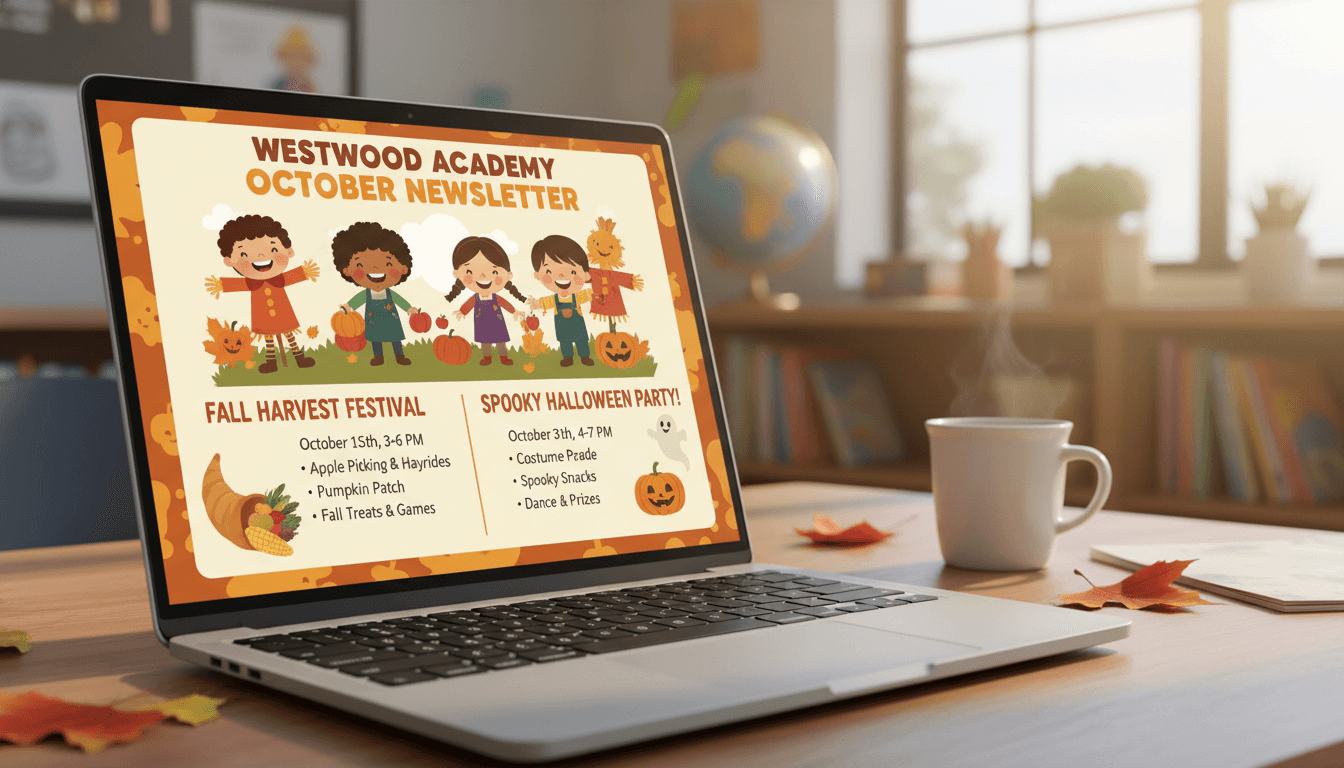
October Newsletter Template for Elementary School Parents
October is the month when the school year starts to feel real. The honeymoon phase from September is over, academic work is in full swing, Halloween is coming, and parent-teacher conferences are on the calendar. A well-timed October newsletter handles the logistics families need before they start emailing you individually to ask the same questions.
This template covers the four things October families need most. Fill in your specifics and send it before the second week of October.
Opening: October Is When the Year Gets Real
Frame October as the month where routines are solid and the real academic work is underway. Families who understand this context take the newsletter seriously rather than skimming it for party dates.
Sample opening: "We have been in school for six weeks and the routines are solid. Students are working hard and I am seeing real growth. October has a few important items: our fall party on October 31st, parent-teacher conferences the week of October 20th, and our first academic progress check-in. Details below."
Halloween or Fall Party: Policies and What to Send
Be specific about your school's policy. Some schools do full Halloween costumes, some allow fall-themed dress only, and some have moved entirely to harvest celebrations with no costume component. Whatever your school does, state it directly so families are not guessing.
Cover: date, time, costume or dress policy, treat policy (store-bought only, nut-free, no treats at all), and whether families can attend. Example: "Our fall celebration is Thursday, October 31st from 2:00 to 2:45 PM. Students may wear a costume to school. Costumes should be school-appropriate and cannot include masks, fake weapons, or anything that prevents the student from working normally during the morning. Treats are welcome but must be store-bought and nut-free. Families are welcome to join us from 2:00 PM."
Parent-Teacher Conferences: How to Schedule Your Slot
Give families all the information they need to schedule a conference in one place. Include the conference week, how to sign up, the length of each slot, and what you will cover.
Example: "Parent-teacher conferences are the week of October 20th. Slots are 15 minutes. Sign up using the link below by October 10th. I will share each student's Q1 reading assessment data, math benchmark score, and a writing sample, along with my observations about work habits and classroom participation. If you have specific concerns, email me before your conference so I can pull the relevant materials."
Add the link or sign-up instructions after this paragraph. Families who can click directly to the sign-up form from the newsletter fill the conference slots faster than families who get a paper form.
Q1 Academic Progress: Where We Are
Do not wait for the conference to give families a sense of where the class is. A brief group-level update tells families what the data looks like and what you are doing in response.
Example: "We completed our Q1 reading fluency assessment in early October. About 75% of students are meeting or exceeding grade-level benchmarks. For students below benchmark, I have adjusted my small group assignments and am providing additional fluency practice four days per week. If your child is in a targeted group, I will explain this during our conference. In math, all students have demonstrated mastery of addition and subtraction with regrouping. We are moving into multiplication this week."
Fall Harvest Activities and Seasonal Learning
October is strong for connecting science, math, and literacy to seasonal content. Let families know what fall-themed activities are happening and how they connect to real academic work.
Example: "This month we are doing two fall science activities. We will observe the changes in a local tree over the next four weeks and record our observations in science notebooks, connecting to our ecosystems and seasons unit. We are also doing a pumpkin measurement lab: students will estimate and measure circumference, height, and weight, then graph the class data. Families can donate a small pumpkin if you would like your child to have their own for the measurement lab. Any size works."
Behavior and Classroom Culture in Q2
October is when behavior patterns from September start to clarify. Let families know what you are working on as a class and what you need them to reinforce at home. A brief, factual note works better than a general statement about effort.
Example: "We are working on two specific behaviors this month: completing classwork before free time and using inside voices during transitions. Both are showing up consistently enough that I want to address them now rather than at conferences. At home, the most useful support is asking your child what they accomplished independently today, not what grade they got. That question reinforces the habits we are building in class."
Reading at Home: October Goal
Give families a specific reading goal for October with a clear expectation. Vague reading encouragement does not produce the habit. A specific target does.
Example: "Our class reading goal for October is 15 minutes of independent reading every school night. At this age, reading aloud together also counts. The genre does not matter. Fiction, nonfiction, graphic novels, and magazine articles all build the same core skills. If your child is resistant to reading independently, have them read aloud to you for the 15 minutes. Reading stamina is built through time in text, not through the difficulty of the material."
October Events and Dates
Close with a clean list of October dates. Include conferences, party, picture retake day if applicable, any early release days, and Columbus Day or Indigenous Peoples' Day depending on your school calendar.
Sample dates: October 10 (conference sign-up deadline), October 13 (Columbus Day/Indigenous Peoples' Day, check your district), October 14 (picture retakes), October 20-24 (conference week), October 31 (fall party, 2:00 PM). Confirm all dates with your school calendar before sending.
Get one newsletter idea every week.
Free. For teachers. No spam.
Frequently asked questions
What should go in an elementary school October newsletter?
October newsletters have four main items: Halloween or fall party logistics, parent-teacher conference scheduling, a Q1 academic progress update, and any fall harvest or seasonal school activities. October is also when teachers see the first signs of students who are falling behind, so a newsletter that communicates academic status honestly and invites conversations before conferences is far more effective than waiting for the sit-down meeting to surface concerns.
How do I handle Halloween party guidelines in the newsletter?
Spell out the school's costume policy, the party date and time, food allergy restrictions, and whether families can send treats. Many schools have moved away from traditional Halloween parties toward fall harvest celebrations, so clarify which framework your school uses and what that means for costumes and decorations. Parents plan ahead for Halloween week, so getting the newsletter out in the first week of October gives families enough time.
How do I communicate parent-teacher conference scheduling in the newsletter?
Give families the scheduling window, how to sign up (sign-up sheet, online link, or teacher-assigned slots), conference length, and what to expect from the meeting. Let families know what data you will share so they can prepare questions. A parent who knows the conference will include a reading fluency score and a writing sample is more prepared and more engaged than one who walks in not knowing what to expect.
How do I share Q1 academic progress without waiting for the conference?
A brief academic snapshot in the October newsletter keeps families informed between report cards. You do not need to share individual scores. A statement like 'most students have met or exceeded our Q1 reading goal and we are on track for Q2' gives families context. If you are seeing a pattern that warrants attention, for example a homework completion issue that is affecting a significant number of students, the newsletter is the right place to address it as a group.
What is the best newsletter tool for elementary schools sending October updates?
Daystage helps elementary teachers send October newsletters that include conference sign-up details, Halloween party logistics, and academic updates in one organized email. The newsletter reaches every family inbox directly, which means conference sign-up information and costume guidelines do not get lost in the backpack folder. You can include a direct link to your conference sign-up form so families can act on it immediately when they open the newsletter.

Adi Ackerman
Author
Adi Ackerman is a former classroom teacher and curriculum writer with 8 years in K-8 schools. She writes about school communication, parent engagement, and what actually works in real classrooms.
More for Elementary
Ready to send your first newsletter?
3 newsletters free. No credit card. First one ready in under 5 minutes.
Get started free