
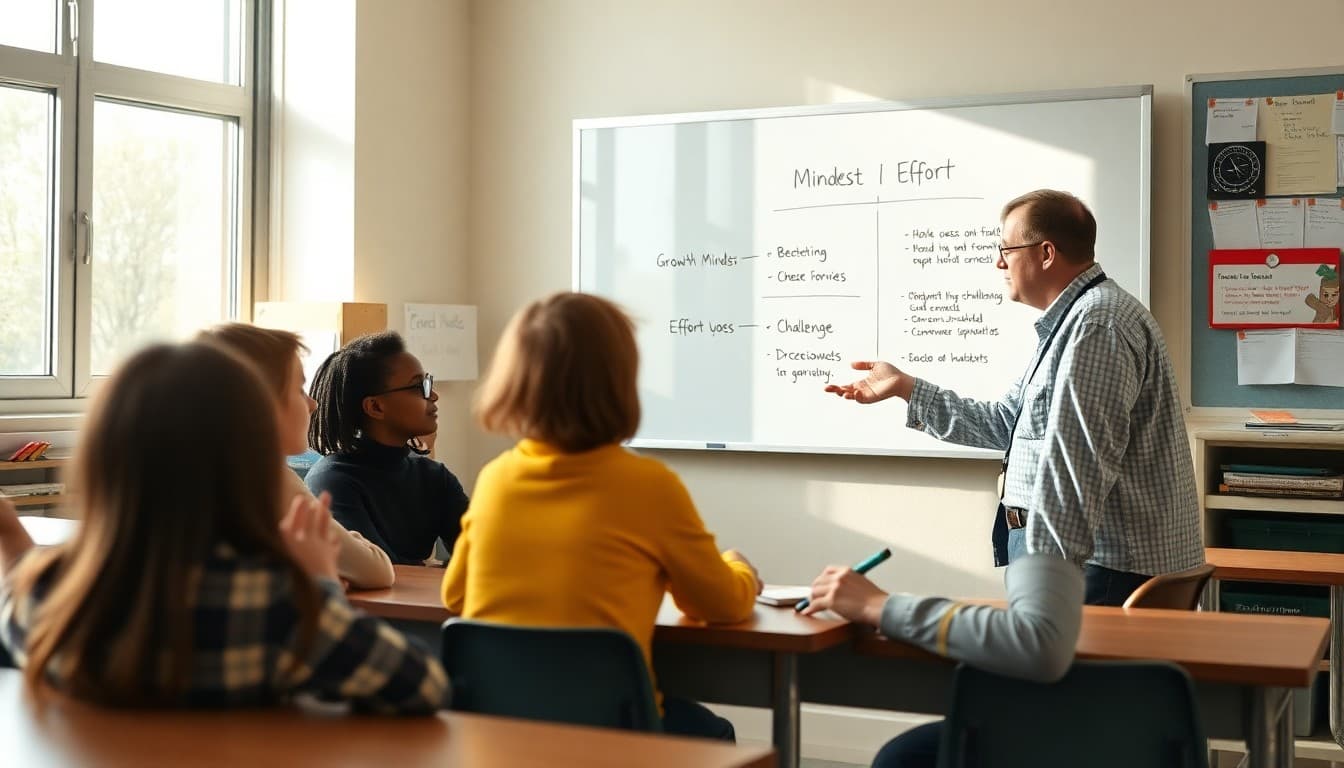
Growth Mindset School Newsletter for Students and Families

Carol Dweck's research on mindset is one of the most widely cited findings in education psychology, and it is also one of the most frequently misapplied. Schools that send growth mindset newsletters saying "believe in yourself and you can do anything" have missed the point. The research is specific. The application should be too. A growth mindset newsletter that explains the actual science and gives families the actual language is genuinely useful. One that offers motivation-poster platitudes is not.
Explain the research briefly and accurately
"Researcher Carol Dweck at Stanford spent decades studying why some students persist through challenges while others give up. She found that the key variable is what students believe about ability. Students who believe intelligence is fixed avoid challenge because failure feels like a verdict on their worth. Students who believe ability can grow through effort treat challenge as an opportunity. That belief, it turns out, changes measurable academic outcomes."
That is the research in four sentences. Families who understand the finding can apply the language more effectively than families who just know the buzzword.
Show how growth mindset is taught in the school
Tell families what this looks like in their child's classroom right now. "Teachers at Jefferson Elementary praise effort and strategy rather than intelligence. When a student gets a hard problem right, the feedback is 'you kept trying different approaches until one worked' rather than 'you are so smart.' When a student struggles, teachers ask 'what strategy have you tried so far?' and 'what could you try next?' rather than offering the answer."
Families who see the school applying the research consistently are more likely to align their own language at home.
Give families the specific language to use
The most actionable part of a growth mindset newsletter is the language guide for families:
- Instead of "you are so smart," try "you worked really hard on that"
- Instead of "this is too hard," try "this is hard, which means my brain is growing"
- Instead of "I am not good at math," try "I am not good at this yet"
- Instead of "you got an A, you must be smart," try "you got an A, what strategies helped you most?"
- When a student fails: "What did you learn from this? What would you try differently?"
Post this list on the refrigerator. The language shift is small. The cumulative effect over months and years is not.
Address the most common misconception
Many families hear "growth mindset" and interpret it as "praise effort no matter what." Dweck herself has pushed back on this misinterpretation. The newsletter should address it directly: "Growth mindset is not about praising students for trying hard at something that is not working. It is about praising effort plus effective strategy. When a student tries hard and still fails, the growth mindset response is 'let us look at what you tried and think about a different approach,' not just 'good effort.'"
Share a classroom example
A specific classroom example is worth more than any amount of theory: "Last week, a student in Ms. Ortiz's class got a math test back with a 62 and started to say 'I am bad at math.' Ms. Ortiz stopped her and asked her to add one word to the end of that sentence. The student thought for a second and said 'I am bad at math yet.' That 'yet' changed the conversation. The student asked to stay in at lunch and try the problems she missed. She got them right."
Template: growth mindset family language section
"This month, our school is focusing on growth mindset in every classroom. Here is what you can do at home: when your child succeeds, ask 'what worked?' not 'aren't you smart?' When they struggle, ask 'what have you tried?' and 'what could you try next?' When they say 'I can't do this,' teach them to add the word 'yet.' These three habits, practiced consistently, are among the most powerful things a family can do to build a learner who persists."
Get one newsletter idea every week.
Free. For teachers. No spam.
Frequently asked questions
What should a growth mindset school newsletter include?
Briefly explain Carol Dweck's research in accessible language, describe how the school is teaching growth mindset in classrooms with specific examples, identify the most common ways fixed mindset shows up for students, and give families specific language to use at home. The newsletter that only explains the theory without giving families practical tools misses the main opportunity.
How do you explain growth mindset to families who have not encountered the concept?
Start with the core finding: Carol Dweck's research at Stanford showed that students who believe their abilities can grow through effort perform better academically than students who believe abilities are fixed. That single sentence is enough foundation. Then move quickly to what this looks like in practice: praising effort and strategy rather than intelligence, framing challenges as opportunities to grow, treating mistakes as information rather than failure.
What language shifts should a growth mindset newsletter teach families?
Replace 'you are so smart' with 'you worked really hard on that.' Replace 'I am not good at math' with 'I am not good at this yet.' Replace 'this is too hard' with 'this is hard, which means my brain is getting a workout.' Replace 'I give up' with 'what strategy haven't I tried yet?' These specific phrase swaps are the most actionable part of a growth mindset family newsletter.
What are the common pitfalls in growth mindset school programs?
The most common problem is praising effort without praising effective strategies. 'You tried really hard' without 'let's think about a different approach' does not build growth mindset. It builds effort without direction. The newsletter should acknowledge this nuance: effort matters, but effort combined with good strategy is what produces growth. Families need to praise both.
How does Daystage support growth mindset communication across a school year?
Daystage lets you build a multi-newsletter series on growth mindset throughout the year, tracking how classroom practices evolve and sharing student examples of growth mindset in action. A quarterly growth mindset update that includes student stories and family language tips becomes a valued part of the school's communication rhythm.

Adi Ackerman
Author
Adi Ackerman is a former classroom teacher and curriculum writer with 8 years in K-8 schools. She writes about school communication, parent engagement, and what actually works in real classrooms.
More for School Culture
Ready to send your first newsletter?
3 newsletters free. No credit card. First one ready in under 5 minutes.
Get started free