
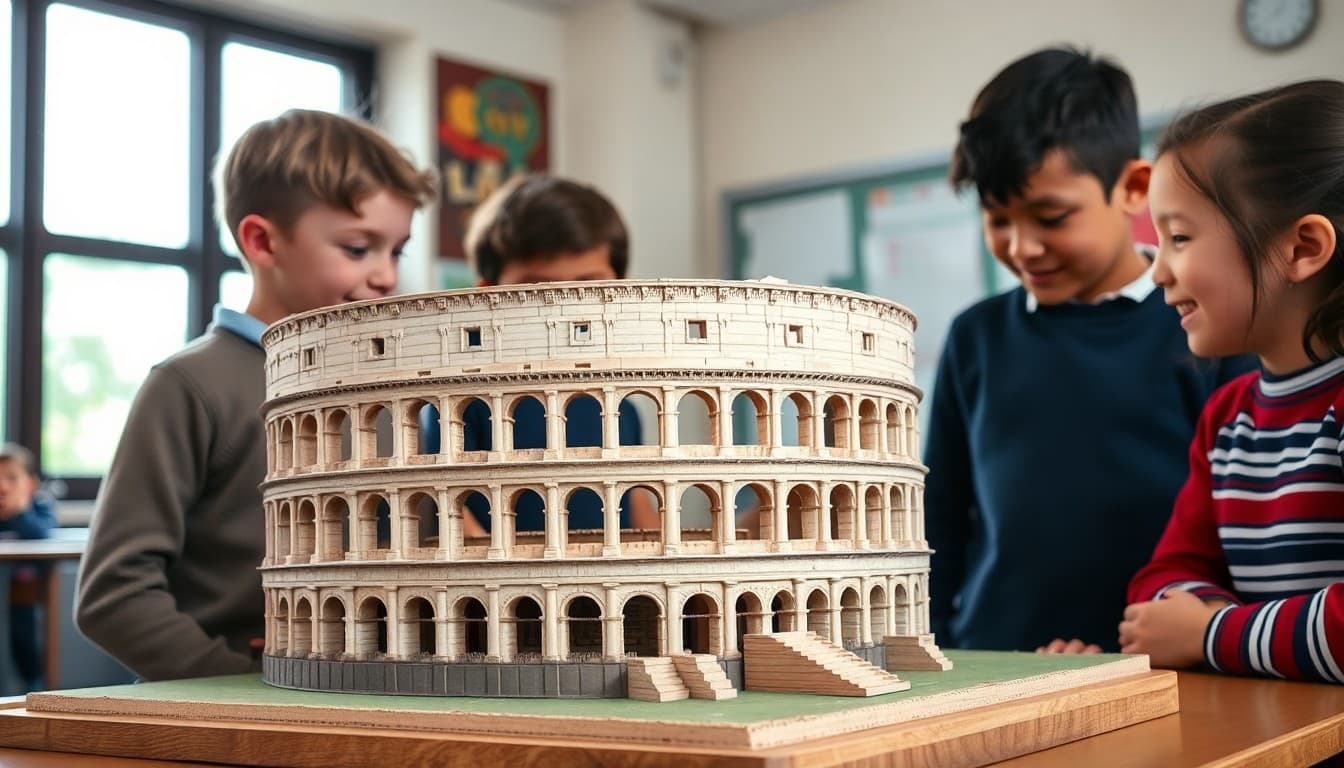
Newsletter for Your Ancient Rome Unit: Connecting Families to the Ancient World

Ancient Rome is one of the most direct ancestors of the modern Western world. The alphabet students write with, the roots of a third of English vocabulary, the concept of a republic with elected representatives, the engineering of aqueducts still standing two thousand years later: Rome is everywhere. A newsletter that helps families see these connections turns the unit from distant history into something immediately relevant.
What Your Unit Covers
Name the scope: the Roman Republic, the transition to the Roman Empire, the Pax Romana, the crisis and fall of the western empire, or Roman culture and contributions depending on your grade level and curriculum. Tell families which period and themes you focus on. A unit centered on the republic and its lessons for democracy looks different from one tracing the rise and fall of the empire. Both are valid; families should know which is yours.
Key Vocabulary
Republic (a government in which citizens elect representatives to govern on their behalf), senate (the governing body of the Roman Republic), emperor, patrician (a member of the wealthy Roman ruling class), plebeian (an ordinary Roman citizen), tribune (an official elected to represent plebeians), legion (a unit of the Roman army), aqueduct (a structure built to carry water over a distance), and the Roman Empire are the foundational terms. Brief definitions in the newsletter save a lot of homework confusion.
Why Rome Matters Today
Latin is the root of Spanish, French, Italian, Portuguese, Romanian, and about one-third of English vocabulary. The concept of a republic with a senate, citizen rights, and elected officials descends from Rome. Roman law principles, including the idea of innocent until proven guilty, are foundational to modern legal systems. Roman engineering produced roads, bridges, and aqueducts that shaped Europe for two thousand years. Your newsletter can invite families to spot these connections: "Ask your child to find three English words with Latin roots this week. Start with aqua, terra, and port."
The Republic and Democracy
Rome was not a democracy in the modern sense: only male citizens could vote, and wealthy patricians held most power. But it was a significant early experiment in representative government. The Roman Republic influenced the American founders, who modeled the Senate, the separation of powers, and the concept of citizen representation on Roman precedents. That connection gives students a way to see the Roman Republic as living history rather than dead civilization.
Roman Engineering at Home
Suggest families look up a Roman aqueduct online. The Pont du Gard in France, built around 19 BCE, still stands. Ask their child: how did Roman engineers build something that precise without modern tools? That question leads to a discussion of mathematics, surveying, and the use of the arch, all concepts the unit covers. The arch is the most important Roman engineering innovation and the structural principle behind most domed buildings today, including the US Capitol.
Sample Newsletter Excerpt
Here is language you can use: "This month we study Ancient Rome. We will look at the Roman Republic, how it governed, and why it eventually gave way to the Roman Empire. We will also examine Rome's contributions to language, law, engineering, and the idea of democratic government. At home, try this: look up the word 'senator.' Where does it come from? What did it originally mean in Rome? Then ask your child: how is the U.S. Senate similar to the Roman Senate? How is it different? That comparison connects two thousand years of government history in one conversation."
Julius Caesar and the End of the Republic
If your unit covers the fall of the Republic, Julius Caesar is the central figure. His crossing of the Rubicon, his assassination on the Ides of March, and the civil war that followed are foundational events. The phrase "crossing the Rubicon" still means making an irreversible decision. Tell families if this is part of your unit so they can watch for it in homework and ask the right questions.
Sending the Ancient Rome Newsletter
Daystage lets you include a map of the Roman Empire, a Latin word list, and home activities in one newsletter to every family. A map is especially valuable for a world history unit because it immediately shows families the geographic scale of what they are studying. Write your Ancient Rome update, add a map, and send before the unit begins.
Get one newsletter idea every week.
Free. For teachers. No spam.
Frequently asked questions
What should an Ancient Rome unit newsletter include?
Cover the scope of your unit (republic, empire, or both), key periods and figures, vocabulary, the aspects of Roman culture most relevant to today, and home activities that connect Roman engineering, law, and language to students' everyday experience.
How do I explain why Ancient Rome matters to families?
Rome's influence is everywhere. The Roman alphabet, Latin roots of English words, Roman law concepts, aqueduct engineering, and the idea of a republic with elected representatives are all Rome's contributions. Students who study Rome are studying the foundation of Western civilization and direct ancestors of modern democratic systems.
What vocabulary should an Ancient Rome newsletter include?
Republic, senate, emperor, patrician, plebeian, tribune, legion, aqueduct, gladiator, the Roman Empire, Julius Caesar, and Latin are the key terms. Brief definitions help families follow homework discussions and support review for assessments.
What home activities connect to an Ancient Rome unit?
Look for Latin roots in everyday English words (port, rupt, scrib). Look at a map of the Roman Empire at its height and compare it to a modern map. Look up a Roman aqueduct online and ask: how did they build something that complex without modern tools? These activities take 10 minutes and connect the unit to the real world.
What tool helps teachers send world history unit newsletters to families?
Daystage is a classroom newsletter platform that lets teachers send formatted history unit updates with vocabulary, home activities, and maps or images to all families at once. Teachers use it throughout the history year to keep families connected to the content.

Adi Ackerman
Author
Adi Ackerman is a former classroom teacher and curriculum writer with 8 years in K-8 schools. She writes about school communication, parent engagement, and what actually works in real classrooms.
More for Classroom Teachers
Ready to send your first newsletter?
3 newsletters free. No credit card. First one ready in under 5 minutes.
Get started free