

March Newsletter Ideas for 3rd Grade Teachers: What to Send This Month
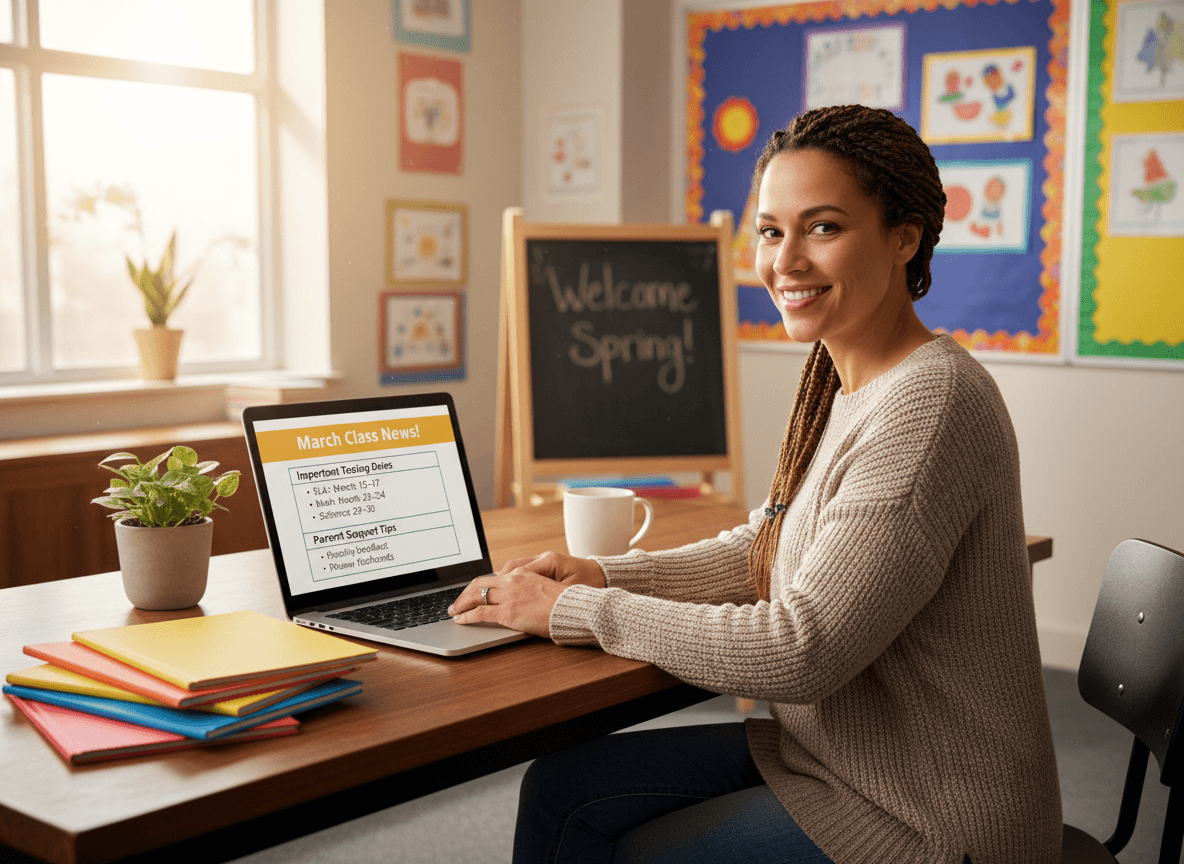
March is the most academically consequential month of 3rd grade for many students. State testing either opens this month or is directly on the horizon. Multiplication fluency is in its final push. Spring break is approaching, and the decisions parents make about reading during that week have real impact on testing readiness. Your March newsletter is the communication that keeps parents informed, calm, and engaged during the stretch that matters most.
Open with the testing timeline, clearly and calmly
Parents of 3rd graders who find out about state testing from a newsletter in March feel informed. Parents who find out the week before the test feel blindsided. Your newsletter should state the testing window clearly: when it begins, how many days it runs, what subjects are covered, and roughly what the test looks like.
Avoid language that raises the stakes unnecessarily. Third grade state tests are important, but the best preparation is the academic work already happening in your classroom. Tell parents that, specifically, and you reduce the anxiety that leads to unhelpful cramming at home.
Give a direct multiplication fluency update
March is the final push for multiplication fluency before spring testing. Your newsletter should name where the class is: which fact families are solid, which need more work, and what fluency looks like on a timed test or in the context of multi-step problems. Give parents a specific home practice recommendation for this month.
Focus on the fact families that matter most for the testing window. If your class is still working on the sixes, sevens, eights, and nines, say so directly. Five minutes of daily flashcard or oral practice, starting now, makes a measurable difference by the time testing begins.
Connect Women's History Month to the classroom work
March is Women's History Month, and 3rd grade is ready for substantive engagement with it. If your class is reading biographies of women scientists, civil rights leaders, or athletes, name who you are studying. If students are writing essays, doing research, or creating visual projects, describe the academic goal behind them. Parents who understand that Women's History Month is connected to your ELA and social studies standards treat it as curriculum, not decoration.
Name the spring break reading goal
Spring break is a week-long pause at a moment when reading stamina and comprehension are still building toward testing readiness. Your newsletter should give parents a concrete reading goal for the break: thirty minutes of chapter book reading each day, a visit to the library, or an audiobook on a car trip. Name the specific habit and explain briefly why it matters at this particular point in the year. Parents who understand the timing are more motivated to follow through.
Address testing-week routines before they are needed
The week before state testing begins is too late to introduce the idea of good sleep and a calm morning. Your March newsletter should plant those seeds now. "The most helpful thing families can do during testing is maintain regular sleep, keep mornings calm, and avoid scheduling anything stressful before school on testing days." That is the whole message. Simple and direct.
Update parents on the ELA focus for this stretch
Third grade ELA in March often focuses on reading comprehension strategies for complex text: identifying main idea and key details in informational text, making inferences in fiction, and writing extended text-based responses. If these are the skills your class is working on, describe what they look like in practice. Parents who know their child is learning to write a response using evidence from the text can ask better questions at home than parents who just know their child is "doing reading."
Close with a simple action for spring break and beyond
End with one specific thing parents can do during spring break and one they can do in the weeks that follow. Read together for thirty minutes every day of the break. Keep the multiplication practice habit going through April. Simple, specific, and tied to something real happening in school right now.
Daystage makes it straightforward to send a March 3rd grade newsletter that covers the testing window, multiplication update, and spring break reading goal in one well-organized communication. Parents read it, follow through, and come back after spring break ready to support the final push.
Get one newsletter idea every week.
Free. For teachers. No spam.
Frequently asked questions
What is the most important thing a 3rd grade March newsletter needs to communicate?
State testing. March is when the testing window opens in most states, and parents of 3rd graders need to hear from you about what the test covers, what date testing begins, and what the most helpful thing they can do at home is. Calm, direct communication now prevents the panicked emails you get the week of testing when families feel blindsided. The newsletter is your best tool for setting the right tone early.
How do I write about multiplication in a March 3rd grade newsletter without sounding like a warning?
Frame it as a final push, not a failure. Something like: 'We are in the last stretch of building multiplication fluency before state testing. Most students are doing well, and five minutes of daily practice at home makes a real difference. Focus on the sixes, sevens, eights, and nines this month.' That is honest, specific, and actionable. Parents respond to concrete guidance much better than general pressure.
Should the March 3rd grade newsletter address spring break reading goals?
Yes. Spring break falls at a critical moment in 3rd grade, right before testing season intensifies. Your newsletter should tell parents what reading looks like during the break: thirty minutes per day of chapter book reading, a trip to the library, or an audiobook during long car rides. Name the specific habits rather than just saying 'keep reading.' The more specific the suggestion, the more likely families are to follow through.
What Women's History Month content is appropriate for a 3rd grade March newsletter?
Third grade students are ready for more complex Women's History Month content: biographies that include obstacles and perseverance, stories of women in STEM or civil rights, and research projects that go beyond simple facts. If your class is working on a written or visual project, describe it in the newsletter. Parents who know what their child is learning are better positioned to extend the conversation at home.
What newsletter tool works best for 3rd grade teachers?
Daystage is ideal for third grade teachers who need to send a newsletter that covers testing updates, multiplication practice, and spring break guidance all in one place. The editor is simple and fast. Parents get consistent formatting in their inbox every week, which makes the newsletter a reliable source of information rather than a one-off communication they might miss.

Adi Ackerman
Author
Adi Ackerman is a former classroom teacher and curriculum writer with 8 years in K-8 schools. She writes about school communication, parent engagement, and what actually works in real classrooms.
More for Classroom Teachers
Ready to send your first newsletter?
3 newsletters free. No credit card. First one ready in under 5 minutes.
Get started free