
First Grade Book Report Newsletter: A Clear Guide for Parents
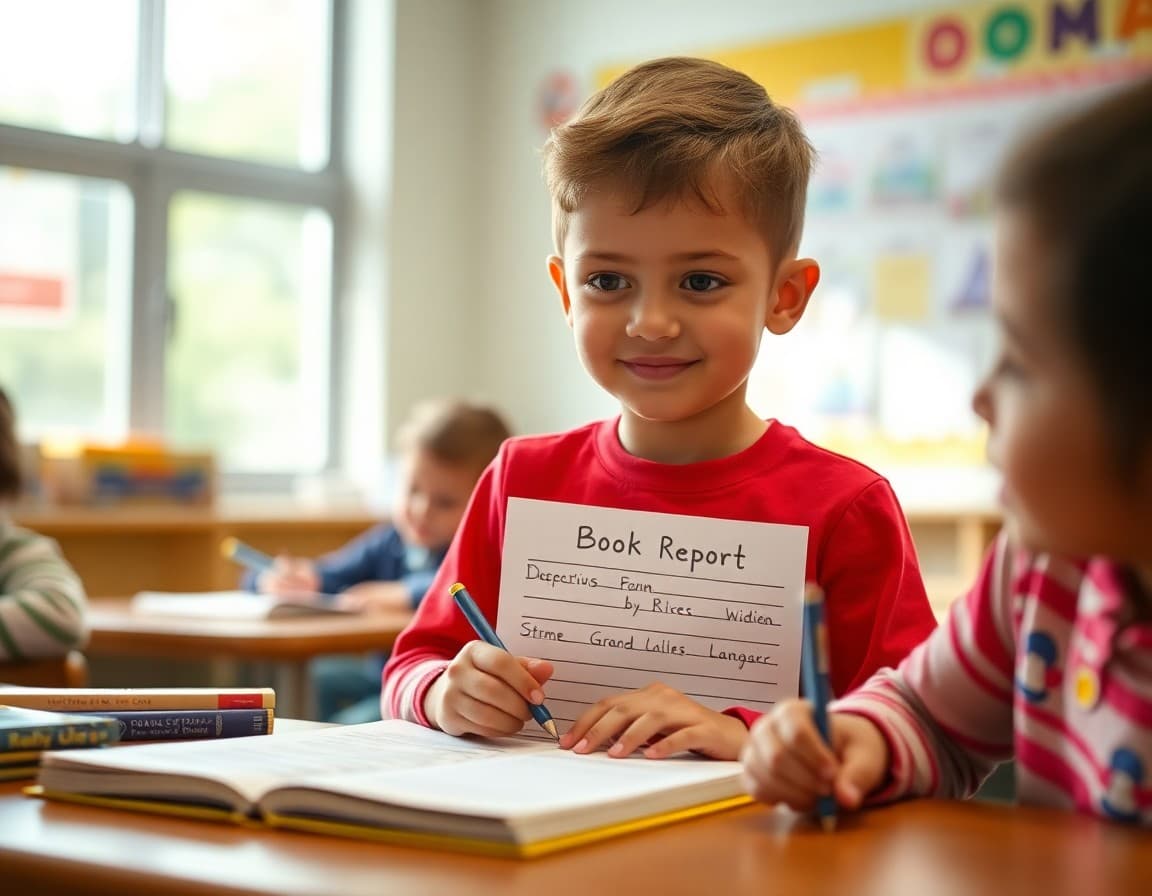
First grade book reports work best when families understand exactly what the assignment is, what it is not, and what their role in the process looks like. A clear newsletter prevents the two most common problems: parents who do too much and end up submitting their own writing, and parents who do too little because they were not sure how much help was appropriate.
Define the Assignment Clearly
Start with a one-paragraph description that leaves no room for interpretation. Something like: "Students will read one picture book and complete a one-page response form. The form asks for the title, author, a drawing of their favorite scene, and 2-3 sentences answering the prompts. Parent help is expected. The writing should be in your child's own words, even if you write it down for them."
The Response Prompts to Include
If you are using a response template, include the prompts in the newsletter. Four prompts that work well at the first grade level: What was the main character's name? What was the problem in the story? How was the problem solved? What was your favorite part and why?
Some teachers add a fifth prompt for enrichment: Would you recommend this book to a friend? That adds a judgment element that more advanced first grade readers can engage with.
Choosing the Right Book
Give families guidance on book selection. For independent readers, a book at their current reading level is ideal. For students who are still developing, a family read-aloud is completely appropriate. Recommend a range of options: early readers like Elephant and Piggie or Fly Guy for developing readers, Mercy Watson or Henry and Mudge for emerging chapter book readers, Biscuit or Pete the Cat for students who need accessible text.
What Good Looks Like: A Sample Response
Include an example of a good first grade book response in the newsletter. Seeing what "right" looks like is more useful than reading 3 paragraphs of instructions. A sample response that works:
Book: Elephant and Piggie: Can I Play Too?
Main character: Gerald the elephant
Problem: Snake wanted to play but could not hold hands.
How it was solved: They found a new way to play together.
Favorite part: I liked when Snake got really long. It was funny.
That level of writing, with the spelling and sentence structure of a first grader, is exactly what you want to see.
Due Date and Submission Instructions
Be specific: the completed form is due in the Friday homework folder on [date]. If families can also email a photo of the completed form, say so. A two-day grace period for late submissions is worth noting if you have one, because it prevents the "we were out of town" email from becoming a crisis.
How You Use the Reports
Tell families what you do with the completed reports. Do students share their books with the class? Do you display them on a reading bulletin board? Do you use them as conference materials? Parents are more motivated to help with assignments that feel purposeful.
Grading the Book Report
If you grade book reports, be transparent about the criteria. For first grade, most teachers assess on: completion, whether the student can discuss the book in person, and evidence that the child actually read (or heard) the book. Effort and engagement matter more than spelling accuracy.
Get one newsletter idea every week.
Free. For teachers. No spam.
Frequently asked questions
What does a first grade book report typically look like?
A first grade book report is usually a one-page response that includes the book title and author, a drawing of a favorite scene or character, and 2-4 sentences in the student's own words about the story. It might include prompts like: who was the main character, what was the problem, how was it solved, and what was your favorite part. It should look like student work, with inventive spelling and simple sentences.
How much writing should a first grader do for a book report?
Two to four sentences is appropriate for most first graders, depending on the time of year. Early in the year, one sentence per prompt with parent support is fine. By spring, many first graders can write 2-3 sentences independently using a template. The goal is meaningful engagement with the text, not a polished composition.
Can first graders do book reports on books they have read independently?
Yes, if the book is at their independent reading level. Students reading at levels D-J (Fountas and Pinnell) can choose from a curated list of books. Students who are still developing readers may use a book read aloud by a parent. Your newsletter should clarify both options so families with struggling readers do not feel excluded from the assignment.
How should parents help without doing the book report for their child?
Parents should read the book with their child, ask comprehension questions afterward, and scribe if the child cannot yet write independently. The parent's role is logistics and support, not composition. If the parent is writing full sentences in their own vocabulary, the report is no longer the child's work. A good rule of thumb: if the sentences sound like a 6-year-old wrote them, you have the balance right.
Does Daystage make it easy to share book report templates with first grade families?
Yes. You can embed a downloadable template link, a photo of a completed example, and the due date all in one Daystage newsletter. Many first grade teachers send the book report instructions as part of their regular Friday newsletter rather than as a separate communication, which reduces the number of messages families need to track.

Adi Ackerman
Author
Adi Ackerman is a former classroom teacher and curriculum writer with 8 years in K-8 schools. She writes about school communication, parent engagement, and what actually works in real classrooms.
More for Classroom Teachers
First Grade Reading Level Newsletter: Talking to Parents About Leveled Reading
Classroom Teachers · 7 min read
Reading Updates in Classroom Newsletters: What Parents Want to Know
Classroom Teachers · 5 min read
How to Announce a Classroom Book Club in Your Parent Newsletter
Classroom Teachers · 5 min read
Ready to send your first newsletter?
3 newsletters free. No credit card. First one ready in under 5 minutes.
Get started free