
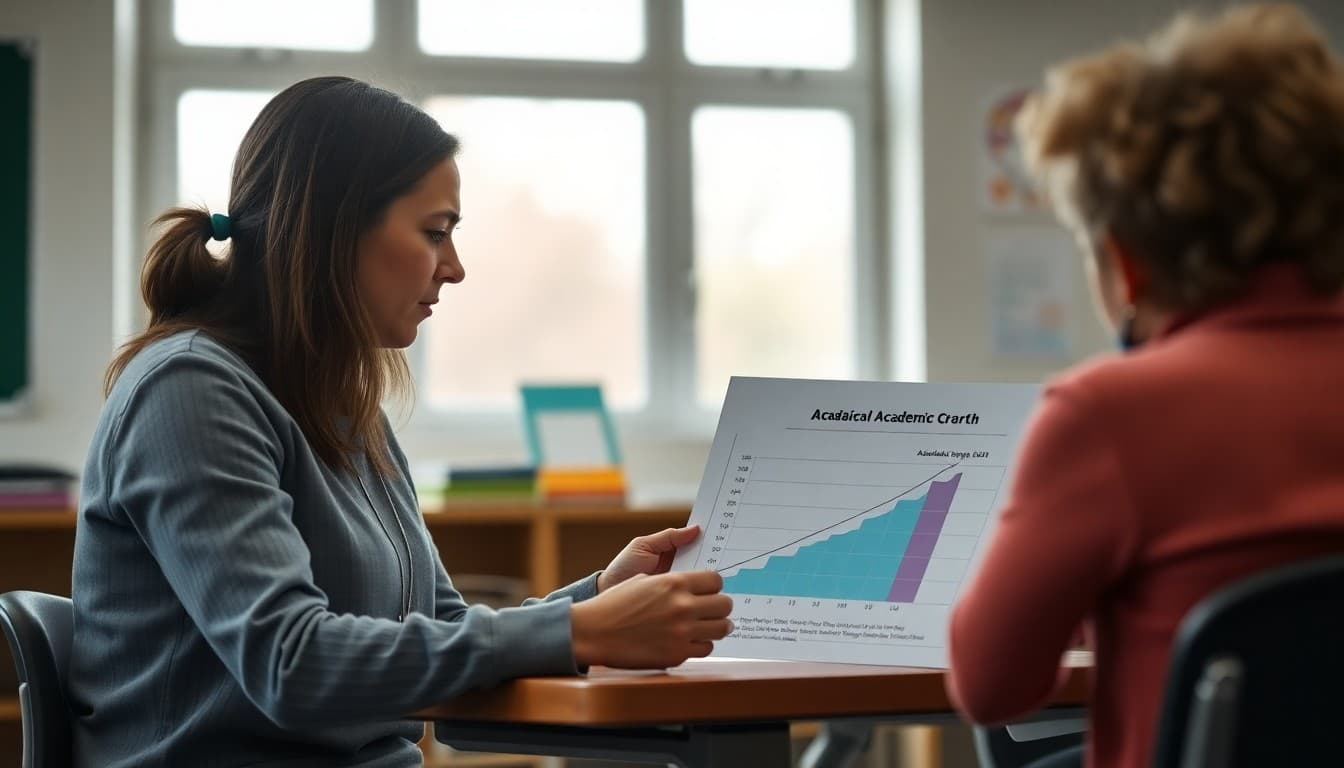
Classroom Growth Chart Newsletter: Tracking Academic Progress

Parents ask "how is my child doing?" because they want to know if their child is moving in the right direction, not just where they stand on a single test. A growth chart answers that question better than a single grade ever can. Your newsletter is the right place to explain the system, show families what growth looks like, and set up the conversation before report cards arrive.
The Difference Between a Grade and a Growth Chart
A grade is a snapshot. A growth chart is a story. A student who scored 62% in September and 81% in January has shown significant growth, but a 81% on a single report card tells you nothing about how far they have come. Helping families understand that distinction changes how they read assessments and talk to their children about school performance.
What You Are Measuring and Why
Tell families exactly which skills you track over time. Reading fluency in words per minute. Math fact accuracy. Writing scores on a four-point rubric. Whatever your growth metrics are, name them clearly. Then explain why those specific skills. "Fluency is a strong predictor of reading comprehension. When fluency grows, comprehension typically follows." That one sentence gives families context for why the measurement matters.
How Often You Assess
Describe your assessment schedule. Every six weeks? Each quarter? Monthly? Families want to know when the next data point is coming and when to expect to hear about results. "We assess fluency every six weeks. After the next assessment, I will send home individual reports so you can see your child's chart." That simple announcement sets expectations and reduces the surprise around report time.
What Class-Level Growth Looks Like
Share aggregate data that shows the class is making progress without identifying individual students. "Our class average on the fluency assessment grew from 78 words per minute in September to 107 words per minute in January. Most students are tracking ahead of the grade-level benchmark." That kind of update gives families confidence in the classroom and shows that the system works.
A Template Newsletter Section
Growth Tracking Update: We just completed our [quarter or month] assessment in [skill]. Here is where the class stands:
Class average: [number or range]
Change since last assessment: [direction and amount]
What this means: [one sentence on what the data shows about the class]
Individual reports: [when families can expect to see their child's specific data]
Connecting Growth to Home Practice
Always close the growth data section with a home connection. "If your child is working on fluency, ten minutes of out-loud reading each evening has a measurable effect on the next assessment." Or "For math facts, five minutes of daily practice with flashcards or a timed app makes a real difference over six weeks." Give families a specific, time-limited action they can take. That converts the data from information into action.
Preparing Families for the Conference Conversation
Before parent-teacher conferences, send a newsletter that previews what you will share about growth data. "At your conference, I will show you your child's personal growth chart for the year. You will see the scores from each assessment point side by side. It is a much better picture of progress than any single grade." Families who arrive having already read that understand the format and engage more meaningfully with the data.
What to Do When Growth Plateaus
Not every student grows every quarter. Sometimes growth plateaus. In your newsletter, acknowledge that this can happen and describe how you respond to it. "When a student's score does not change between assessments, we look at what changed in their routine, adjust our approach, and check in more frequently." Families feel better knowing you have a plan for that situation rather than just reporting numbers.
Get one newsletter idea every week.
Free. For teachers. No spam.
Frequently asked questions
What is a classroom growth chart and how do I explain it to parents?
A growth chart tracks one or more measurable skills over time, usually through repeated assessments at set intervals. Explain it as a way to see progress, not just a snapshot of where a student is today. 'We measure reading fluency every six weeks. Each score gets added to a chart that shows growth from the beginning of the year to now.' That description is enough for most families.
Should I share individual student growth data in the newsletter?
No. The newsletter is for the whole class audience. Share class-level trends and describe how families can access individual data. 'You can see your child's personal growth chart at our upcoming conference' or 'I will send home individual reports with the next report card.' Reserve individual data for private communication.
What growth metrics are worth tracking and sharing?
Reading fluency, math fact fluency, writing scores on a rubric, and assessment scores across quarters all make strong growth charts. The best choice is whatever you are already measuring consistently at regular intervals. Irregular assessment data produces noisy charts that are hard to interpret and harder to communicate to families.
How do I talk about a student who is not showing growth?
At the class level in the newsletter, focus on the students who are making progress and describe what you are doing for the class as a whole. For individual students who are not growing, that conversation belongs in a private meeting or phone call, not in a group newsletter.
Can I use Daystage to show visual progress updates in my newsletter?
Yes. You can include images in your Daystage newsletter, so a class-wide growth trend image or a visual of your tracking system can go directly into the send. That visual context helps families understand the concept faster than a text-only description.

Adi Ackerman
Author
Adi Ackerman is a former classroom teacher and curriculum writer with 8 years in K-8 schools. She writes about school communication, parent engagement, and what actually works in real classrooms.
More for Classroom Teachers
Ready to send your first newsletter?
3 newsletters free. No credit card. First one ready in under 5 minutes.
Get started free