
April Newsletter Ideas for First Grade Teachers: What to Send This Month

April in first grade is busy in the best way. Poetry Month gives reading instruction a creative boost. Earth Day connects science to the world outside the classroom. Spring assessments put a number on the progress students have made since September. And parents are starting to think about second grade, whether they say it out loud or not. Your April newsletter addresses all of it without overwhelming anyone.
Open with a clear picture of the month
Start with a brief overview: the major events coming in April, any dates parents need to hold, and the general rhythm of instruction for the month. Parents who can see the shape of the month from the first paragraph arrive at school events prepared and ask fewer last-minute questions.
Keep it to three or four sentences. A bulleted list of dates at the top of the newsletter also works well for families who skim before they read carefully.
Describe the spring assessment and what it measures
Most first graders encounter some form of spring reading assessment in April. Whether your school uses a running record, a district benchmark, or a state reading screener, parents deserve to know what the process looks like and what the results mean.
Explain the format briefly: the teacher reads with the student one-on-one, notes accuracy and comprehension, and determines a reading level. Give parents the end-of-year target: in many districts, first graders are expected to read at a level equivalent to early chapter books by June. Let parents know the best thing they can do is keep reading together every night. Twenty minutes of connected reading practice at home moves reading levels faster than almost anything else.
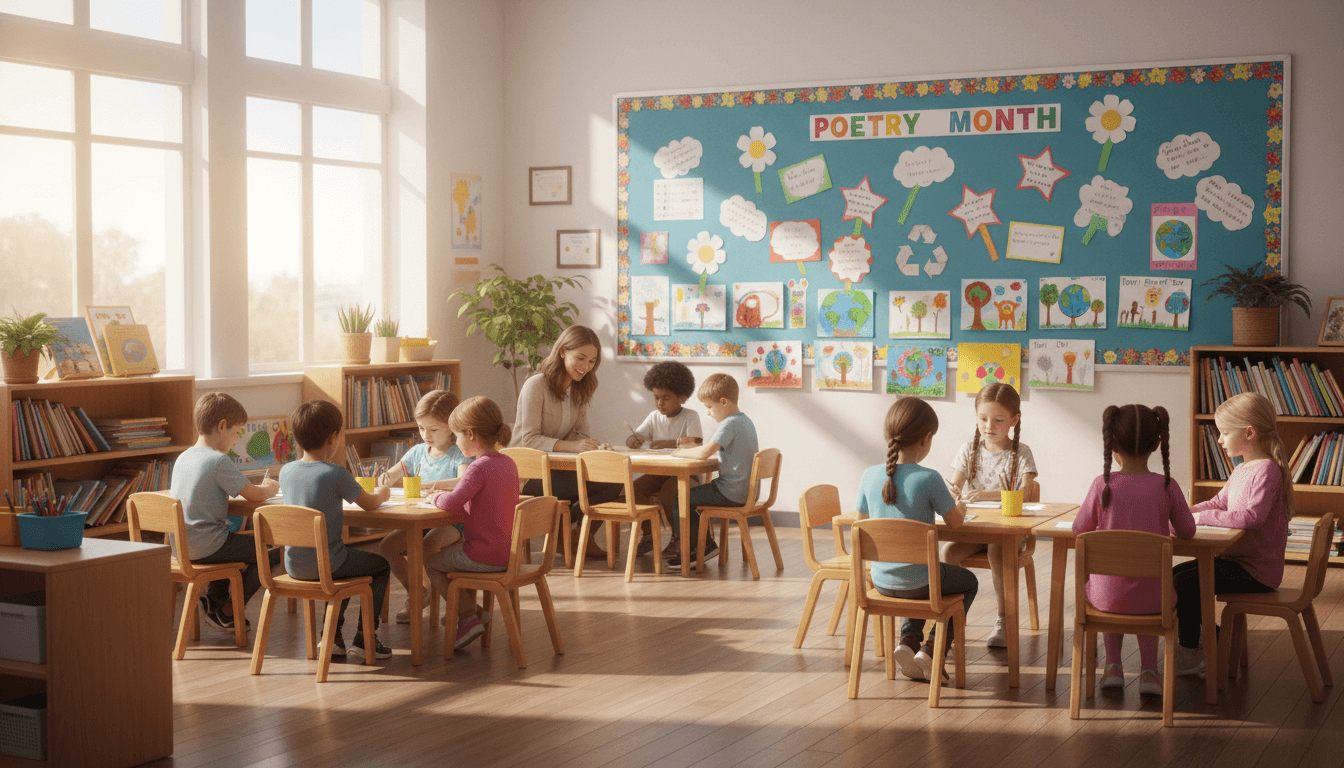
Bring Poetry Month into the newsletter
National Poetry Month in April is one of the best fluency tools available to first grade teachers. Short poems build word recognition, rhythm, and expression in ways that straightforward decodable texts do not. First graders who read poetry aloud develop prosody, the natural rise and fall of speech, that carries over into their reading of all texts.
Share a poem the class learned or wrote together. Suggest three poetry books families can find at the library: "A Pizza the Size of the Sun" by Jack Prelutsky, "Honey, I Love" by Eloise Greenfield, or any poetry reader from the Scholastic Guided Reading library. Challenge families to read one short poem at bedtime every night in April. It takes three minutes and makes a measurable difference.
Connect Earth Day to classroom learning
Earth Day on April 22 is a natural anchor for first grade science. Describe what your class is doing: sorting materials by whether they are recyclable, reading nonfiction books about the earth, drawing and labeling diagrams of the water cycle, or writing sentences about how they help the environment.
A simple home activity connects the classroom to family life: ask your child to find three things in your home that can be recycled. Take a walk and notice plants growing back after winter. These are low-effort for parents and meaningful to students who want to show what they know.
Update reading and writing milestones
April is a good moment to tell parents where most first graders should be with reading and writing and where the class currently stands. If most students are reading level F to J texts and the end-of-year benchmark is level J to L, name that. If students are writing three to five sentence paragraphs with a topic sentence and details, say so. Concrete milestone descriptions give parents a frame of reference that vague progress language does not.
Share the math work happening this month
First grade math in April often covers two-digit addition and subtraction, place value concepts, and early measurement using non-standard units. If your class is working on mental math strategies like counting on from the larger number or making tens, describe what that looks like so parents can reinforce the strategy at home. Consistent language between school and home speeds up mastery.
Close with a specific home action
End the newsletter with one thing parents can do this week. Read a poem together tonight. Ask your child what they learned about Earth Day. Practice the sight words that came home in the Friday folder. One concrete ask is more effective than a general reminder to support reading at home. Parents want to help; they just need a clear, specific direction.
Daystage makes it easy to send an April first grade newsletter that covers testing, poetry, and Earth Day in a single, readable message. Write it once and parents have everything they need for the month.
Get one newsletter idea every week.
Free. For teachers. No spam.
Frequently asked questions
What should a first grade April newsletter focus on that earlier months did not?
April is when first grade parents start to ask whether their child is on track for second grade. The newsletter should address reading levels directly: what the end-of-year benchmark looks like, where the class is, and what families can do at home to close any gaps. Being transparent about expectations at this stage prevents the end-of-year surprises that are hardest for families to process.
How should the April newsletter handle spring testing for first graders?
Most first graders participate in some form of spring reading assessment, whether it is an informal running record, a district-administered benchmark, or a state screener. The newsletter should name what is coming, explain what the assessment measures, and reassure parents that daily reading practice is the best preparation. Avoid framing it as high-stakes even if the data gets used for placement or intervention decisions.
What does Poetry Month look like in first grade and how should it appear in the newsletter?
First graders are ready for more complex poetry than Kindergarteners. They can read short poems independently, clap syllables, identify rhyme schemes, and begin writing their own two to four line poems. The newsletter should describe what poetry activities are happening in class, share a student poem or class poem as an example, and suggest that families read poetry aloud at home together. A poem a night is better fluency practice than most workbooks.
Should the April newsletter include information about the transition to second grade?
A brief mention is appropriate. First grade parents appreciate knowing what second grade will require: reading longer chapter books independently, writing in complete paragraphs, and handling multi-step math problems. You do not need to turn April into a second grade preview, but a sentence or two that says the class is building toward those skills can reassure parents who are watching their child's progress closely.
What newsletter tool works best for first grade teachers?
Daystage is designed for teachers who need to send a clear, professional newsletter without spending significant time on formatting. For an April first grade newsletter covering testing, poetry month, and Earth Day, the platform handles text, images, and links in one place. Parents get a consistent, readable message in their inbox, and writing it takes around fifteen minutes.

Adi Ackerman
Author
Adi Ackerman is a former classroom teacher and curriculum writer with 8 years in K-8 schools. She writes about school communication, parent engagement, and what actually works in real classrooms.
More for Classroom Teachers
ELA Curriculum Update in Your Classroom Newsletter: What Parents Need to Know
Classroom Teachers · 6 min read
How to Write About Tests and Quizzes in Your Classroom Newsletter
Classroom Teachers · 5 min read
Communicating a Community Service Project in Your Classroom Newsletter
Classroom Teachers · 5 min read
Ready to send your first newsletter?
3 newsletters free. No credit card. First one ready in under 5 minutes.
Get started free