
April Newsletter Ideas for Fifth Grade Teachers: What to Send This Month

April in fifth grade is the most loaded month of the year. State testing dominates the schedule for many teachers. Poetry Month offers a genuine creative and analytical outlet. Earth Day lands in the middle of it all. And somewhere in the background, parents are starting to think about middle school. Your April newsletter holds the whole picture together and gives families the information and calm they need to support their child through it.
Put the testing information front and center
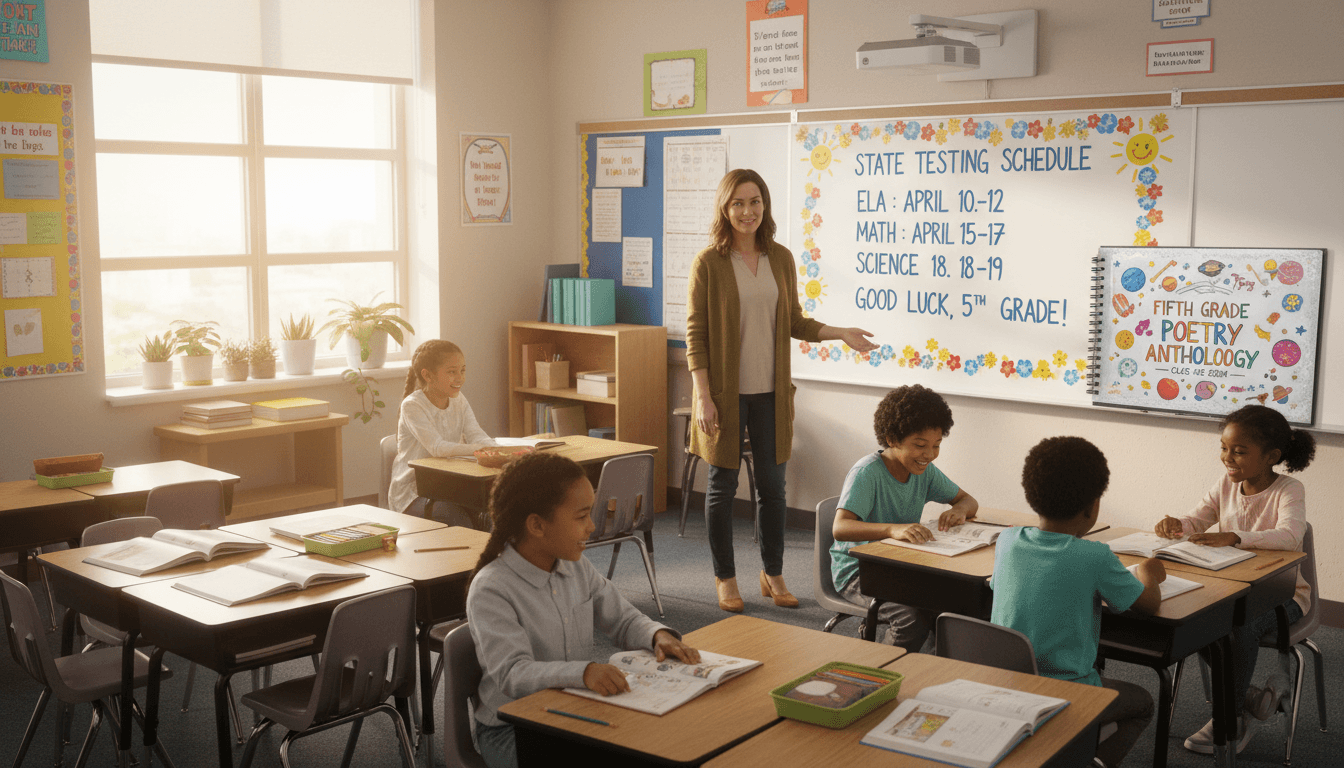
Fifth grade families expect the April newsletter to address state testing directly. Give them the name of the test, the specific dates and session schedule, which subjects are covered on which days, and how long each session lasts. If testing changes the daily schedule in any way, such as a delayed start, a modified lunch period, or a specific arrival requirement, include those details.
Parents who have the full picture before testing week begins can prepare their child's routine, arrange drop-offs, and communicate calmly with their child rather than scrambling for information the morning of the first session.
Give parents practical test-week guidance
The most valuable testing prep parents can provide is not academic. Name that clearly. The regular bedtime, an actual breakfast before school, a calm morning drop-off, and no score-based conversations on the drive home are more effective than any review packet sent home the week before.
Fifth graders are old enough to feel the weight of state testing and absorb their parents' stress directly. A parent who says "you know this material, just do your best" and then follows through with a normal evening routine gives their child a genuine advantage over a parent whose anxiety becomes another thing the student has to manage during a long testing session.
Feature the Poetry Month unit with real examples
National Poetry Month in fifth grade is worth more than a brief mention. At this level, students can write and analyze poetry with real sophistication: extended metaphors, shifts in tone, voice and perspective choices, and structural decisions that affect meaning. These are the same close reading and analytical writing skills that appear on state reading and writing assessments.
Describe what the class is working on. If students are writing persona poems that adopt the point of view of a historical figure, share that. If the class is studying how contemporary poets like Kwame Alexander use line breaks and white space, say so. Include a student poem with that student's permission. Real writing samples are always more persuasive than a description of the unit.
Connect Earth Day to fifth grade science
Earth Day on April 22 is a strong anchor for fifth grade science. Students at this level can engage with environmental systems at a meaningful depth: carbon cycles, the long-term effects of deforestation, the relationship between industrial agriculture and soil quality, or what drives ocean plastic accumulation.
Describe what specific project or inquiry your class is doing around Earth Day. Suggest a conversation families can have at home: ask your child what environmental issue they are researching and what solutions they found. Fifth graders often have more knowledge about these topics than their parents, and giving them a chance to teach what they know is a genuine motivator.
Preview the final stretch of fifth grade
April is late enough in the year that a brief note about what is still ahead is appropriate and useful. Tell parents what the class will be studying in May, what projects or presentations are coming, and how the year will close. If there is a fifth grade graduation, a capstone project, or a special event in May or June, put a placeholder date in the newsletter so families can plan around it.
Acknowledge the middle school transition
A brief mention of middle school is warranted in April. Parents are thinking about it, and the newsletter can normalize that transition without making it the main focus. A sentence noting that the reading, writing, and math skills being built this spring are exactly what sixth grade will require gives parents a useful frame. If your school has a middle school orientation or transition event scheduled, include that date here.
Close with one specific action for families
End the newsletter with a single, clear ask. Keep the regular bedtime through testing week. Ask your child what they are writing for Poetry Month. Talk about Earth Day at dinner. One specific action is easier to follow through on than a general invitation to stay engaged. Families who do one thing feel connected. That connection carries through to the end of the year.
Daystage makes it easy to send an April fifth grade newsletter that handles testing communication, poetry month, and middle school preview in one clean, readable message that parents open and finish.
Get one newsletter idea every week.
Free. For teachers. No spam.
Frequently asked questions
What does a fifth grade April newsletter need to cover that lower grade newsletters do not?
Fifth grade April newsletters carry more weight because parents are thinking about middle school transition alongside state testing. The newsletter should address both: what the state assessment looks like and how to support the student through it, and a brief preview of what comes after fifth grade. Parents who feel informed about the full picture are more likely to stay calm and supportive through the high-pressure stretch.
How should a fifth grade teacher communicate about state testing in April?
Be direct and specific. Name the test, the dates, the subjects tested, and what a good score looks like. Then give parents clear, practical guidance: keep the normal bedtime, feed the student a real breakfast on test days, and resist the urge to quiz them the night before. Fifth graders pick up on parent anxiety acutely. A parent who treats testing week as a normal week gives their child a better environment than one who treats it as a crisis.
What does Poetry Month look like in fifth grade?
Fifth grade poetry can go deep. Students at this level can analyze how a poet uses tone, voice, irony, and extended metaphor. They can write original poems with deliberate structural choices: line breaks for emphasis, repetition for effect, or a shift in the final stanza that changes the poem's meaning. The newsletter should describe what specific techniques the class is studying and include a student example. Parents who see the analytical work understand that poetry month is not a break from rigorous instruction.
Should the April newsletter mention middle school transition?
A brief mention is appropriate and appreciated. Parents of fifth graders are already thinking about middle school, and the newsletter can acknowledge that without making it the main topic. A sentence or two noting that the skills the class is building this spring, strong reading comprehension, organized writing, and fact fluency, are exactly what sixth grade teachers expect can help parents see the year's work in context.
What newsletter tool works best for fifth grade teachers?
Daystage is built for teachers who need to send a clear, professionally formatted newsletter quickly. For a fifth grade April newsletter covering state testing, poetry month, Earth Day, and middle school transition, the platform handles all of it without formatting hassle. Parents receive a consistent, readable newsletter in their inbox, and teachers spend about fifteen minutes writing it rather than an hour.

Adi Ackerman
Author
Adi Ackerman is a former classroom teacher and curriculum writer with 8 years in K-8 schools. She writes about school communication, parent engagement, and what actually works in real classrooms.
More for Classroom Teachers
Ready to send your first newsletter?
3 newsletters free. No credit card. First one ready in under 5 minutes.
Get started free