

School Newsletter for Haitian Creole-Speaking Families: Communication Strategies for Schools
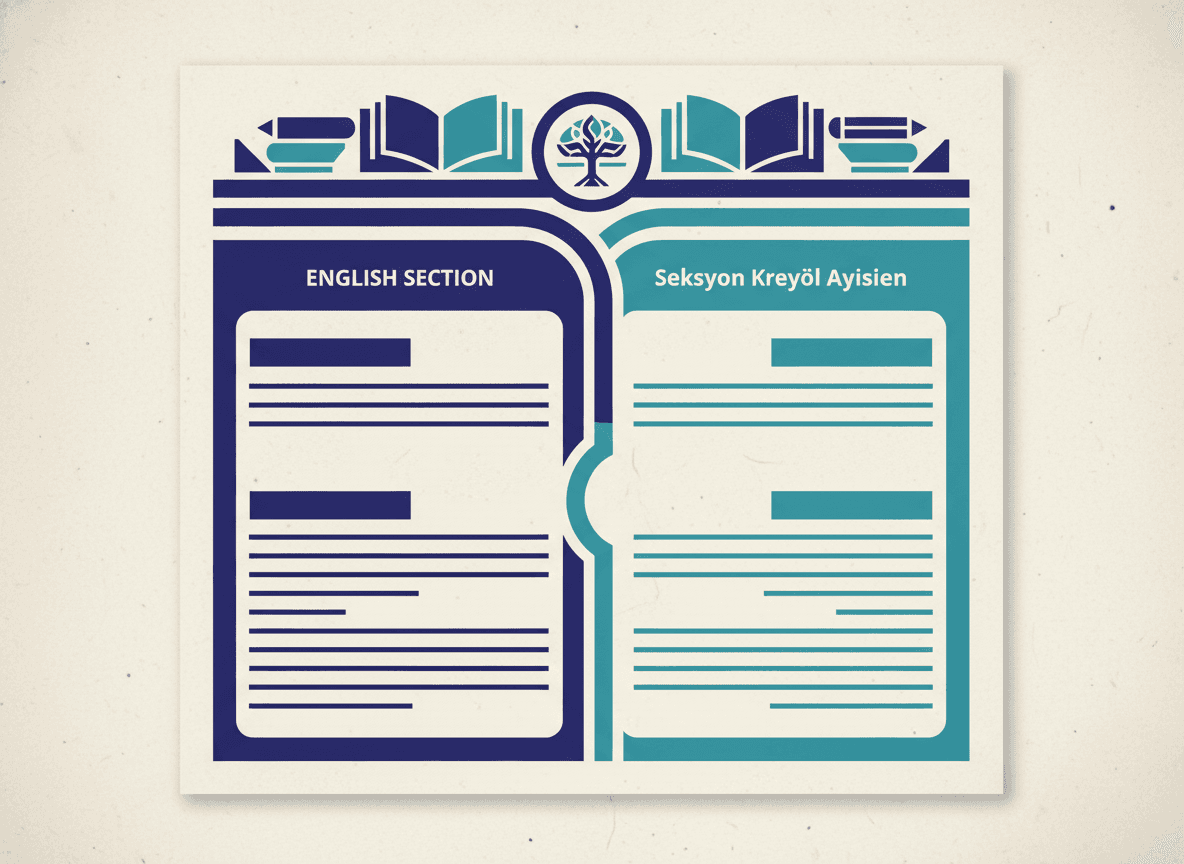
Haitian Creole is spoken by more than 800,000 people in the United States, with significant concentrations in Florida, New York, Massachusetts, and New Jersey. In districts where Haitian families are a substantial part of the school community, English-only communication leaves many parents without the information they need to support their children.
Haitian Creole-speaking families are often highly motivated to participate in their children's education. The barrier is not interest. It is access. A thoughtful, accurately translated newsletter in Haitian Creole removes a real obstacle and signals to the community that your school values their participation.
Understanding Haitian Creole as a written language
Haitian Creole (Kreyol ayisyen) has been a recognized official language of Haiti alongside French since 1987. It has a standardized orthography, meaning it has a formal written system. However, a significant portion of adult Haitian immigrants have varying levels of written Haitian Creole literacy depending on their educational background in Haiti, where French was historically the primary language of instruction.
What this means practically: some Haitian families will read Haitian Creole comfortably. Others, particularly those who completed their education in French-language schools, may read French more fluently than Haitian Creole. A small number may have limited written literacy in any language.
For school newsletters, Haitian Creole is still the right choice. It is the language of daily communication for most Haitian families, and a newsletter in Haitian Creole will be more accessible to more families than one in French. For high-literacy families who prefer French, an offer to provide French translations of key documents is a useful supplement.
Getting accurate Haitian Creole translations
Machine translation quality for Haitian Creole has historically been poor compared to major world languages. Tools like Google Translate can produce approximate Haitian Creole text, but accuracy varies and educational or legal terminology often translates incorrectly.
The better options:
- Hire a certified Haitian Creole translator. Translation agencies that specialize in education or healthcare often have Haitian Creole translators available. The American Translators Association has a directory that includes language specialists.
- Engage community organizations. Haitian community centers, churches, and mutual aid organizations often have members who can help with translation or connect you with qualified translators. Building a relationship with these organizations also opens doors for broader community engagement.
- Use bilingual school staff or parent volunteers. If you have Haitian Creole-speaking staff members or parents who are comfortable with written translation, their review of a machine-translated draft can significantly improve accuracy. Make clear that you value this contribution and consider compensating staff or volunteers for their time.
For any communication involving attendance consequences, special education rights, discipline procedures, or legal notices, a certified translator is required, not a preference.
Cultural context for Haitian families
Haitian families often hold teachers and school administrators in high regard. Education is viewed as a path to advancement, and teachers are respected authority figures. This means families may be reluctant to question school decisions or advocate assertively for their children, particularly recent immigrants who are still learning how American schools work.
Your newsletter can actively address this. Explicitly explain that families have the right to ask questions, request meetings, and advocate for their child. "We encourage you to contact your child's teacher anytime with questions. Our teachers want to hear from you." This is not obvious to families whose schooling experience did not include this norm.
Extended family networks are common in Haitian households. Grandparents, aunts, and uncles may be involved in a child's daily care and education. Your newsletter can acknowledge this: "We welcome all family members to participate in school events." Do not address communication only to parents if the child is actually being raised by a grandparent or other relative.
Religious community is central to many Haitian families' lives. Many are practicing Catholics or Protestant Christians. School events that conflict with major religious observances should acknowledge this, and newsletters that mention any school values related to community, care, or character can connect to shared values many Haitian families hold.
Structuring your bilingual newsletter
A practical structure for Haitian Creole-English newsletters:
- Open with a bilingual header that identifies the newsletter in both languages. "School Newsletter / Bilten Lekol" at the top tells families immediately what to expect.
- Run the full English content first, then the full Haitian Creole translation. Avoid interleaving languages sentence by sentence, which is harder to read for families who speak only one.
- Use plain English in the source version. Avoid idioms and colloquialisms that do not translate naturally.
- Include a contact in the Haitian Creole section specifically. If there is a Creole-speaking staff member or community liaison, name them and include their contact information directly in the Haitian Creole section.
Going beyond the newsletter
A bilingual newsletter is a starting point. Haitian families who receive consistent translated communication will engage more, but only if the rest of the school experience supports their participation.
Consider whether interpretation is available for parent-teacher conferences, whether school events are scheduled at times working families can attend, and whether there are Haitian community liaisons or family engagement specialists who can follow up with families who may need support beyond what a newsletter can provide.
The newsletter is the invitation. The rest of the school's systems are what determine whether families actually walk through the door.
How Daystage helps with bilingual delivery
Daystage's block editor makes it straightforward to create a bilingual newsletter with separate language sections in the same email. You can tag Haitian Creole-speaking families in your subscriber list and ensure they receive a version that includes both languages. Analytics show you who opened the newsletter and whether families are engaging with the content.
Consistent, professional-looking newsletters build trust over time. Daystage handles the formatting and delivery so you can focus on getting the content and translation right.
Get one newsletter idea every week.
Free. For teachers. No spam.
Frequently asked questions
When should schools begin providing Haitian Creole newsletters to Haitian-speaking families?
Begin at enrollment. Title VI obligations require schools with a significant number of Haitian Creole-speaking families to provide meaningful access to school communications, which means newsletters, not just interpreter availability at meetings. Early and consistent outreach also signals respect for the community before trust has been established.
What should a school newsletter for Haitian Creole-speaking families include to be genuinely useful?
Use standard written Haitian Creole rather than a direct phonetic transcription of spoken Creole, which is a common translation error. Include explanations of US school system concepts that have no Haitian equivalent, and acknowledge community holidays and observances when relevant. Families who see their culture reflected in school communications engage more consistently.
How should schools find qualified Haitian Creole translators for newsletter content?
Haitian Creole is a distinct language with its own orthography and is not a dialect of French. Translators should be native or highly proficient Haitian Creole writers, not French speakers, since the two languages share some vocabulary but differ substantially in grammar and written form. Many Haitian community organizations can refer qualified translators.
What are common challenges with reaching Haitian Creole-speaking families through school communication?
Haitian families, particularly recent immigrants, may have lower institutional trust due to historical and political factors that affect how they interpret official school communications. A newsletter that is formally written in Haitian Creole but reads as cold or bureaucratic can still fail to engage. Warm, community-facing language matters as much as translation accuracy.
How can schools deliver Haitian Creole newsletters to the right families without manual list management?
Using a platform like Daystage with subscriber language tagging means Haitian Creole-speaking families get the appropriate version automatically without a staff member manually splitting distribution. Open-rate tracking also helps identify families who may need follow-up through a bilingual community liaison.

Adi Ackerman
Author
Adi Ackerman is a former classroom teacher and curriculum writer with 8 years in K-8 schools. She writes about school communication, parent engagement, and what actually works in real classrooms.
More for Bilingual
Bilingual Family Engagement Newsletter: Building Genuine Participation Across Languages
Bilingual · 6 min read
Chinese Bilingual Newsletter: Reaching Mandarin and Cantonese-Speaking Families
Bilingual · 6 min read
Multilingual Document Distribution: How Schools Manage Document Translation and Delivery
Bilingual · 6 min read
Ready to send your first newsletter?
3 newsletters free. No credit card. First one ready in under 5 minutes.
Get started free