

District-Wide Attendance Communication Strategy: A Newsletter Approach That Works
Chronic absenteeism is a district-level problem. Individual schools can make progress, but sustainable improvement requires a coordinated approach that starts at the district level and reaches into every classroom. Communication is a core part of that approach.
A district attendance communication strategy answers a few basic questions: What do families across all schools need to know? How do we communicate that consistently without making every school sound identical? Who sends the message, and when? And how do we know if the communication is actually reaching the families who need it most?
This guide walks through how to build that strategy using newsletters as the primary communication vehicle.
Why newsletters work at the district level
Districts have several communication options: robocalls, text alerts, email blasts, social media posts, and paper letters home. All of these have their place. But newsletters, when done well, do something none of the others do: they build a sustained communication relationship with families over time.
A robocall about an upcoming attendance milestone gets attention once. A newsletter that includes attendance data every month, alongside school updates families actually care about, becomes something families look for. The attendance message is delivered in a context that does not feel like a warning. It is just part of the school communication families trust.
This is the newsletter advantage: consistency and context. Attendance communication that arrives in a familiar, trusted format is more likely to change behavior than a standalone alert that feels like a form letter from the district compliance office.
The two-layer district communication structure
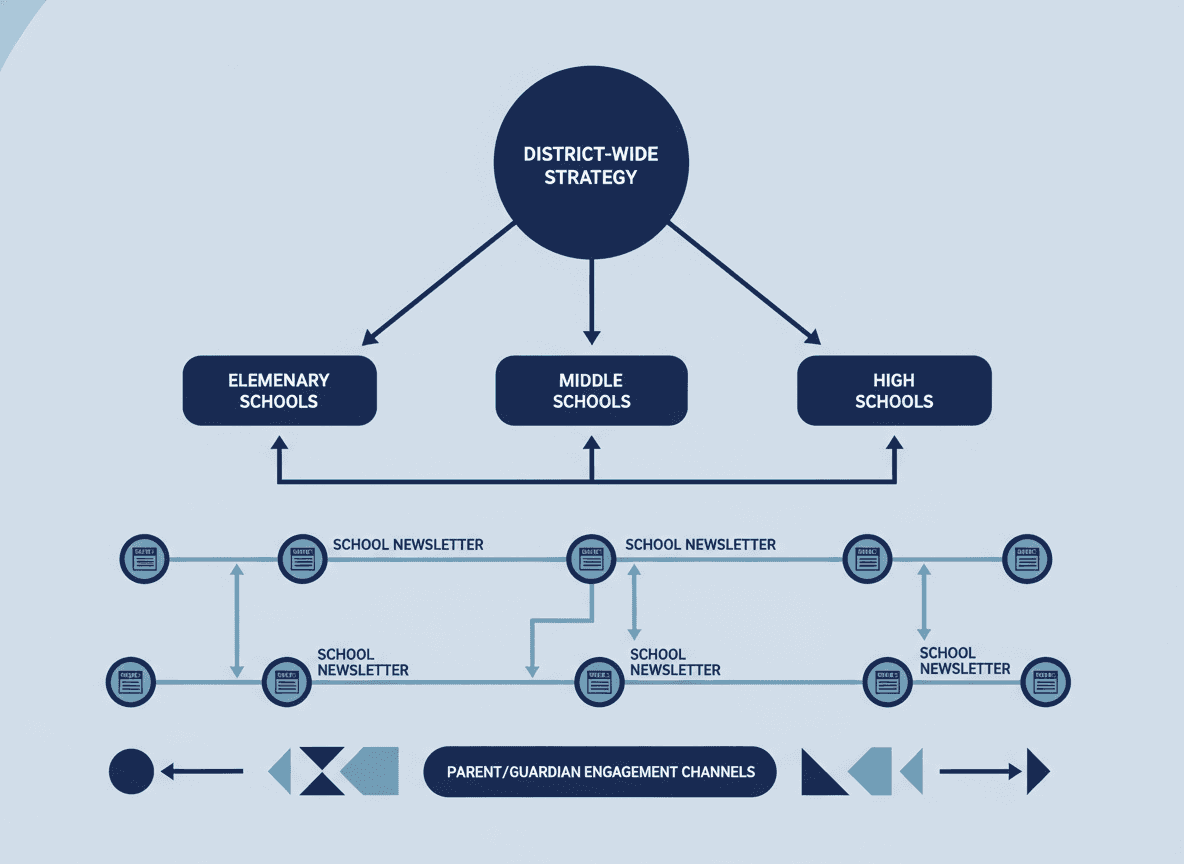
The most effective district attendance communication strategy works at two levels simultaneously.
The first layer is the district-level newsletter. Sent monthly by the superintendent's office or the district communications team, this newsletter covers the big picture. What is the district's overall attendance rate this month? How does it compare to last year? What are the goals, and why does attendance matter at this scale? This is the message that sets the tone and the expectation.
The second layer is the school and classroom-level newsletter. This is where attendance gets personal. A teacher sharing their classroom attendance data. A principal explaining what chronic absenteeism means for a student's specific grade level. A counselor describing what supports are available for families who are struggling to get their child to school consistently. This layer makes the district-level message relevant to a specific child in a specific classroom.
These two layers reinforce each other. Families who receive a district newsletter saying the district is focused on attendance, and then receive a classroom newsletter with their specific teacher talking about the same thing, experience attendance communication as a whole-school-community value rather than a policy pushed down from administration.
What to include in the district attendance newsletter
District newsletters tend to struggle with abstraction. The temptation is to share broad statistics and policy language. Resist this.
The most effective district attendance newsletters include:
- A district-wide attendance rate with context. "Our district's attendance rate this month was 89 percent. Our state average is 91 percent. Our goal is 95 percent." Numbers with benchmarks tell families whether the district is performing above or below expectations without requiring them to interpret raw data.
- A brief explanation of chronic absenteeism. Not every family knows the definition. Include it every few months, especially early in the year. "A student is considered chronically absent when they miss 10 percent or more of school days. In a 180-day school year, that is 18 days. Missing more than 18 days is associated with lower academic achievement and higher dropout risk."
- School-specific recognition. Name the schools with the best attendance improvements this month. This creates healthy competition and signals to school communities that the district is paying attention.
- A clear set of resources for families who are struggling. Transportation support, food programs, counseling, home visits, attendance mentors. Many districts have these resources but families do not know about them. Your newsletter is the right place to surface them.
- A direct quote or message from the superintendent. A one-paragraph personal note from the superintendent, written in plain language, changes the tone of the entire newsletter. It signals leadership priority in a way that a communications team byline does not.
Building school-level consistency without uniformity
One of the hardest parts of a district attendance strategy is getting school-level buy-in and consistency without stripping away each school's identity.
A shared template with school-specific branding is the solution. The district provides a newsletter structure with required attendance sections: the school's attendance rate this month, the chronic absenteeism definition, and contact information for attendance support. Each school then fills in the rest of the newsletter with their own content: classroom updates, upcoming events, teacher spotlights.
This approach gives principals and teachers ownership of their communication while ensuring the attendance message is present every month across every school. Families in different schools receive newsletters that look and feel like their school, but all of them are getting the same core attendance information.
Targeting your communication by risk level
Not every family needs the same attendance message. A district-wide newsletter reaching all families is valuable for setting culture. But the families of students who are already chronically absent need something more specific and more personal.
A segmented newsletter strategy allows districts to send one version of the attendance newsletter to all families and a second, more targeted version to families of students who have already missed 10 or more days. This targeted version acknowledges where the student is, explains the consequences if nothing changes, and provides a direct path to intervention support.
This kind of segmentation requires knowing which students are approaching the chronic threshold. Most student information systems have this data. The gap is usually in connecting that data to the communication tool.
Measuring whether the communication is working
A district attendance communication strategy needs a feedback loop. Without one, you are sending newsletters into a void and hoping something changes.
Track three things: newsletter open rates (are families actually reading the communication?), attendance rates for schools with consistent newsletter programs versus those without, and family response rates when the newsletter includes a direct contact or resource link.
If open rates are low, the newsletter is not reaching families effectively. Consider whether the subject line is compelling, whether the send time is right, or whether families need to be re-subscribed because their email addresses have changed.
If attendance rates are not improving despite consistent communication, the newsletter is necessary but not sufficient. Personal outreach, attendance support programs, and barrier removal are also needed. Newsletters are the awareness layer. They are not the entire intervention.
How Daystage supports district-scale attendance communication
Daystage gives districts and schools a consistent newsletter platform where each school maintains its own branding while following a shared structure. Subscriber management works at the classroom, school, and district level. Analytics show open rates and engagement across the whole system so district administrators can see which school communications are performing.
Teachers who send regular classroom newsletters using Daystage become natural delivery points for the district attendance message. When the district provides a shared template that teachers can customize, adoption is faster and communication stays consistent.
The result is a district where families hear about attendance from every level of the school system, in a voice they recognize and trust. That is how communication becomes culture change.
The communication strategy that compounds
Districts that communicate about attendance once a year see limited results. Districts that build a consistent, layered communication strategy across the school year, from superintendent newsletter to classroom update, see attendance culture shift over time. Families begin to understand what is at stake. Schools begin to see attendance as a community value, not just a compliance metric.
Start with the structure. Build the two-layer approach. Make it consistent. And measure what happens.
Get one newsletter idea every week.
Free. For teachers. No spam.
Frequently asked questions
When should districts develop a district-wide attendance communication strategy?
Build the strategy before the school year begins, not in response to a chronic absenteeism crisis. Districts that wait until attendance data looks bad are already six to eight weeks behind where consistent communication could have helped.
What should a district attendance newsletter include?
Include district-wide attendance data with context, the specific threshold that defines chronic absenteeism, what families can do when a student is struggling to attend, and resources the district offers. Keep the data transparent and the tone supportive.
How should districts build consistency across schools without eliminating school-level flexibility?
Provide a required structure (attendance data section, absence reporting reminder, support resources) and let schools fill in the school-specific content. Consistency in the framework with flexibility in the details respects both district goals and school culture.
What mistakes do districts make in attendance communication strategy?
Treating attendance communication as a single-letter event rather than an ongoing cadence is the most common strategic failure. One letter in September does not change attendance culture. Consistent, low-pressure monthly communication does.
How does Daystage support district-scale attendance communication?
District administrators use Daystage to distribute newsletter templates to all schools in the district, so each school can publish its own attendance newsletter with consistent structure while maintaining its own voice and school-specific data.

Adi Ackerman
Author
Adi Ackerman is a former classroom teacher and curriculum writer with 8 years in K-8 schools. She writes about school communication, parent engagement, and what actually works in real classrooms.
More for Attendance
Attendance for English Learners Newsletter: Reaching Multilingual Families With Attendance Communication
Attendance · 5 min read
How to Write a Chronic Absenteeism Letter to Parents (With Templates)
Attendance · 6 min read
Multi-Tiered Attendance Support Newsletter: How to Communicate Your MTSS Approach to Families
Attendance · 6 min read
Ready to send your first newsletter?
3 newsletters free. No credit card. First one ready in under 5 minutes.
Get started free