
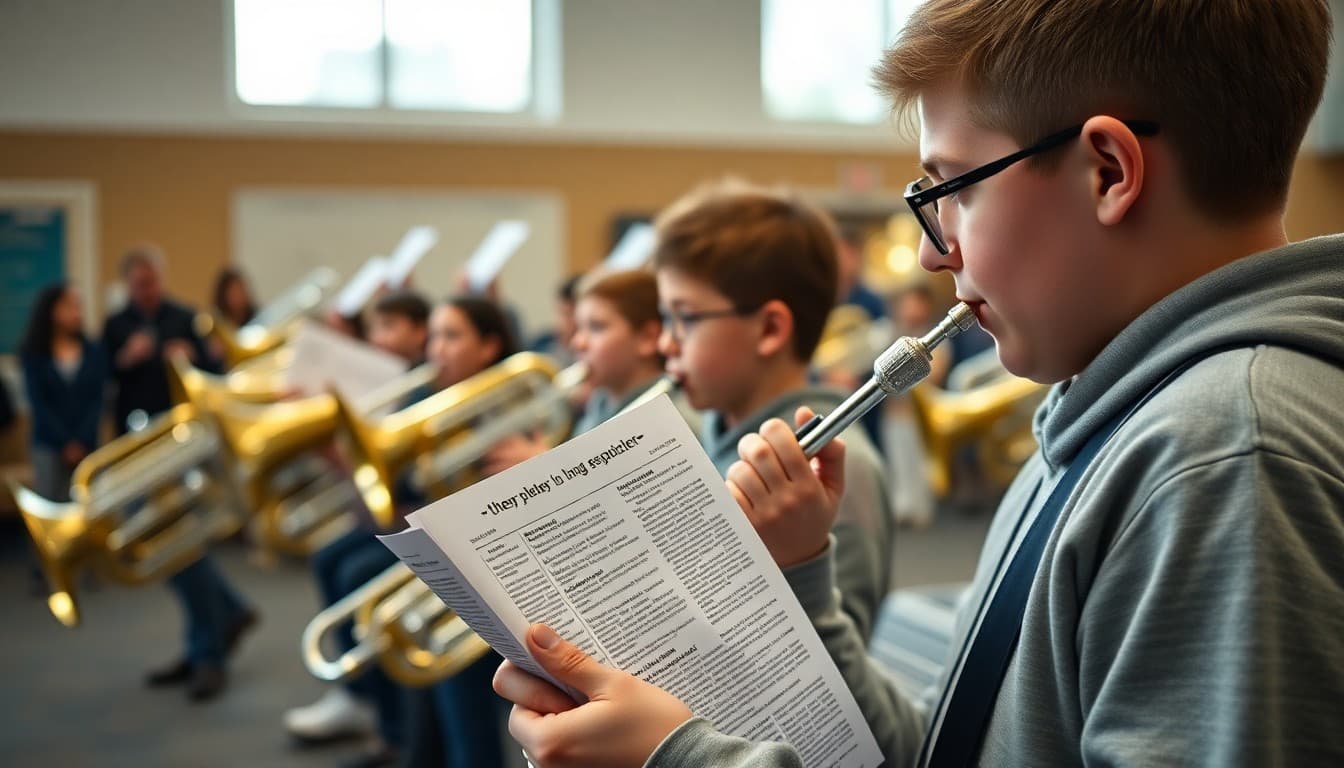
Marching Band Newsletter: Competition Season Communication

Marching band families are among the most committed parents in a high school community. They volunteer for competitions, drive equipment trailers, donate food for travel days, and spend hundreds of hours in the stands across a fall season. A marching band newsletter that honors that commitment with clear, professional, and timely communication is both appropriate and essential.
The Band Calendar: More Complex Than Any Sports Schedule
A marching band's fall calendar involves band camp before school starts, weekly rehearsals often running three to four nights per week, performances at every home football game and sometimes select away games, local competitions, regional competitions, possibly state competitions, and a holiday parade or winter concert transition. All of this runs simultaneously with the school academic calendar, AP exams, college application deadlines, and every other obligation of a high school student's life.
Your first newsletter of the season should contain the complete annual calendar in a format families can download or add to a shared calendar. Competition venues require travel times and addresses, not just dates. Game performances require sideline call times and return times. Band camp requires a day-by-day schedule. The more specific and complete this calendar is, the fewer last-minute calls and conflicts you will manage throughout the fall.
Band Camp Communication
Band camp deserves its own dedicated newsletter issue. This is where the marching show is first learned, where sections develop chemistry, and where students make the conditioning adaptations required for outdoor marching. It is also where families most need specific information.
A band camp newsletter should cover: exact dates and hours each day, arrival and dismissal procedures, what students must bring (water jug minimum 64 oz., sunscreen, athletic shoes that support outdoor marching, instrument and required accessories, lunch if not provided), what students wear each day (if the program has a dress code for camp), heat management procedures, and what the first week of camp involves musically and physically.
Uniform Care Instructions
Marching band uniforms are expensive and delicate. A newsletter section on uniform care prevents the damage that comes from uninformed families washing jackets in hot water or hanging bibbers improperly. Cover: how to hang the uniform after each performance, what can and cannot be washed at home vs. dry cleaned, what to do if a uniform piece is damaged or missing, and the cleaning and return deadline at the end of the season.
"Marching band jackets must be hung on the provided garment hanger and stored in the uniform bag after each use. Do not fold the jacket. Pants (bibbers) may be spot-cleaned but should not be machine washed. Full uniform dry cleaning is provided by the program at the end of the season -- include your uniform in the cleaning drop-off by [date]."
A Template Competition Day Newsletter
Here is a format that works for a competition day information newsletter:
"[Competition Name] -- [Date]. Venue: [name and full address]. Schedule: Band departs school at [time] from [location]. Students must arrive at school by [time]. Performance: approximately [time] (subject to change -- final schedule released [date]). Awards ceremony: approximately [time]. Return to school: approximately [time]. What students need: [specific list]. Spectator tickets: [cost and where to purchase]. Spectators please arrive at least 60 minutes before our performance time -- the venue is large and parking fills early. Parent volunteers: [specific roles needed, sign-up link]."
Competition Judging Explained
Marching band competition scores are divided among multiple caption judges, each responsible for a specific area: music performance judges evaluate tone quality and accuracy, visual performance judges evaluate marching technique and formation precision, and general effect judges evaluate the overall impact of the show design and execution. A show with outstanding music but weaker visual performance may place lower than a show with balanced scores across captions, even if the music sounds better.
Explaining this prevents the parent conversation after a competition where "but our band sounded the best" conflicts with a lower placement. "We place based on aggregate scores across all categories. A strong performance in one area cannot fully compensate for weaknesses in others. This is why we work in rehearsal on both the music and the visual aspects of the show."
Volunteer and Fundraising Needs
Marching band programs typically have the largest and most active booster organizations in any school activity. Your newsletter should include specific volunteer roles with sign-up links for every event: pit crew parents who transport the front ensemble equipment, chaperones for overnight invitationals, food committee volunteers for travel day meals, and uniform crew members who help students in and out of uniforms on competition day. Families who receive specific, actionable requests through the newsletter volunteer at higher rates than those who receive general appeals.
Get one newsletter idea every week.
Free. For teachers. No spam.
Frequently asked questions
What are the most important logistical items for a marching band newsletter to cover?
Marching band logistics are among the most complex in any high school activity. The newsletter must cover: the full competition schedule with venue addresses and approximate performance times, the full game day sideline schedule (both home and away games), band camp schedule and what students need to bring, uniform care instructions and fitting schedule, equipment and instrument transport logistics, parent chaperone and volunteer needs, and fundraiser schedule. Band has more overlapping obligations than most programs, and families need a clear calendar from day one.
How do you communicate marching band competition judging to families?
Marching band competitions are judged on multiple categories including music performance, visual performance, marching technique, general effect, and percussion and front ensemble performance. Different circuit organizations (Bands of America, WGI, state organizations) use different rubrics. Your newsletter should explain which circuit you compete in, what the major judging categories are, and how placement is determined. Families who understand that a narrow score difference can result in a large placement swing are better prepared for competition results.
How do band camps and summer rehearsals fit into newsletter communication?
Band camp is where the marching show is first learned, and it requires significant family commitment and logistical support from parents. The band camp newsletter should cover: dates and times, what students need to bring each day, meals (whether provided or brought from home), the daily schedule including water and food breaks, heat safety protocols, and what families can expect when they pick up their student at the end of each day. Band camp families appreciate specific communication more than almost any other group because the daily logistics are genuinely complex.
What are the financial expectations families need to know about for marching band?
Marching band has significant costs: uniform maintenance fees, show shirt and apparel purchases, transportation fees for competitions, hotel costs for overnight invitationals, and food contributions for travel days. Your season-opening newsletter should itemize all expected family costs for the season with clear payment deadlines. Families who learn about a $150 competition travel fee two days before the event feel blindsided. Families who received the full cost breakdown in August can plan for it.
How can Daystage help band directors communicate with hundreds of families efficiently?
Daystage lets band directors build professional newsletters with the full competition schedule, volunteer sign-up links, and photos from rehearsals and performances all in one send to the full band family list. For programs with hundreds of families, the ability to send a polished, consistent newsletter from one system rather than mass emails saves significant time. Band directors who use Daystage report that competition attendance is higher and volunteer sign-up rates are better when families have clear, professional information from the first week of the season.

Adi Ackerman
Author
Adi Ackerman is a former classroom teacher and curriculum writer with 8 years in K-8 schools. She writes about school communication, parent engagement, and what actually works in real classrooms.
More for Athletics
Ready to send your first newsletter?
3 newsletters free. No credit card. First one ready in under 5 minutes.
Get started free