
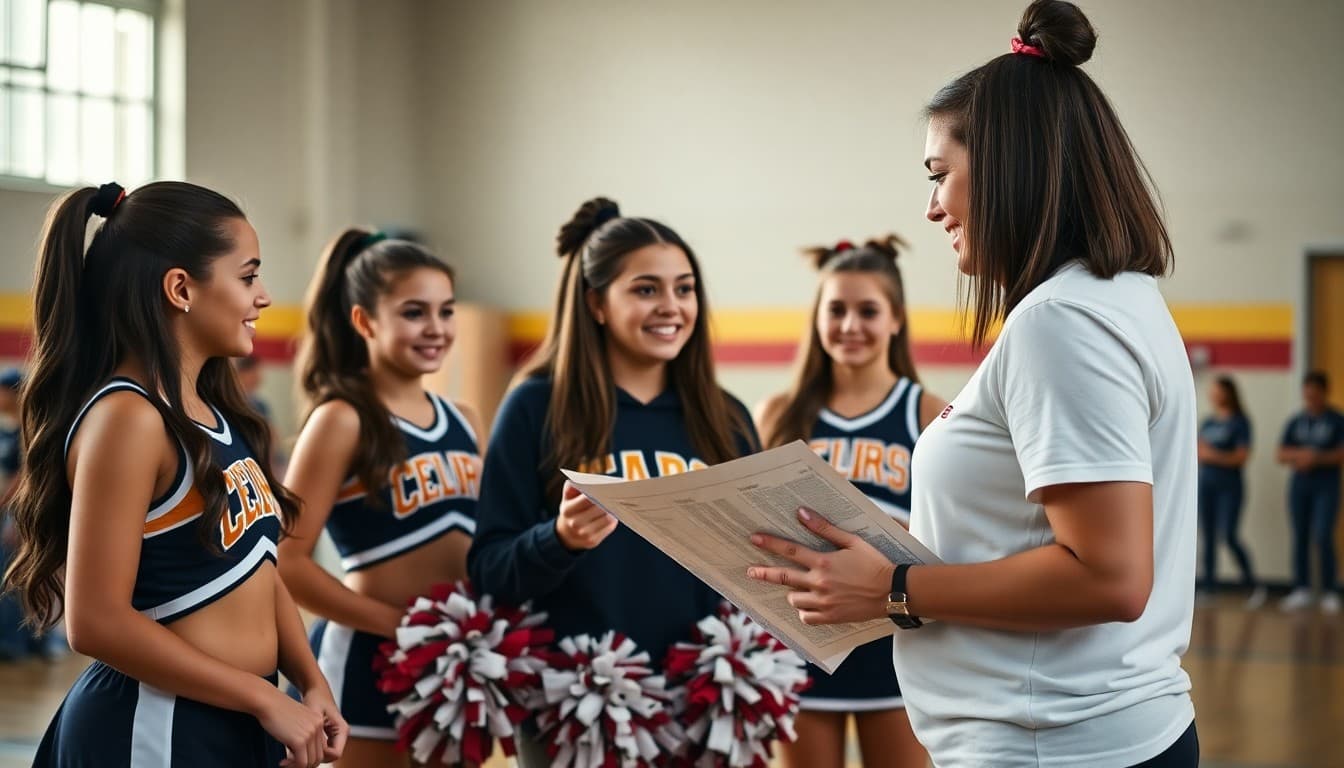
Cheerleading Team Newsletter: Season Communication Guide

Cheerleading coaches manage the most communication-intensive program in most athletic departments. The squad performs at almost every home game and significant away game, practices intensively for competitions, and navigates the social dynamics of a team where every athlete is visible in every performance. A cheerleading newsletter that covers logistics clearly and supports the program's culture makes that management significantly easier.
Sideline Schedule vs. Competition Schedule
The most confusing aspect of cheerleading communication for families is the dual nature of the commitment: sideline appearances at games and competitive events at competitions. Both require attendance. Both have consequences if athletes miss them. Your first newsletter of the season must clearly distinguish between the two and communicate expectations for both.
A simple two-column schedule in your opening newsletter -- one column for game sideline schedule, one for competition schedule -- gives families the full picture at one glance. Note any dates where games and competitions overlap and explain the priority policy clearly upfront rather than waiting for the conflict to arise.
Uniform and Appearance Standards
Cheerleading uniform and appearance standards are among the most specific in any athletic program. Hair requirements, makeup expectations, bow color and style, shoe type, and nail policy are all legitimate areas of program policy. Your newsletter should state these clearly without leaving room for ambiguity that creates day-of conflicts.
A template uniform standards section: "Game day appearance standards: hair must be in a high ponytail with the team bow. No loose pieces or alternative hairstyles. Natural makeup is required for games; full competition makeup (including false lashes) is required for competitions. White athletic shoes with white laces -- no exceptions. Uniform skirt and shell must be clean, pressed, and unmodified. Jewelry is not permitted. Athletes who arrive at a game or competition out of compliance with appearance standards may not perform."
A Template Competition Preview Newsletter
Here is a section that works for the first competition preview of the season:
"Our first competition is [name] at [venue, full address] on [date]. Competition doors open at [time]. Our squad performs at approximately [estimated time] -- the exact performance order will be confirmed two days before the competition and posted at [platform]. Spectator tickets: [price/where to buy]. Athletes report to [location] no later than [time]. Full competition makeup and hair is required -- see the competition appearance guide [link]. Bring: [snacks, water, change of clothes, etc.]. Plan for an approximately [X]-hour event."
Tumbling and Stunt Progression Communication
Cheerleading families often want to know whether their athlete is progressing in tumbling skills. This is a sensitive topic: tumbling development is highly individual and comparing athletes' progress creates interpersonal tension. Your newsletter can address this in aggregate terms -- "Our athletes have been working hard on back handspring connections this month and we are seeing strong progress across the squad" -- without identifying individuals or creating comparisons.
A safety framework note is also valuable: "All stunts and tumbling skills are introduced and approved by coaching staff following our safety progression plan. Athletes are not cleared to attempt advanced skills until they have demonstrated consistent proficiency in prerequisite skills. This approach protects athletes from injury and ensures the program builds on a foundation of safety."
Parent Volunteer Opportunities and Booster Roles
Cheerleading programs often rely heavily on parent volunteers: competition transportation, concession donations for competition days, costume and uniform repairs, and booster fundraising for travel costs. Your newsletter should include specific, actionable volunteer requests with sign-up links rather than general requests for help. A family who sees "we need three parents to drive to the invitational on October 19th" and a link to sign up acts on it. A family who reads "we welcome parent volunteers" files it under things to think about later.
Competition Season Wrap-Up
At the end of competition season, send a wrap-up newsletter that recaps the season's achievements, recognizes senior squad members, acknowledges parent volunteers and supporters, and previews the next season's tryout timeline. This newsletter has the highest sentimental value of any cheerleading communication and deserves the time it takes to write it thoughtfully. Families who feel the program values their child's experience will support it actively in the years ahead.
Get one newsletter idea every week.
Free. For teachers. No spam.
Frequently asked questions
What makes a cheerleading newsletter different from other team sport newsletters?
Cheerleading programs often run two parallel commitments simultaneously: sideline cheering at games and competitive cheerleading at competitions. A newsletter must cover both schedules clearly. Families need to know which games require sideline attendance, when competition practices begin, the competition season schedule, and how the program balances sideline obligations with competition preparation. When competitions and games conflict, the program's priority policy needs to be stated explicitly.
What should a cheerleading season opening newsletter include?
A cheerleading opening newsletter should cover: the full sideline schedule (every game or pep rally where attendance is required), the competition schedule and location, practice schedule and any schedule changes when competition season begins, uniform and appearance requirements (hair, makeup, bow, shoe style), camp or clinic schedule if applicable, fees and payment deadlines, parent volunteer opportunities, and the squad's goals for the competition season. This is a dense communication document because cheerleading has more ongoing schedule commitments than most sports.
How do you communicate cheerleading competition judging criteria to families?
Competitive cheerleading is judged by trained officials on multiple categories: stunts, tumbling, jumps, motion technique, choreography, and building (pyramids and tosses). Families who do not understand how judging works cannot interpret placements or provide constructive support. Your newsletter should explain the scoring categories in plain terms and acknowledge that competition cheerleading judging is subjective -- a winning routine at one competition may place lower at another depending on the panel.
How should a newsletter handle the sensitive topic of squad cuts and tryout results?
Tryout results and squad selection decisions should never be communicated by newsletter. These are individual conversations handled before the season begins. The team newsletter starts after the team is selected and focuses entirely on the season ahead. If families have questions about the selection process, your newsletter should include a specific contact method and a clear statement that individual selection conversations must be scheduled directly with the coach rather than handled via email.
Can Daystage help cheerleading programs manage both sideline and competition season communication?
Yes. Daystage lets cheerleading coaches send separate newsletters for different parts of the season -- a sideline schedule update early in fall, a competition season preview in October, and weekly updates during competition season. You can include competition results, upcoming competition details with venue addresses, and photos from recent events. Coaches who use Daystage report that cheerleading families are notably more organized about the schedule when they receive consistent, clear communication from the start of the year.

Adi Ackerman
Author
Adi Ackerman is a former classroom teacher and curriculum writer with 8 years in K-8 schools. She writes about school communication, parent engagement, and what actually works in real classrooms.
More for Athletics
Ready to send your first newsletter?
3 newsletters free. No credit card. First one ready in under 5 minutes.
Get started free